
5G NR Open RAN Hardware End-to-End Architecture Explained
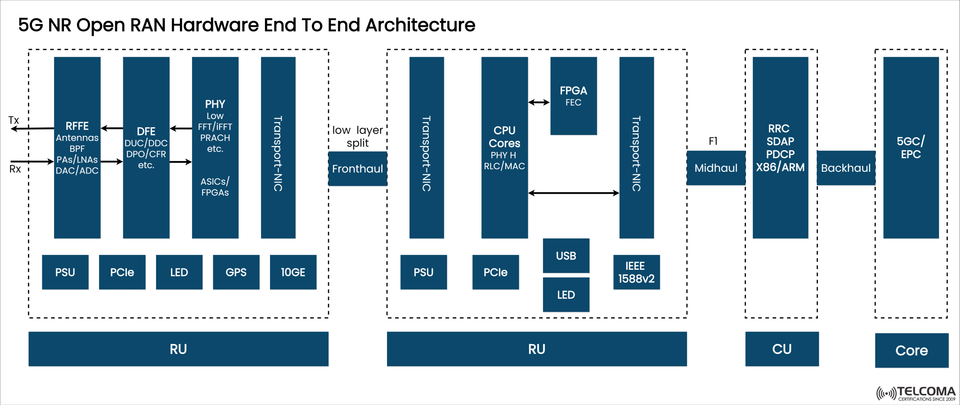

📡 5G NR Open RAN Hardware End-to-End Architecture: The full scope explained
As the telecom sector transitions to Open RAN (O-RAN) architectures, systems that are modular in nature and vendor-agnostic, we identified the details through the image above which is an end-to-end view of 5G NR Open RAN hardware. It shows the architecture of the Radio Unit (RU), Distributed Unit (DU), Centralized Unit (CU), and Core Network with fronthaul, midhaul, and backhaul interconnections.
This blog will break down the architecture layer-by-layer with the intent of providing helpful insights to telecom professionals and technology enthusiasts around the functional components properly structured in modern open 5G networks.
🔩 Components of 5G NR Open RAN Architecture
The Open RAN stack has physically separated several major units to facilitate modular design, scale with flexibility and vendor interoperability.
🧱 1. Radio Unit (RU)
The RU handles all radio frequency (RF) functions and some physical layer (PHY-Low) functions and is located at the edge, which is at the antenna level.
Components:
Component Function
RFFE RF Front-End including antennas, DAC/ADC, BPFs, LNAs, PAs
DFE Digital Front-End for up/down conversion, crest factor reduction
PHY (Low) FFT/iFFT processing, PRACH
Transport NIC Sends processed to the DU and has a fronthaul interface
Support Modules PSU, PCIe, GPS, 10GE, LEDs
Data Flow:
RF signal → RFFE → DFE → PHY → Transport NIC → Fronthaul
🔗 2. Fronthaul Interface
This is a link that connects the Radio Unit and the Distributed Unit. It transmits low-layer split data, usually via eCPRI or ORAN compliant interfaces.
High bandwidth and low latency needed
Allow a split of PHY-Low and PHY-High:
🖥️ 3. Distributed Unit (DU)
Physically central or at an edge site, the DU connects upper PHY, MAC, and RLC.
Featured Components:
Component Function
CPU Cores Execution of the PHY-High, MAC and RLC processing
FPGA For FEC (Forward Error Correction)
Transport NIC Interface to receive data from the RU and then send to the CU
Support Module USB, IEEE 1588v2 (timing), PCIe, PSU
🔗 4. Midhaul Interface (F1)
Connects the DU to the CU using 3GPP F1 interface, that is, it will have PDCP and RRC signalling.
Moderate bandwidth capabilities
Allows the CU placement in centralized data centers
🧠 5. Centralized Unit (CU)
Manages PDCP, SDAP, and RRC layers. This unit can run on general-purpose CPUs (i.e., in x86 or ARM platforms) and connects to the 5G Core (5GC) or EPC via backhaul.
Functions:
Encryption/decryption
RRC state management
Session and bearer establishment
🔗 6. Backhaul Interface
Connects the CU to the Core Network (5GC or EPC) using IP/MPLS transport.
Lowest bandwidth
Capabilities for long-distance connectivity.
🧬 Overview of Functional Split
Split Type Location Purpose
Low Layer Split - Between RU & DU(e.g Split 7.2x) -- Lower RU complexity and centralized processing.
High Layer Split - Between DU & CU(e.g Split 2) -- Lower Layer architectural decoupled from the control plane.
This means that we can "split" the network functions based on latencies, capacity requirements, and deployment methods.
🧭 What Open RAN Hardware Architecture Bring
The modular and disaggregated hardware architecture provides many advantages:
Vendor Interoperable: You can RU, DU, CU from any source(s)
Scalability: Only deploy the amount of whatever you need for that site (edge deployment vs centralized).
Cloud-Native Ready: DU, CU can be virtualized in x86/ARM
Cost Effective: Don't have to worry about proprietary black box RANs.
🧮 A Quick Reference:
Hardware Component Definition
Layer Main Functions Example Hardware
RU RF , PHY-Low Antennas, FPGAs, NIC
DU PHY - High, MAC , RLC CPUs, FEC FPGAs
CU PDCP , RRC ARM/x86 platforms
Core EPC, 5GC Cloud-native or legacy core
✅ Conclusion
The 5G NR Open RAN hardware architecture aligns with the evolution from monolithic system architecture to heterogeneous, open, modular, and software-based framework. Understanding how each layer interacts (RU, DU, CU, Core) is critical to telecom engineers in planning for modern, scalable 5G networks.
🧱 Deployment Models for 5G NR Open RAN
Operators have a range of deployment options to choose from depending on their use cases, infrastructure availability, and latency requirements. Three popular models are:
- Centralized RAN (C-RAN)
CU and DU are remote centralized data center.
RU deployed at the cell site.
Ideal for dense urban areas where high fiber deployment can support the fronthaul.
Benefits:
Easier coordination and interfering management.
Reduced hardware footprint at edge locations.
- Distributed RAN (D-RAN)
CU, DU and RU are co-located at the site.
Eliminates fronthaul or midhaul links.
Best for rural or remote areas, where backhaul is more practical than fronthaul.
Benefits:
Lower latency.
Ease of deployment.
- Hybrid RAN
DU at an edge site close to RU
CU centralized in regional cloud or data center.
Provides a balance between C-RAN and D-RAN.
Benefits:
Optimized latency and costs.
Supports Edge Computing Integration.
⏱ Synchronization and Timing in Open RAN
In Open RAN, timing synchronization becomes critical to coordinating distributed components.
Key Technologies:
IEEE 1588v2 (Precision Time Protocol): allow network elements to synchronize to a packet-based timing.
SyncE (Synchronous Ethernet): provides frequency sync to clients over Ethernet.
⚠️ Challenges to Deploying Open RAN Hardware
While Open RAN offers unprecedented flexibility, some technical and operational challenges remain.
- Interoperability
Different vendors may provide devices with different functional splits and interface standardizations (particularly Split 7.2x). - Latency and Jitter
With fronthaul, tight latency requirements must be adhered to (~250 µs round-trip) for Split 7. - Security
Everything is open, so a different attack surface is presented.
Needs strict Zero Trust Architecture, role-based access, and encryption.
- System Integration
Vendors may implement optional features or make other vendor-specific changes requiring custom integration.
Testing environments will need all loads tested, and real-world procedures simulated.
🌐 The Future of 5G NR Open RAN Hardware
Open RAN is moving fast with contributions from the O-RAN Alliance, TIP, and open-source initiatives like ONF, OpenRAN, and OpenAirInterface.
What's Next:
Trend Description
RAN Intelligent Controllers (RIC) Adding intelligence and automation to RAN with xApps/rApps
AI/ML-based Optimization Predictive scheduling, conserving energy, anomaly detection
6G Preparation Open RAN will be the basis for future networks
Cloud-Native Evolution Virtualization of full CU/DU with Kubernetes-native deployments
Commercial Ecosystem Maturity Tier-1 operators scaling-out large Open RAN implementations commercially (e.g. Rakuten, Vodafone, Dish Network)