
5G NR Physical Cell ID (PCI) Explained: PSS, SSS, and Synchronization

Introduction: The Role of PCI in 5G Networks
When it comes to 5G New Radio (NR), having an efficient way to identify cells and synchronize is key to maintaining smooth connectivity. Every gNB, or 5G base station, sends out signals that help devices, also known as UEs, find and connect to it. The core part of this process is the Physical Cell ID (PCI).
The PCI serves as a unique identifier that allows user devices to tell one cell apart from another. Without it, key functions like searching for cells, handling handovers, managing interference, and ensuring mobility just wouldn’t work reliably.
In this article, we’ll dive into how the PCI is structured, how it’s derived from the Primary Synchronization Signal (PSS) and Secondary Synchronization Signal (SSS), and why it’s essential for deploying 5G effectively.
What is Physical Cell ID (PCI)?
Definition: The Physical Cell ID is a number that ranges from 0 to 1007, which uniquely identifies a cell within a network.
Purpose: User Equipment (UE) uses it to:
Identify which cell it’s connected to.
Get initial synchronization.
Differentiate between neighboring cells when moving around.
PCI Range
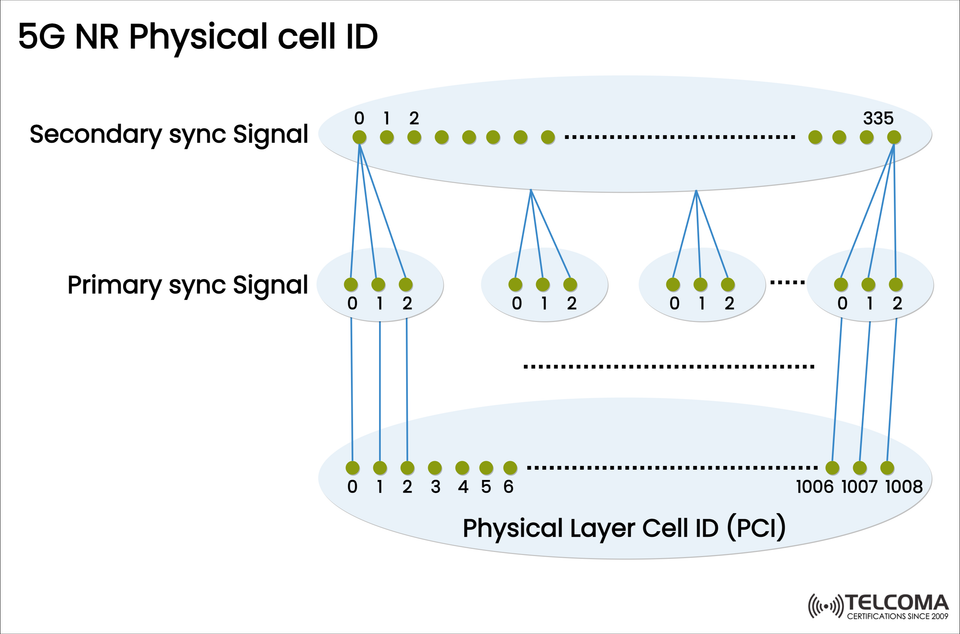
There are 1008 unique PCIs available in 5G NR.
These are organized as 336 groups with 3 IDs per group.
The formula for calculating PCI is: PCI = (3 × SSS) + PSS where SSS is the Secondary Synchronization Signal and PSS is the Primary Synchronization Signal.
Synchronization Signals in PCI
Here’s how PCI is derived from the PSS and SSS signals.
- Primary Synchronization Signal (PSS)
It identifies one of 3 values (0, 1, 2).
It provides coarse synchronization regarding frequency and timing.
This helps the UE determine the slot boundary and figure out the cell’s identity within its group.
- Secondary Synchronization Signal (SSS)
This one offers fine synchronization.
Consists of 336 unique values (0–335).
Works with PSS to create the PCI.
- PCI Calculation Example
If SSS equals 200 and PSS equals 2, the calculation would be: PCI = (3 × 200) + 2 = 602
So, by decoding both PSS and SSS, the UE can find out the unique PCI of its serving cell.
Importance of PCI in 5G NR
Cell Search and Initial Access
UEs need to pick up synchronization signals to find available cells.
The PCI lets the device lock onto the correct serving cell.
Handover and Mobility Management
While on the move, the UE checks neighboring PCI values.
This makes the handover between cells smooth and ensures there are no dropped calls.
Interference and Neighboring Cells
Good PCI planning means no two adjacent cells get the same PCI.
This step helps reduce signal confusion and interference.
Synchronization and Timing
It makes sure devices align with the frame structure and timing of the cell.
PCI Planning in 5G Networks
Proper planning for PCI is vital for performance.
Key Considerations:
Avoid PCI Confusion: No two neighboring cells should share the same PCI.
Avoid PCI Collision: Adjacent cells shouldn’t use PCIs that overlap in synchronization.
Efficient Allocation: Strategically use PCI groups to handle dense deployments.
PCI Assignment Strategies
Automatic PCI Allocation: Self-Organizing Networks (SON) can assign PCIs dynamically.
Manual Planning: For smaller or critical setups, engineers might pre-assign PCI values.
PCI Structure at a Glance
ComponentRangeFunctionPSS0–2Coarse synchronization, identifies cell within a groupSSS0–335Fine synchronization, identifies cell ID groupPCI0–1007Unique identifier for each physical cell
PCI in 4G vs 5G: What Changed?
Though the concept of PCI was around in 4G LTE, 5G brings in some upgrades:
Higher PCI range: While we still have 1008 values, there's better detection thanks to NR synchronization signals.
Beam-based synchronization: 5G NR utilizes beamforming, so the synchronization signals are specific to those beams.
Dense small cells: Planning for PCI gets trickier because of the higher cell density found in 5G networks.
This all makes careful PCI management even more important for 5G compared to LTE.
Practical Example of PCI Usage
Picture a 5G-enabled city filled with small cells overlapping each other:
A user with a smartphone picks up synchronization signals from multiple gNBs.
By decoding PSS and SSS, the phone figures out the PCIs:
Cell A: PCI 45
Cell B: PCI 122
Cell C: PCI 602
Based on these PCIs, signal strength, and quality, the device chooses the best serving cell.
As the user moves, the network initiates a handover by comparing neighboring PCIs.
This guarantees smooth connectivity whether the user is streaming 8K video, gaming in the cloud, or diving into AR apps.
Challenges with PCI in 5G Deployments
PCI Collisions: When two neighboring cells end up with the same PCI.
PCI Confusion: When nearby cells have PCIs that lead to ambiguity for UEs.
High-Density Networks: Small cells in cities raise the odds of poor planning.
Beamforming Complexity: Since synchronization is beam-specific, it’s trickier for UEs to detect than in LTE.
Solution: A mix of network planning tools, SON automation, and smart PCI allocation algorithms can help.
Conclusion: Why PCI Matters in 5G NR
The 5G NR Physical Cell ID (PCI) is essential for initial access, synchronization, and mobility in contemporary cellular networks. By utilizing PSS and SSS, the PCI gives each cell a unique identity, ensuring devices can connect, synchronize, and hand over smoothly.
For telecom professionals, getting to grips with PCI is crucial for:
Optimizing network planning.
Preventing interference and confusion.
Guaranteeing reliable connectivity in high-density 5G setups.
As 5G continues to grow with small cells, IoT, and critical applications, PCI planning and management will be vital for network quality and user experience.
In simple terms: no PCI means no 5G connectivity.