
5G NR Physical Layer Specifications Explained: 3GPP TS 38.211 to 38.215 Overview
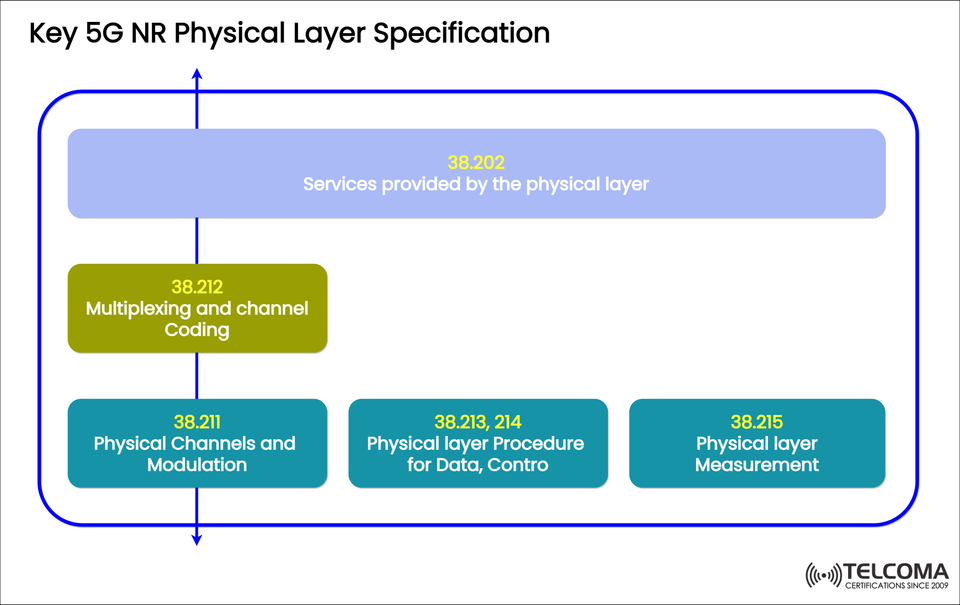

The Backbone of 5G NR Physical Layer
The 5G New Radio (NR) standard marks a significant evolution in wireless communication, enabling lightning-fast data speeds, extensive device connectivity, and remarkably low latency. At the heart of this innovation is the Physical Layer (PHY), which acts as the base for all the higher-layer functionalities.
The 3rd Generation Partnership Project (3GPP) has defined the physical layer to ensure data is transmitted and received efficiently over the air. They've laid out a series of technical specifications (TS) for Release 15 and beyond that detail how the 5G NR PHY works.
The diagram above highlights these essential documents — from TS 38.202 to TS 38.215 — each focusing on different aspects of the physical layer. Together, they cover everything from modulation techniques and coding to physical measurements and procedures.
Overview: 3GPP Specifications for 5G NR Physical Layer
Specification Title / Function Purpose
38.202 | Services Provided by the Physical Layer | Defines PHY services and interactions with higher layers
38.211 | Physical Channels and Modulation | Details modulation schemes, frame structure, and channel mapping
38.212 | Multiplexing and Channel Coding | Specifies error correction coding and multiplexing methods
38.213/38.214 | Physical Layer Procedures for Control and Data | Defines procedures for scheduling, HARQ, link adaptation
38.215 | Physical Layer Measurements | Covers measurement models for RSRP, SINR, and channel quality
These documents create the technical foundation for the 5G NR radio interface, promoting interoperability, efficiency, and reliability among equipment manufacturers and network providers around the globe.
3GPP TS 38.202 – Services Provided by the Physical Layer
This specification outlines the functional services that the physical layer offers to higher layers, especially the Medium Access Control (MAC) and Radio Resource Control (RRC) layers.
Key Responsibilities:
Defines the interface between PHY and MAC.
Manages transport channels (like DL-SCH, UL-SCH, PUSCH, PDSCH).
Oversees control channels such as PDCCH, PUCCH, and PHICH.
Ensures synchronization signals (SS/PBCH blocks) for initial access.
Basically, TS 38.202 lays out what the PHY layer does, while the remaining specifications explain how it gets those jobs done.
Purpose in the 5G Stack
It guarantees that all physical layer functions align with the logical and transport channel needs of higher layers, ensuring smooth integration between protocol layers.
3GPP TS 38.211 – Physical Channels and Modulation
TS 38.211 specifies how 5G NR uses Orthogonal Frequency Division Multiplexing (OFDM) to maximize spectral efficiency and flexibility. It outlines the structure and modulation methods of the physical channels.
Main Concepts:
Subcarrier Spacing (SCS): 15, 30, 60, 120, and 240 kHz numerologies.
Slot and Frame Structure: 10 ms frames split into subframes and slots.
Waveforms: * Downlink: CP-OFDM (Cyclic Prefix OFDM) * Uplink: CP-OFDM or DFT-s-OFDM
Modulation Schemes: QPSK, 16QAM, 64QAM, and 256QAM.
Defined Physical Channels:
Channel | Function
PDSCH | Downlink shared channel for user data
PUSCH | Uplink shared channel for user data
PDCCH | Downlink control channel for scheduling
PUCCH | Uplink control channel for feedback
PBCH | Broadcast channel carrying system info
This specification allows flexible bandwidth configuration, enabling 5G NR to operate from sub-1 GHz (FR1) to mmWave (FR2) deployments.
3GPP TS 38.212 – Multiplexing and Channel Coding
Once data is allocated to physical channels, it must be safeguarded against transmission errors. TS 38.212 outlines the coding, rate matching, and multiplexing methods to maintain robustness and reliability.
Core Functions:
Channel Coding: * LDPC (Low-Density Parity Check) for data channels (PDSCH/PUSCH) * Polar Codes for control channels (PDCCH, PUCCH)
CRC Attachment: Provides redundancy for error detection.
Rate Matching: Modifies code rates based on channel conditions.
Code Block Segmentation: Manages large transport blocks.
Why It Matters:
These coding techniques are tailored for 5G’s high throughput and low latency needs. LDPC delivers excellent performance at high data rates, while Polar coding ensures efficient control signaling — both are crucial for 5G reliability.
3GPP TS 38.213 and 38.214 – Physical Layer Procedures
These two documents detail the procedures that control the dynamic features of the physical layer — how resources are allocated, how the link adjusts, and how retransmissions are handled.
38.213 – Physical Layer Procedures for Control
Focuses on procedures for:
Scheduling requests (SR)
Random access procedures
Power control strategies
Timing advance adjustments
HARQ (Hybrid Automatic Repeat Request) feedback timing
38.214 – Physical Layer Procedures for Data
Focuses on:
Link adaptation (CQI, PMI, RI reporting)
HARQ retransmission methods
MIMO precoding and layer mapping
Resource allocation and time-domain structure
In Practice:
These procedures make the 5G physical layer adaptive and intelligent, reacting in real time to changes in the channel, user movement, and interference. They help ensure the network maintains optimal throughput and reliability across various radio environments.
3GPP TS 38.215 – Physical Layer Measurements
Measurements are essential for maintaining link quality and ensuring network efficiency. TS 38.215 outlines measurement models and metrics that user equipment (UE) and gNodeB rely on to make smart decisions.
Key Measurement Types:
RSRP (Reference Signal Received Power)
RSRQ (Reference Signal Received Quality)
SINR (Signal-to-Interference-plus-Noise Ratio)
Channel State Information (CSI)
Timing and frequency accuracy
These metrics are used in higher-layer algorithms for mobility management, beamforming, handover, and link adaptation.
Significance:
Accurate measurements are vital for features like beam management in FR2 and massive MIMO systems, where precision directly influences spectral efficiency.
How These Specifications Work Together
All these specifications are interconnected and complementary:
38.202 – Defines the services the PHY layer offers.
38.211 – Discusses signal structures and modulation.
38.212 – Manages error correction and data multiplexing.
38.213/214 – Describe operational procedures for data and control.
38.215 – Supplies measurement mechanisms for feedback and optimization.
Together, they create the complete physical layer stack, linking theoretical design with real-world application.
Importance of 5G NR PHY Layer for Future Networks
The 5G NR physical layer isn’t static; it evolves with each 3GPP release.
Its adaptable design supports:
Dynamic spectrum sharing (DSS)
Massive MIMO and beamforming
Carrier aggregation across FR1 and FR2
URLLC and eMBB working together
This adaptability allows 5G to easily adjust to new frequency bands, use cases, and device types — an essential base for 6G advancement.
Conclusion
The 5G NR Physical Layer is the cornerstone of the entire 5G ecosystem.
Through the definitions from 3GPP TS 38.202, 38.211, 38.212, 38.213/38.214, and 38.215, it creates a robust, flexible, and scalable framework for wireless communication.
In summary:
TS 38.211–38.212 explain how data is transmitted and safeguarded.
TS 38.213–38.214 focus on adaptation, control, and efficiency.
TS 38.215 guarantees accurate performance monitoring.
For telecom professionals, understanding these specifications is crucial for designing, optimizing, and troubleshooting 5G NR systems. As we move toward 6G, these foundational principles will continue to be key to future connectivity.