
5G NR QoS Architecture Explained: QoS Flows, Bearers, and PDU Sessions

Understanding 5G NR QoS Architecture: A Comprehensive Guide
The 5G New Radio (NR) QoS architecture is key to ensuring end-to-end service quality for a variety of applications, ranging from enhanced mobile broadband (eMBB) to ultra-reliable low-latency communications (URLLC) and massive machine-type communications (mMTC).
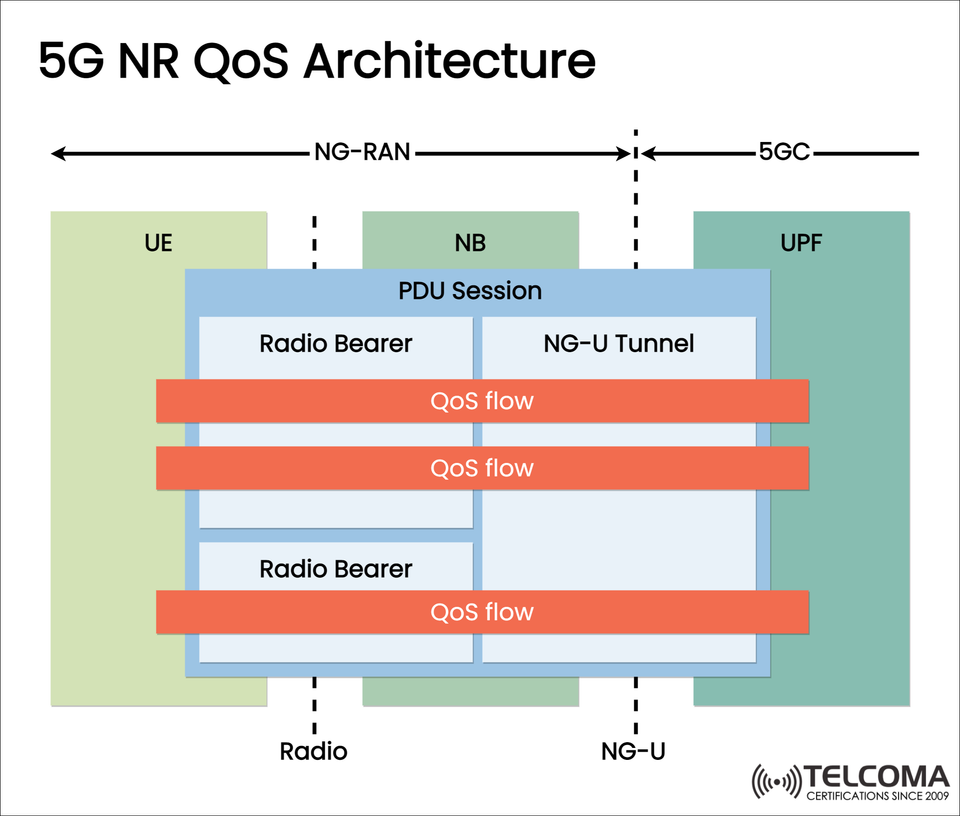
Unlike 4G LTE, where the concept of bearers was tightly linked to QoS, 5G brings in a more flexible and detailed QoS framework. The diagram you provided shows how QoS flows, radio bearers, and PDU sessions interact within the user equipment (UE), NG-RAN, and 5G Core (5GC).
In this blog, we'll explore the 5G QoS architecture, breaking down each component, what it does, and why it's crucial for achieving the promised performance, reliability, and customization in 5G networks.
The Evolution of QoS in 5G
Back in LTE, each bearer was linked to a specific QoS, which made things pretty rigid and limited the flexibility when handling various applications.
5G shakes things up with:
QoS flows: These are the smallest units of QoS in 5G.
Separation of bearers: Radio Bearers for the RAN and NG-U Tunnel for the transport layer.
Unified PDU sessions: These support multiple QoS flows within a single session.
This setup lets operators manage service-based QoS tailored to different applications, devices, and slices.
Key Components of 5G NR QoS Architecture
The diagram points out three major components of QoS architecture:
- PDU Session
A PDU (Protocol Data Unit) session signifies an end-to-end communication link between the UE and the User Plane Function (UPF) in the 5GC.
Every QoS flow and bearer is wrapped up inside a PDU session.
A single UE can handle multiple PDU sessions for different services, like video streaming or voice calls.
- QoS Flow
A QoS flow is the most granular level of QoS in 5G.
Each flow is recognized by a QoS Flow Identifier (QFI).
There are two types of QoS flows:
GBR (Guaranteed Bit Rate): For services that need reserved bandwidth, like VoNR or URLLC.
Non-GBR: Best-effort services, such as web browsing or messaging.
The Policy Control Function (PCF) manages the policies for QoS flows, while the Session Management Function (SMF) enforces them.
- Radio Bearer and NG-U Tunnel
The Radio Bearer (RAN side): Handles the mapping of QoS flows onto the air interface, ensuring resource isolation.
The NG-U Tunnel (Core side): Manages user data transport over the N3 interface between gNB and UPF, keeping QoS flows separate at the transport level.
Together, radio bearers and tunnels create robust support for QoS flows across the whole network.
How QoS Flows Operate in 5G
Let’s take a look at how QoS flows travel end-to-end:
At the UE:
Applications seek specific QoS characteristics, like low latency for gaming.
These requests get converted into QoS flows with defined settings.
Across the NG-RAN:
QoS flows are assigned to radio bearers, optimizing radio spectrum use.
The gNB carries out scheduling and prioritization.
Through the 5G Core:
QoS flows tunnel through NG-U, ensuring transport separation.
The UPF applies QoS rules, like rate limiting and packet marking.
Toward the Data Network (DN):
QoS flows guarantee the data network gets traffic with the needed quality, enhancing application-level QoE (Quality of Experience).
Example: Mapping QoS Across Services
Service Type QoS Type Example Parameters Voice over NR (VoNR)GBR Latency < 50 ms, high reliability Video Streaming Non-GBR Best-effort throughput, buffering tolerance Online Gaming GBR Latency < 20 ms, low jitter IoT Sensors (mMTC)Non-GBR Low data rate, many connections Autonomous Vehicles GBRURLLC: < 10 ms latency, 99.999% reliability
This level of flexibility allows operators to customize network behavior for each service, marking a significant improvement over LTE.
Benefits of 5G NR QoS Architecture
✅ Granular QoS Management: Facilitates QoS tailored to each service and application.
✅ Efficient Spectrum Use: Radio bearers enhance wireless resource allocation.
✅ Scalable for Massive IoT: Can handle billions of devices with varied QoS needs.
✅ Supports Network Slicing: Each slice can define its own QoS policies.
✅ Enhanced User Experience: Custom service delivery boosts user satisfaction.
Differences Between 4G and 5G QoS Models
Feature4G LTE QoS Model5G NR QoS Model QoS Unit EPS Bearer QoS Flow Flexibility Limited (per bearer)High (per flow)End-to-End Structure Bearer-based PDU session with flows Control Function PCRFPCF + SMF Service Customization Generic Per-application and slice-based
This shift is what makes 5G networks truly aware of services.
Challenges in Implementing 5G QoS
Even with its powerful architecture, operators do face some hurdles, like:
Complexity in Policy Enforcement: Managing various QoS flows for each user requires advanced controls.
Interoperability: Keeping consistent QoS across different vendors can be tricky.
Mobility Management: Ensuring QoS during handovers between gNBs.
Scalability: Handling millions of concurrent flows in IoT-heavy settings.
Role of QoS in Network Slicing
5G QoS is closely linked to network slicing, where each slice can have its own QoS rules:
eMBB Slice: High throughput for video and browsing.
URLLC Slice: Ultra-low latency and highly-reliable flows for self-driving cars.
mMTC Slice: Scalable, low-priority flows for countless IoT connections.
This setup supports business-driven SLAs (Service Level Agreements) across sectors like healthcare, automotive, and manufacturing.
Future Outlook: QoS in 6G
Looking ahead to 6G, QoS is set to evolve for even more advanced applications, like holographic communication and tactile internet.
Future networks might feature:
AI-driven QoS Predictions: Anticipating traffic needs before congestion hits.
Dynamic QoS Reallocation: Adjusting in real-time based on user mobility.
Cross-Domain QoS: Ensuring smooth QoS across land, satellite, and edge networks.
Conclusion
The 5G NR QoS architecture is a significant advancement in mobile networking. By incorporating QoS flows, radio bearers, and PDU sessions, it provides unparalleled flexibility and detail compared to LTE.
For telecom experts, getting a grip on this architecture is crucial for rolling out and managing next-gen services, from VoNR calls to industrial IoT and autonomous vehicles.
Ultimately, 5G QoS makes sure that networks deliver what they promise: the right service quality for each application, right when it’s needed.