
5G NR RLC Sublayer Explained: Modes, Interfaces, and Functions

Understanding the 5G NR RLC Sublayer and Its Interfaces
In the 5G NR (New Radio) protocol stack, the Radio Link Control (RLC) sublayer is essential for efficient, reliable, and flexible data transmission, both for user and control planes. It sits between the PDCP (Packet Data Convergence Protocol) and the MAC (Medium Access Control) layers, taking care of data segmentation, reassembly, retransmissions, and error handling.
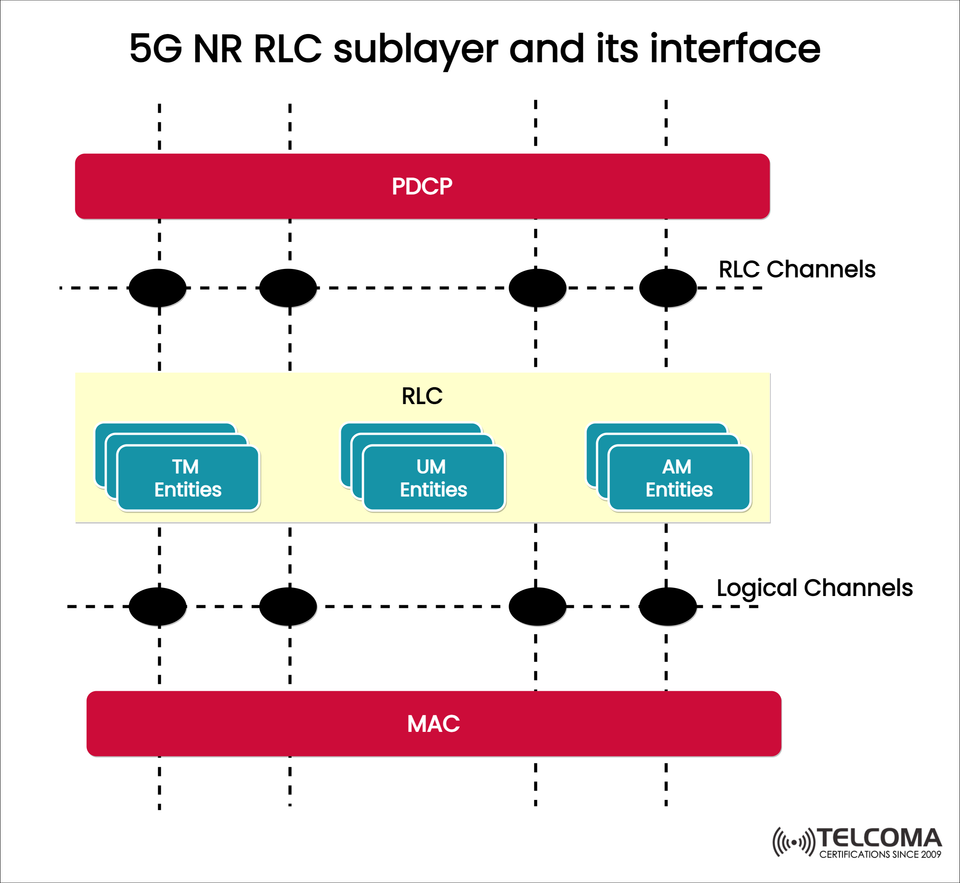
The diagram provided makes it clear how the RLC connects upward with PDCP through RLC channels and downward with MAC using logical channels. Within the RLC sublayer, there are three operational modes: Transparent Mode (TM), Unacknowledged Mode (UM), and Acknowledged Mode (AM).
In this blog post, we'll dive into the workings of the RLC sublayer within 5G NR, explore the importance of its various components, and discuss why it serves as a foundational element for 5G's performance.
Positioning RLC within the 5G Protocol Stack
To grasp the role of RLC, let’s put it in the context of the 5G NR protocol architecture:
Above RLC: * The PDCP layer takes care of ciphering, integrity protection, and header compression. * Data moves from PDCP to RLC through RLC channels.
Below RLC: * The MAC layer focuses on scheduling, multiplexing, and hybrid ARQ retransmissions. * RLC sends data to MAC using logical channels.
This setup positions the RLC sublayer as a kind of middle manager, ensuring that the data coming from PDCP is properly segmented, ordered, and sent to MAC for transmission over the radio interface.
Key Functions of the RLC Sublayer
The 3GPP specifications (TS 38.322) outline these primary functions of RLC:
Segmentation and Concatenation: Breaking down or combining SDUs (Service Data Units) into RLC PDUs for smoother transmission.
Reassembly: Reconstructing fragmented PDUs back into full SDUs before they go to PDCP.
Error Correction: Through retransmissions in Acknowledged Mode (AM).
In-sequence Delivery: Making sure packets arrive in the right order.
Duplicate Detection: Getting rid of repeat packets that are a result of retransmissions.
Protocol Error Detection and Recovery: Handling data that is mis-sequenced or corrupted.
RLC Operating Modes
The RLC sublayer offers flexibility through three different modes, each catering to specific types of services or traffic.
a. Transparent Mode (TM)
Purpose: Sends data without RLC headers.
Use Case: Ideal for broadcast or signaling messages, like system information blocks (SIBs).
Features: * No retransmissions. * No sequence numbering. * Minimal processing overhead.
b. Unacknowledged Mode (UM)
Purpose: Supports real-time services that can't afford retransmissions.
Use Case: Great for voice over NR (VoNR), video streaming, or gaming.
Features: * Sequence numbering for order. * Segmentation and reassembly. * No retransmission, which means faster delivery but less reliability.
c. Acknowledged Mode (AM)
Purpose: Ensures reliable data delivery through retransmissions.
Use Case: Used for services where accuracy really matters, like file transfers or web browsing.
Features: * Bi-directional data transfer. * Automatic Repeat Request (ARQ) for retransmissions. * Sequence numbering for catching errors and correcting them.
RLC Sublayer Interfaces
As demonstrated in the diagram, the RLC sublayer serves as a bridge:
Upward Interface (with PDCP): * Receives PDCP SDUs via RLC channels. * Takes care of segmentation, reassembly, and delivery services back to PDCP.
Downward Interface (with MAC): * Sends RLC PDUs to MAC via logical channels. * MAC schedules and mixes them for transmission over the radio link.
This dual interface ensures a smooth flow of both user plane data (like videos or browsing) and control plane signaling.
RLC Entities and Their Functions
The image highlights three types of RLC entities, each tied to an operational mode:
TM Entities – Manage transparent data flow without headers.
UM Entities – Handle sequencing and segmentation without retransmission.
AM Entities – Implement ARQ methods for reliable data delivery.
Each radio bearer in 5G is linked with a specific RLC entity, depending on the QoS (Quality of Service) needs.
- Practical Examples of RLC Use
TM (Transparent Mode): * Broadcasting SIB1 (System Information Block 1) to all UEs, where retransmissions or headers aren’t necessary.
UM (Unacknowledged Mode): * Delivering live video calls where retransmissions could increase lag. * Acceptable packet loss helps keep playback smooth.
AM (Acknowledged Mode): * Transferring files over HTTP, where precision is key, so retransmissions are crucial for reliability.
- Comparing RLC Modes
RLC Mode Reliability Latency Overhead Use Case
Transparent Mode (TM) Low Very Low Minimal Broadcast signaling (SIBs)
Unacknowledged Mode (UM) Medium Low Moderate Voice, video streaming
Acknowledged Mode (AM) High Higher (due to ARQ) High File transfer, web browsing
This comparison illustrates how choosing an RLC mode balances latency, reliability, and overhead, depending on the service.
Importance of RLC in 5G Performance
The RLC sublayer has a direct impact on:
User Experience: Striking a balance between low latency and high reliability.
Network Efficiency: Segmentation and concatenation make the best use of radio resources.
QoS Differentiation: Different modes accommodate a variety of applications, from real-time gaming to large file downloads.
5G Flexibility: Enabling enhanced Mobile Broadband (eMBB), Ultra-Reliable Low Latency Communications (URLLC), and massive IoT.
Differences Between RLC in 4G LTE and 5G NR
Although the RLC concepts are quite similar between LTE and NR, there are some significant distinctions:
Optimized for 5G’s varied services, particularly supporting ultra-low-latency URLLC traffic.
Closer integration with SDAP (Service Data Adaptation Protocol) in 5G for better QoS management.
Improved throughput and segmentation strategies for high-bandwidth scenarios in NR.
Summary
The RLC sublayer in 5G NR is a vital part of the radio protocol stack, ensuring smooth and reliable data flow between PDCP and MAC. With its three operational modes — Transparent (TM), Unacknowledged (UM), and Acknowledged (AM) — RLC delivers the flexibility needed for a wide range of 5G applications.
TM is perfect for broadcast signaling.
UM supports low-latency real-time services.
AM makes sure data delivery is reliable and error-free.