
5G NR Spectrum Explained: Sub-6 GHz vs. mmWave Bands

5G NR Spectrum Breakdown: Sub-6 GHz vs. mmWave Bands
The launch of 5G New Radio (5G NR) is changing the way we connect, communicate, and use data. At the core of this shift is spectrum — the unseen channel that allows 5G to provide faster speeds, lower latency, and greater capacity. Not all spectrum is the same, though.
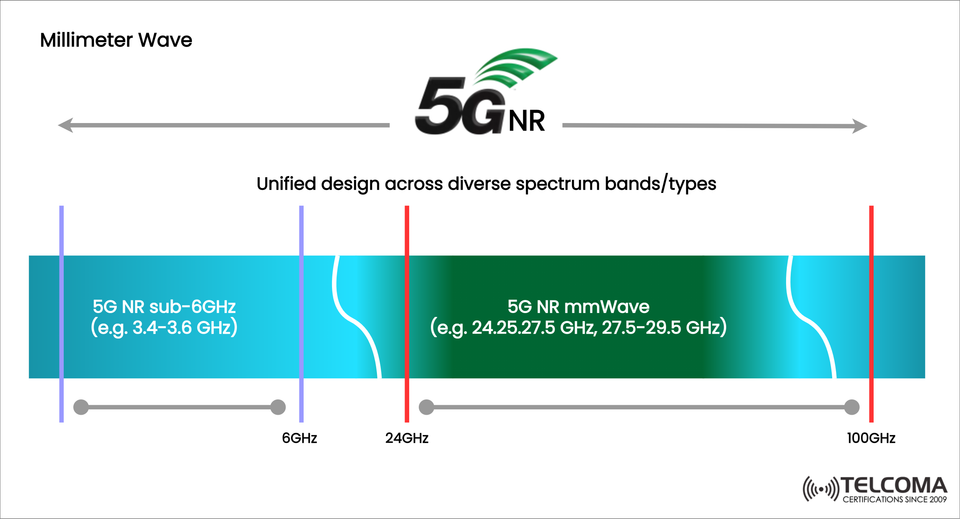
The diagram provided illustrates how 5G NR functions within two key spectrum categories: sub-6 GHz and millimeter wave (mmWave). These bands are essential for 5G’s performance, coverage, and future possibilities.
In this article, we’ll explore what each spectrum range means, why it’s important, and how they work in tandem to fuel next-generation wireless networks.
Understanding 5G NR Spectrum
5G NR (New Radio) is the global standard for 5G wireless tech defined by 3GPP (3rd Generation Partnership Project). Unlike its predecessors, 5G uses a cohesive design across various spectrum bands, spanning from below 6 GHz to above 24 GHz (mmWave).
The image shows this cohesive approach:
5G NR sub-6 GHz (like 3.4–3.6 GHz)
5G NR mmWave (about 24.25–27.5 GHz and 27.5–29.5 GHz)
By merging these two spectrum categories, 5G strikes a balance of coverage, capacity, and speed.
What’s Sub-6 GHz 5G?
The sub-6 GHz spectrum includes all frequency bands below 6 GHz. These bands are already in heavy use by 4G LTE networks, which makes them easier to roll out.
Key Features of Sub-6 GHz:
Frequency Range: Below 6 GHz (like 3.4–3.6 GHz used for 5G).
Coverage: Great — lower frequencies travel further and can go through buildings.
Speed: Moderate — faster than 4G LTE, yet slower than mmWave.
Latency: Improved compared to LTE, making it good for real-time applications.
Deployment: Great for broad coverage, particularly in suburban and rural areas.
Sub-6 GHz is the backbone of 5G’s initial rollout because it provides a solid mix of performance and range.
What’s 5G mmWave?
The millimeter wave (mmWave) spectrum covers frequencies between 24 GHz and 100 GHz. These higher-frequency bands are crucial for unlocking the full potential of 5G.
Key Features of mmWave:
Frequency Range: 24 GHz – 100 GHz.
Speed: Very high — multi-gigabit speeds (up to 10x faster than LTE).
Latency: Ultra-low, enabling real-time communication for things like AR/VR and self-driving cars.
Capacity: Huge, supporting crowded places like stadiums or smart cities.
Coverage: Limited — signals don’t travel far and have trouble getting through walls and obstacles.
mmWave provides the super-fast 5G speeds everyone talks about, but it needs a dense network of small cells because of its limited range.
A Quick Look: Sub-6 GHz vs. mmWave
FeatureSub-6 GHz (e.g., 3.4–3.6 GHz)mmWave (24–100 GHz)Frequency< 6 GHz24–100 GHzCoverageWide area, decent indoor reachLimited, struggles with penetrationSpeedModerate (100 Mbps – 1 Gbps)Ultra-high (up to 10 Gbps)LatencyLow (~10 ms)Ultra-low (<1 ms)Best Use CasesRural and suburban coverage, IoTDense urban areas, AR/VR, self-driving vehiclesDeployment CostLower (makes use of LTE infrastructure)Higher (requires small cells)
Both bands work together rather than compete. Sub-6 provides broad coverage, while mmWave offers lightning-fast connectivity in busy areas.
The Unified 5G Design Across Spectrum
One of 5G’s biggest advantages is its integrated approach across different spectrum bands. Rather than treating each band separately, 5G NR combines sub-6 GHz and mmWave seamlessly.
This means operators can implement 5G across various frequencies based on:
Location (urban vs. rural).
Use case (IoT, gaming, streaming, autonomous driving).
Capacity needs (stadiums vs. suburban neighborhoods).
The result is a flexible, scalable network that can support everything from basic mobile broadband to future tech.
Why Both Bands Matter for 5G Success
Strengths of Sub-6 GHz
Broad coverage for nationwide expansion.
Strong indoor penetration for reliability.
Crucial for IoT and mission-critical communications.
Strengths of mmWave
Unmatched speeds for next-gen applications.
Supports massive data needs in busy urban areas.
Facilitates futuristic scenarios like immersive AR/VR and autonomous transport systems.
Combining both allows 5G to fulfill its promise of connecting people, machines, and industries.
Real-World Uses for Sub-6 and mmWave
Sub-6 GHz: * Rural internet access * Smart homes and IoT devices * Cloud-based applications * Video streaming and typical mobile usage
mmWave: * 4K/8K video streaming in stadiums * Smart cities with dense networks of sensors * Augmented reality (AR) and virtual reality (VR) * Connected vehicles and V2X communication * Industrial automation in manufacturing
The Future of 5G Spectrum
As 5G becomes more widespread, how spectrum is allocated will be crucial. Regulatory bodies worldwide are auctioning off both mid-band sub-6 GHz and high-band mmWave frequencies to mobile operators.
Looking ahead, dynamic spectrum sharing (DSS) and carrier aggregation will let operators blend different spectrum bands, offering a smooth experience across coverage areas.
Plus, research into terahertz spectrum (>100 GHz) could push the boundaries of mobile communication even further for 6G.
Closing Thoughts
The journey of 5G thrives on spectrum diversity. Sub-6 GHz provides wide, reliable coverage, while mmWave offers lightning speeds and capacity in urban centers. Together, they form a unified 5G NR ecosystem that meets both current mobile broadband demands and future applications.
For telecom experts and tech enthusiasts, grasping these spectrum bands is vital to understanding how 5G is reshaping connectivity. The future of mobile networks isn’t about just one frequency range — it’s in the smooth integration of sub-6 GHz and mmWave.