
5G NSA Architecture Explained: Components, Interfaces, and Network Functions

Understanding 5G NSA Architecture: Its Components, Interfaces, and Functions
As 5G continues to spread around the world, many operators are turning to Non-Standalone (NSA) architecture as the quickest route to rolling out 5G services. This model uses the existing LTE Evolved Packet Core (EPC) for control signaling, while adding 5G New Radio (NR) to achieve faster data speeds.
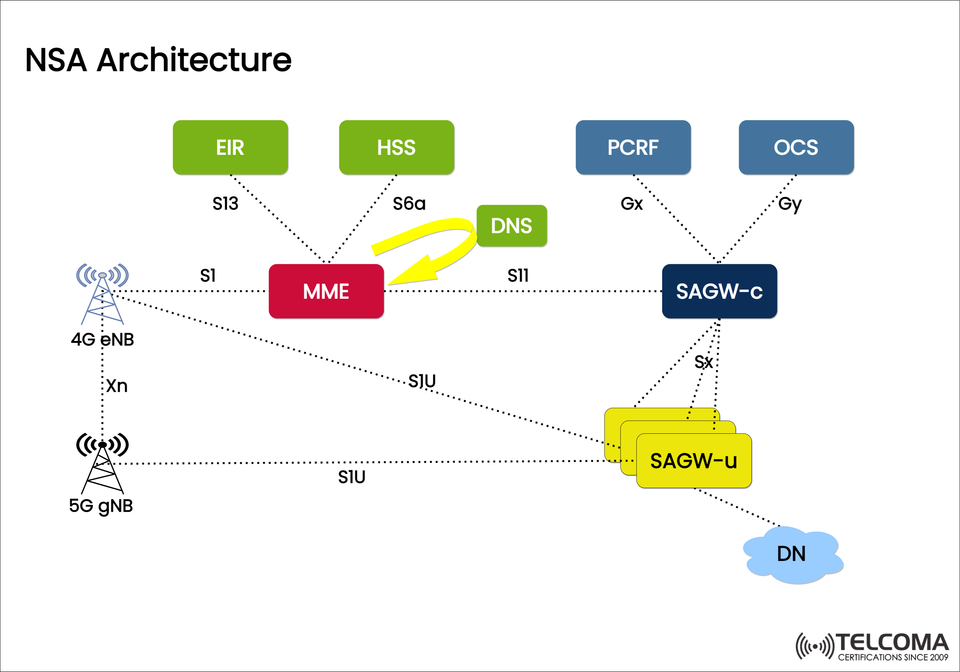
The diagram titled “NSA Architecture” shows how LTE and 5G come together in this transitional setup. In this post, we’ll dive into:
What NSA is and its significance.
A detailed look at the components of NSA architecture.
Key interfaces that connect LTE EPC and 5G NR.
The advantages and drawbacks of NSA deployment.
A comparison of NSA and SA for telecom experts.
What exactly is 5G NSA?
Non-Standalone (NSA) is a model for deploying 5G where the control plane (which includes signaling, session management, and authentication) still relies on the 4G LTE EPC, while the user plane (that handles data transfer) can utilize both LTE and 5G NR.
Rather than starting from scratch with a new 5G Core (SA), NSA lets operators reuse existing LTE infrastructure for a quicker rollout of 5G.
Why choose NSA first?
It speeds up the time-to-market for 5G services.
It's cost-effective by using the established LTE EPC.
It allows for smooth transitions between 4G and 5G.
It enables dual connectivity, letting devices connect to both LTE and NR at the same time.
Overview of NSA Architecture
The provided image illustrates how LTE EPC and 5G NR collaborate in the NSA model. Here’s a simplified workflow:
UE (User Equipment) connects to the LTE eNB (control anchor) and 5G gNB (for NR data).
MME (Mobility Management Entity) is in charge of signaling, mobility, and session setup.
HSS (Home Subscriber Server) handles authentication and provides subscriber info.
PCRF (Policy and Charging Rules Function) manages QoS and charging rules.
SGW-C (Serving Gateway – Control Plane) and SGW-U (Serving Gateway – User Plane) are separated for improved efficiency.
OCS (Online Charging System) supports real-time billing.
EIR (Equipment Identity Register) checks device IMEI numbers.
DNS resolves EPC elements dynamically.
Data traffic travels from UE → gNB → SGW-U → DN (Data Network).
This framework allows NSA to offer 5G data speeds with the reliability of LTE.
Key Components in NSA Architecture
Let’s take a closer look at each network component shown in the diagram:
- 4G eNB (Evolved NodeB)
Main anchor for control plane signaling.
Connects to MME via the S1-MME interface.
Works with the 5G gNB using the Xn interface.
- 5G gNB (Next Generation NodeB)
Provides 5G NR radio access for enhanced data throughput.
Connects to SGW-U over the S1-U interface for user plane data.
- MME (Mobility Management Entity)
Central point for control plane functions.
Manages: * Authentication through HSS. * Session control. * Mobility between LTE and NR.
Connects with SGW-C using the S11 interface.
- HSS (Home Subscriber Server)
Houses subscriber profiles and authentication details.
Communicates with MME over the S6a interface.
- EIR (Equipment Identity Register)
Verifies device IMEIs to prevent the use of stolen or unauthorized devices.
Linked to MME via the S13 interface.
- DNS (Domain Name System)
Dynamically resolves addresses for EPC elements (like SGW, PGW).
Aids MME in finding SGW-C over the S11 link.
- SGW-C (Serving Gateway Control Plane)
Manages session control.
Works alongside PCRF for policy implementation.
Communicates with SGW-U through the Sx interface.
- SGW-U (Serving Gateway User Plane)
Manages user data traffic.
Transfers packets between gNB/eNB and DN (Data Network).
- PCRF (Policy and Charging Rules Function)
Sets policy rules for quality of service.
Links to SGW-C via the Gx interface.
- OCS (Online Charging System)
Facilitates real-time billing and charging.
Connected to PCRF through the Gy interface.
- DN (Data Network)
Encompasses the internet, IMS, or enterprise services.
Final destination for user data traffic.
NSA Key Interfaces
InterfaceConnectionPurposeS1-MMEeNB ↔ MME Control plane signalingS1-UeNB/gNB ↔ SGW-U User plane data transmission XneNB ↔ gNB Coordination for dual connectivityS11MME ↔ SGW-C Control plane bearer management SxSGW-C ↔ SGW-U Control of user plane sessionsS6aMME ↔ HSS Authentication and subscriptionS13MME ↔ EIR Equipment identity verification GxPCRF ↔ SGW-C Policy and charging control GyOCS ↔ PCRF Online charging DNSMME ↔ EPC nodes Resolves EPC elements dynamically
How NSA Functions (Step-by-Step Call Flow)
UE connects through LTE eNB (for control signaling).
MME interacts with HSS to verify the subscriber.
EIR checks the device IMEI for authorization.
MME uses DNS to find the SGW-C address.
MME sets up bearers with SGW-C (control plane).
SGW-C directs SGW-U to establish user plane tunnels.
PCRF enforces policy rules and QoS profiles.
OCS activates real-time charging.
UE benefits from dual connectivity: * LTE eNB serves as the control plane anchor. * 5G gNB manages high-speed data through SGW-U to DN.
This setup guarantees effective control plane anchoring on LTE while also allowing for 5G NR speeds.
Benefits of NSA
Quick Deployment: Makes use of LTE EPC, cutting down on costs.
Smooth Mobility: Ensures LTE fallback when 5G NR isn't available.
High Data Rates: Utilizes 5G NR for enhanced broadband experiences.
Budget-Friendly: Postpones the need for a full 5G Core investment.
Adaptability: Supports dual connectivity for better performance.
Challenges of NSA
Reliance on LTE: The control plane anchored in EPC limits what 5G can do.
Higher Latency: Not as low as what you get with 5G SA.
Complexity: Managing dual connectivity between LTE and NR requires careful synchronization.
Scalability Issues: Components like MME and SGW-C could see higher loads due to 5G traffic.
Comparing NSA and SA
Feature NSA (Non-Standalone)SA (Standalone 5G)Control Plane LTE EPC (MME, HSS)5G Core (AMF, SMF)User Plane EPC with NR support Fully 5G Core Rollout Speed Fast (reusing LTE)Slower (new infrastructure)Cost Lower Higher investment Latency Moderate Ultra-low latency Future Preparedness Transitional Long-term solution
Looking Ahead
NSA will remain a key stepping stone for the full transition to 5G Standalone. As more operators move to 5G Core (SA), NSA will keep supporting:
Initial 5G rollouts.
Business use cases that need quick 5G implementation.
Areas where upgrading the EPC isn’t feasible yet.
In the end, SA with Service-Based Architecture (SBA) will take the lead, but NSA will always be recognized as the bridge between LTE and true 5G.
Summary
The 5G NSA Architecture combines LTE EPC with 5G NR, offering high data speeds while using LTE for control signaling. With components like MME, HSS, SGW-C/U, PCRF, and gNB, NSA paves a cost-effective and speedy way to roll out 5G services.
For those in the telecom field, NSA is more than just a temporary solution—it’s a strategic transitional model that enables large-scale 5G deployment while setting the stage for complete 5G Core integration.