
5G NSA (CUPS-Based) Network Topology: Architecture, Functions, and Benefits

5G NSA (CUPS-Based) Network Topology: Architecture, Functions, and Benefits
The launch of 5G networks has introduced fresh architectural strategies that blend innovation with the existing 4G framework. One of these evolving models is the 5G Non-Standalone (NSA) architecture, which is typically used alongside Control and User Plane Separation (CUPS).
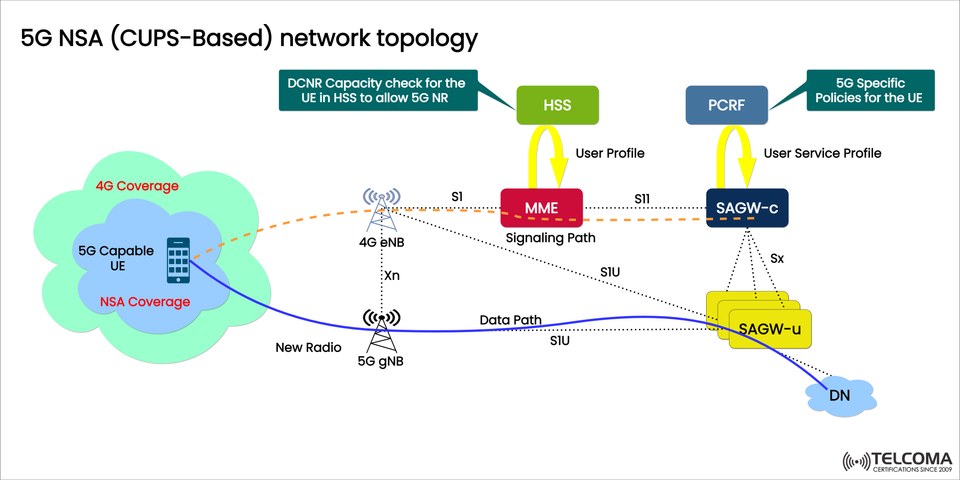
The diagram labeled “5G NSA (CUPS-Based) Network Topology” illustrates how a 5G-capable User Equipment (UE) connects to both 4G and 5G networks at the same time, utilizing CUPS to distinguish the signaling (control) path from the data path.
In this post, we’ll delve into:
The fundamentals of NSA in 5G.
The importance of CUPS for network efficiency.
A detailed breakdown of the NSA topology as shown in the diagram.
Key components: MME, HSS, PCRF, and SGW (covering control and user planes).
The advantages and challenges linked to deploying CUPS-based NSA.
Understanding 5G Non-Standalone (NSA)
5G NSA (Non-Standalone) is a deployment model where the new 5G radio (NR) works alongside the existing 4G LTE EPC (Evolved Packet Core). Instead of rolling out a complete 5G Core (SA), NSA allows operators to reuse the LTE control plane while incorporating 5G NR for faster data speeds.
Why Choose NSA First?
It allows for quicker deployment of 5G with less investment.
Maintains backward compatibility with 4G networks.
Takes advantage of existing EPC while providing enhanced mobile broadband (eMBB).
What’s CUPS in 5G NSA?
Control and User Plane Separation (CUPS) is an upgrade in network architecture where the control plane (signaling) and user plane (data forwarding) are separated.
Key Points:
Control Plane (C): Manages signaling, mobility, authentication, and session control.
User Plane (U): Handles data transfer between UE and data networks.
Using CUPS allows operators to:
Scale the user plane separately from the control plane.
Position user plane nodes closer to the edge, reducing latency.
Streamline upgrades and optimize resource distribution.
Breaking Down the 5G NSA (CUPS-Based) Topology
The diagram illustrates how LTE EPC and 5G NR interact, along with the CUPS framework. Here’s a step-by-step breakdown:
- User Equipment (UE)
A 5G-capable UE connects to both 4G eNB and 5G gNB simultaneously.
Coverage options include 4G LTE and NSA coverage (LTE+NR dual connectivity).
- Radio Access Network
4G eNB: Serves as the main anchor for control signaling.
5G gNB (New Radio): Offers a high-speed data path.
Xn Interface: Links eNB and gNB for effective coordination during dual connectivity.
- EPC Core Functions
MME (Mobility Management Entity):
Manages signaling (S1-MME).
Coordinates session management.
Works with HSS for user authentication and profiles.
HSS (Home Subscriber Server):
Stores user profiles and subscription data.
Conducts capacity checks for 5G NR access.
PCRF (Policy and Charging Rules Function):
Sets QoS and charging policies.
Supplies 5G-specific user service profiles.
SGW-C (Serving Gateway Control Plane):
Manages signaling control for bearer setup.
Interfaces with PCRF and MME.
SGW-U (Serving Gateway User Plane):
Forwards user data traffic.
Directly connects to DN (Data Network).
- Data Path Versus Signaling Path
Signaling Path: UE → eNB → MME → SGW-C → PCRF/HSS.
Data Path: UE → gNB → SGW-U → DN.
This control and user plane separation is the core idea behind CUPS.
Key Interfaces in NSA CUPS
Interface Function Example from DiagramS1-MMEControl signaling between eNB and MMEUE registration/authenticationS1-UUser plane connection between eNB/gNB and SGW-U Data forwarding Xn Coordination between eNB and gNB Dual connectivityS11Control plane link between MME and SGW-C Bearer management Sx Interface between SGW-C and SGW-U User plane controlS6aHSS ↔ MME for subscriber data Authentication & capacity check
Simplified Call Flow for How NSA CUPS Works
UE attaches to 4G eNB (signaling anchor).
MME checks HSS for subscriber profile and NR capability.
PCRF provides service and policy rules for 5G usage.
MME sets up bearer sessions via SGW-C.
SGW-C configures SGW-U for data forwarding.
Data travels from UE → gNB → SGW-U → DN, avoiding signaling components.
This setup keeps signaling on LTE while making sure data takes advantage of 5G NR speeds.
Benefits of NSA with CUPS
Faster 5G Rollout: Makes use of LTE EPC infrastructure.
Optimized Resource Usage: Allows independent scaling of control and user planes.
Lower Latency: User plane nodes can be set up at the edge.
High Data Rates: Data path benefits from 5G NR.
Future-Ready: Offers a smooth transition towards full 5G SA.
Challenges in NSA CUPS
Despite its advantages, NSA CUPS brings some difficulties:
Complexity: Dual connectivity needs synchronization between eNB and gNB.
LTE Dependency: The control plane still relies on 4G EPC.
Policy Integration: PCRF needs to adjust to 5G-specific profiles.
Scalability Issues: Large-scale NSA setups might need frequent updates.
Quick Comparison: NSA vs SA
Feature NSA (CUPS-Based)SA (Standalone 5G Core)Control Plane Anchor LTE EPC (MME)5G Core (AMF, SMF)User Plane Split with CUPS Fully 5G Core-based Rollout Speed Faster Slower, requires 5G C Latency Moderate Ultra-low Cost Lower (reuses LTE)Higher (new infrastructure)Future Readiness Transitional Long-term solution
Future Outlook
NSA with CUPS is more than just a transitional architecture; it connects LTE and full 5G Core implementation. As operators keep launching Standalone (SA) 5G, CUPS will still play a key role in:
Edge computing setups.
Private enterprise 5G networks.
IoT-heavy applications that require flexible scaling.
In the end, while SA 5G with Service-Based Architecture (SBA) will take over NSA, CUPS will remain a foundational element for how telecom networks manage scalable, distributed data processing.
Wrap-Up
The 5G NSA (CUPS-Based) network topology enables operators to tap into 5G’s high-speed data potential while still utilizing existing LTE infrastructure for control signaling. By separating the control plane (MME, SGW-C) from the user plane (SGW-U), networks gain more flexibility, scalability, and efficiency.
For telecom professionals, NSA with CUPS isn’t merely a temporary fix; it’s a vital stepping stone towards complete 5G Core (SA) deployments. It showcases how smart architectural choices can lead to speedy rollouts, reduced latency, and an enhanced user experience—setting the stage for the next wave of 5G advancements.