
5G NSA vs SA Deployment Architectures: Explained with Use Case Scenarios

📶 5G Deployment Scenarios: Architecture using NSA and SA Models
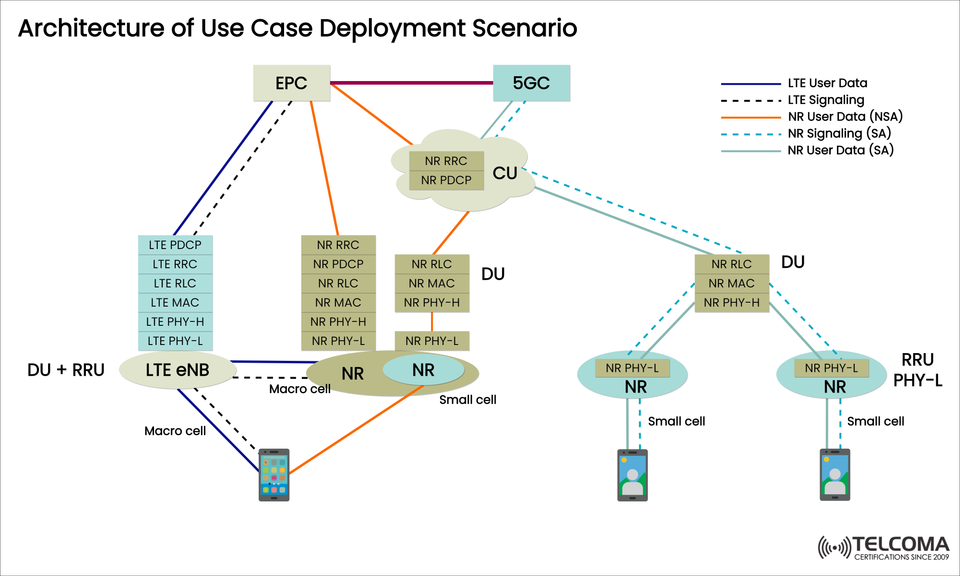
Understanding the transition from 4G LTE to 5G systems is complex with regard to architecture - there are two distinct ways that the core and radio can be integrated. The image shows the actual deployment architecture of both Non-Standalone (NSA) and Standalone (SA) 5G use cases, illustrating the interaction between EPC, 5GC, CU, DU, and RRU.
In this blog, we will provide the technical architecture while exposing how the different protocol layers (for example PDCP, RLC, MAC, PHY) are deployed in both LTE and NR stacks.
🧠 NSA vs SA in your 5G deployment
Feature Non-Standalone (NSA) Standalone (SA)
Core Network EPC (Evolved Packet Core) 5GC (5G Core)
Anchor technology LTE NR (New Radio)
Use Case Fast 5G, LTE dependent Complete 5G full performance ultra-low latency
Control Plane Signaling Based on LTE 5G NR based via CU
Deployment complexity Lower, LTE reuse Higher, 5GC required
🔍 Image Explanation: Two paths NSA (on the left) and SA (on the right) with user data and signaling handled.
📌 The NSA Path (left-hand side):
LTE eNB +NR (EN-DC mode):
The LTE eNB will handle the LTE RRC, PDCP, RLC, MAC and PHY-H and PHY-L,
The NR node includes RRC, PDCP, RLC, MAC, and PHY layers for NR.
Data Flow:
LTE Signaling is represented by dashed black lines
LTE User Data is indicated by solid blue lines
NR User Data (NSA) is indicated by solid orange lines
It's worth noting that the EPC Core can connect both LTE and NR nodes:
Use Case: This can refer to 5G-capable devices that use LTE for control and NR for high speed data. This use case is very common in the early roll out of 5G, where existing LTE infrastructure is utilized.
📌 SA Path (Right Side)
NR Nodes connect directly to the 5GC using CU and DU split architecture.
CU (Central Unit) handles:
NR RRC and PDCP,
DU (Distributed Unit) handles:
NR RLC, MAC, PHY-H,
RRU/PHY-L are indicated at the edge of the NS2, closer to the radio antennas.
Data Flow:
NR Signaling (SA) is represented by dashed blue lines
NR User Data (SA) is indicated by solid teal lines
Use case: When devices fully utilize the 5G NR and 5GC roaming features, such as ULLC (Ultra-reliable ultra-low-latency communications) and massive IOT.
🔧 Layered Protocol Stack Summary
Layer NSA NR Node SA NR Node
PHY-L Physical Layer (Low) Physical Layer (Low)
PHY-H Physical Layer (High) Physical Layer (High)
MAC Medium Access Control Medium Access Control
RLC Radio Link Control Radio Link Control
PDCP Packet Data Convergence Protocol in CU only
RRC Radio Resource Control in CU only
🛰 Important Components
✔ EPC (Evolved Packet Core)
In the NSA mode, takes responsibility for LTE and NR nodes and is a 4G core, in the "legacy" sense.
✔ 5GC (5G Core)
In the SA mode, one program acts as the 5G core and it will add advanced capabilities, such as:
Service-based architecture
Network slicing
Edge computing support
✔ CU/DU Split
CU: Centralized functions (RRC/PDCP)
DU: Distributed functions (RLC, MAC, PHY)
✔ RRU (Remote Radio Unit)
Handles the low-level radio signal processing, PHY-L, typically at the antenna sites.
📲 The Practical Implications of Deployment With NSA or SA
Reasons Operators Prefer NSA Right Now:
Quicker deployment
Maximizes previous LTE investment
Lower CapEx
Reasons SA is the Right Decision Moving Forward:
Real 5G capabilities (e.g., 1ms latency, 10Gbps throughput)
It is stand-alone from the LTE network itself
Enables advanced use cases, e.g., slicing, private 5G
🏁 Summary: Architecture Ready for Flexibility and Evolution
This use-case deployment scenario categorizes how telecom networks have evolved by reaction to various deployment configurations with residual LTE infrastructure and new 5G NR technologies with non-standalone (NSA) and standalone (SA) deployments.
NSA gives a practical next step to 5G.
SA gives full-blown 5G capability oriented to the future.
Being familiar with this architectural split is particularly important knowledge for network architects, telecom engineers, and technology strategists as 5G opportunities expand globally.
🌐 Real-world use cases of NSA and SA Architectures
🔗 Non-Standalone (NSA) Use Cases
NSA is for regions or operators who want to deploy a 5G service quickly and do not want to replace the existing LTE infrastructure.
Enhanced Mobile Broadband (eMBB): 5G NR that provides mobile data at high speeds with LTE being the control anchor.
Fixed Wireless Access (FWA): A reliable broadband solution for underserved, rural, and suburban areas.
Urban area deployments that had early 5G deployments with a strong density of LTE backhaul.
🔌 Standalone (SA) Use Cases
SA is more aligned to future 5G use cases that require ultra-low latency and massive connections.
Industrial Automation: 5G SA allows for precision control and real-time monitoring of manufacturing processes, warehousing, supply chain, and logistics.
Private 5G Networks: Private enterprise 5G SA deployments allow for the enterprise to have full control, data sovereignty, and network slicing.
Smart Cities and the Internet of Things (IoT): 5G enables new dense deployments of IoT devices that are scalable and reliable.
🔭 Future Trends in 5G Deployment Architecture
Migration from NSA to SA:
Like LTE, most operators will likely start with NSA and gradually migrate to SA to take advantage of higher-level features.
But dual connectivity (LTE + NR) will soon be phased out as NR standalone connectivity becomes the norm.
Virtualization and Cloud-native Cores:
5GC is being deployed as a cloud-native function more than ever using containers and orchestration tools such as Kubernetes.
💡 Conclusion
There is no one-size-fits-all approach to deploying 5G architecture. Recognizing how the NSA and SA models interact based on the protocol layers, along with the control and user planes, as focal points and certain RAN physical components is extremely practical for network architects as they can:
Reduce deployment costs through NSA.
Position for long-term scalable use of SA.
Increase end-user experience through advanced and intelligent routing, and real-time analytics for early optimization.
Going forward into the cloud-native network, with open interfaces and AI assisted RAN use, navigating through these deployment models will be pivotal in maintaining a competitive advantage in the telecom sector.