
5G PCF and AMF Policy Association Explained | Policy Control and Event Subscription in 5G Core

5G PCF and AMF Policy Association: Managing Policy Control and Event Subscriptions in the 5G Core
In the 5G Core (5GC), the Policy Control Function (PCF) plays a crucial role in overseeing network policies, user data flows, and ensuring quality of service (QoS). It works closely with the Access and Mobility Management Function (AMF) to make policy decisions based on user mobility, registration, and maintaining session continuity.
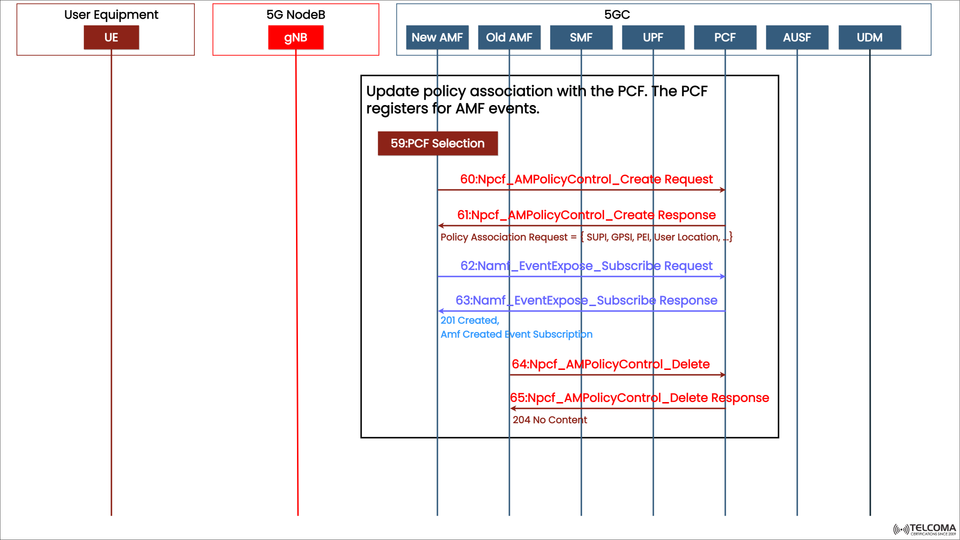
The diagram uploaded shows how the Policy Association Procedure operates between AMF and PCF, and illustrates how the PCF keeps up with AMF events in real time. This setup helps to keep network and user policies aligned as the User Equipment (UE) changes locations or states.
Overview of PCF and AMF in 5G Architecture
Before we dive into the signaling flow, it’s worth getting familiar with the main components:
PCF (Policy Control Function): It’s in charge of setting and enforcing network policies, which include QoS parameters, access permissions, and rules related to mobility.
AMF (Access and Mobility Management Function): This function manages user registration, mobility, and connections within the 5G Core. It also collaborates with the PCF to implement the right policy decisions.
UDM (Unified Data Management): UDM supplies the PCF and AMF with subscriber data to ensure that policy rules are in sync with the user's profile.
Together, these elements enable dynamic, context-aware policy control in the 5G service architecture.
The Role of PCF-AMF Policy Association
The Policy Association allows the AMF to connect to a specific PCF that handles policies for a particular UE.
This association makes it possible to:
Update policies dynamically during UE mobility or when reallocating AMF.
Adjust policies based on triggered events (like registration or location changes).
Keep user and network conditions in sync in real time between AMF and PCF.
Use resources efficiently through policy-aware control plane functions.
This all ties into Event Subscription, where the PCF signs up for notifications about specific AMF events (such as deregistration or mobility updates).
Step 59: Choosing the Right PCF
When a New AMF is assigned to a UE, it needs to pick the right Policy Control Function (PCF) for that subscriber.
The selection process takes into account:
SUPI (Subscription Permanent Identifier)
S-NSSAI (Single Network Slice Selection Assistance Information)
User’s Location and Network Slice
Operator-specific PCF selection policies
Once the right PCF is selected, the AMF starts building a Policy Association with it.
Step 60: Npcf_AM Policy Control_Create Request
The AMF kicks off the policy association by sending a Npcf_AM Policy Control_Create Request to the PCF.
This message includes essential identifiers and attributes like:
SUPI: Identifies the subscriber.
GPSI: Generic Public Subscription Identifier.
PEI: Permanent Equipment Identifier (device info).
User Location Information: Aids the PCF in applying location-based policies.
Supported Features: Lists capabilities like QoS or session continuity.
Purpose:
To set up a policy session that dictates how mobility and access management are handled from a policy standpoint.
Step 61: Npcf_AM Policy Control_Create Response
In return, the PCF sends back a Npcf_AM Policy Control_Create Response message that includes:
Policy Association ID: Unique identifier linking AMF and PCF.
Policy Rules: Existing and dynamic policies applicable to the UE.
Policy Decisions: Such as priority levels, AMF behavior specifications, or QoS profiles.
Now, the AMF follows these policy guidelines as established by the PCF.
Steps 62–63: Subscribing to Event Exposure
With the Policy Association set up, the PCF subscribes to AMF events for real-time updates.
This consists of two messages:
62: Namf_Event Expose_Subscribe Request (from PCF to AMF)
63: Namf_Event Expose_Subscribe Response (confirmation from AMF to PCF)
Purpose:
Enables the PCF to modify its policies dynamically based on AMF events such as:
UE registration or deregistration
Location or connectivity state changes
AMF reallocation
When the PCF gets these event notifications, it can fine-tune policy parameters, enforce new rules, or trigger reauthorization without a hitch.
Steps 64–65: Cleaning Up Policy Associations
Once the AMF reallocation is complete or when a UE deregisters, the old AMF needs to tidy up its policy associations.
It sends:
64: Npcf_AMPolicyControl_Delete (request to remove the association)
65: Npcf_AMPolicyControl_Delete Response (acknowledgment with “204 No Content”)
Purpose:
To release network resources and prevent overlaps or conflicts in policies.
Once deleted, the old AMF no longer keeps an active policy association with the PCF.
Major Advantages of PCF-AMF Policy Association
a. Adaptable Policies in Real Time
By subscribing to AMF events, the PCF can adjust QoS or routing policies based on the UE’s state and location.
b. Improved Mobility Management
As a UE moves or changes tracking areas, the PCF guarantees consistent policy enforcement across AMFs.
c. Streamlined Network Automation
With policy associations, the network can operate more autonomously, cutting down on manual setup.
d. Resource Efficiency
Old policy contexts are promptly deleted, making the system more efficient and avoiding data inconsistencies.
e. Consistent User Experience
Continuity in policies keeps QoS and access controls stable, even during mobility events.
A Real-World Example: Syncing Mobility and Policies
Picture a UE moving from one AMF area to another:
The new AMF picks the right PCF.
A new Policy Association is formed.
The PCF subscribes to AMF events for monitoring the UE’s behavior.
Once the UE fully transitions, the old AMF deletes its policy association.
This keeps both the user experience and network resource allocation in check.
Technical Insights: APIs and Interfaces
Interface / Function / Protocol
Npcf-AM Policy Control Policy association creation, update, deletion REST/HTTP over Service-Based Interface
Namf-Event Exposure Event subscription and notification REST/HTTP
Nudm-Subscriber Data Provides subscriber details to PCF/AMF REST/HTTP
All communications adhere to 3GPP Service-Based Architecture (SBA) norms, utilizing stateless APIs for better interoperability and scalability.
Conclusion
The 5G PCF-AMF Policy Association and Event Subscription processes are essential for smart, dynamic policy management in the 5G Core.
By establishing a structured communication channel between the AMF and PCF, the network can:
Implement user-specific and slice-aware policies,
Quickly respond to mobility or registration changes, and
Sustain consistent QoS enforcement throughout the system.
This setup ensures that both users and operators benefit from adaptive, efficient, and policy-driven 5G operations.
For those working in telecommunications, getting a grip on this interaction is crucial for grasping how 5G Core achieves event-driven, real-time policy control — a key aspect of next-gen mobile networks.