
5G PCF Network Function Explained: Architecture, Role, and Use Cases

The 5G Core (5GC) is designed using a service-based architecture (SBA) that offers flexibility, scalability, and cloud-native deployment options. One key component is the Policy Control Function (PCF), which plays a vital role in managing policies and charging by making real-time decisions about network resources and service delivery.
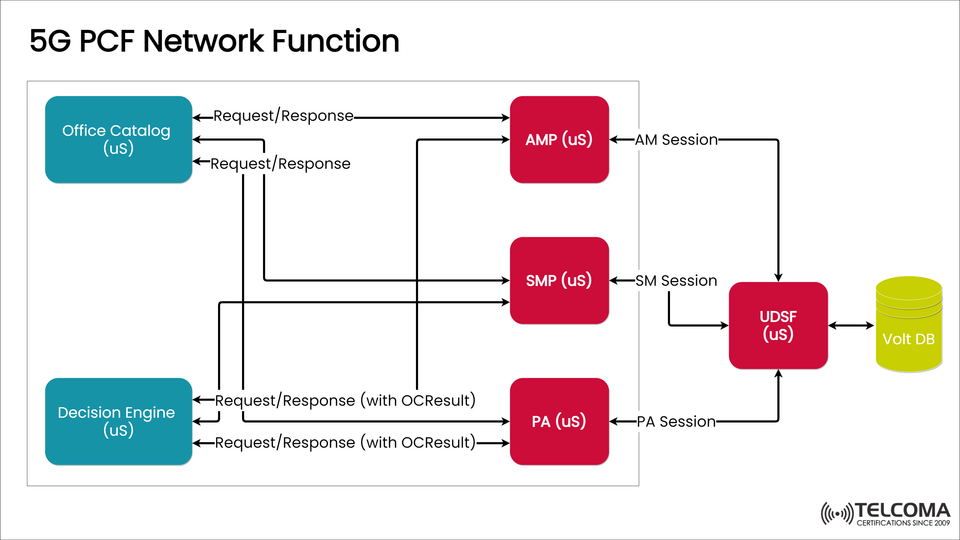
The diagram illustrates how the 5G PCF Network Function interacts with other microservices like AMP, SMP, PA, UDSF, the Decision Engine, and the Office Catalog. All these elements work together to enforce policies consistently across various sessions (AM, SM, PA).
What is the 5G Policy Control Function (PCF)?
The PCF is an essential function in the 5G Service-Based Architecture. Its main goals are:
Policy Decision Making: It sets the rules for Quality of Service (QoS), charging, and how resources are allocated.
Subscriber-Centric Control: It utilizes subscriber profiles and network policies to ensure fair usage and compliance with the operator’s regulations.
Service Differentiation: It supports network slicing and tailored services for enterprises, IoT, and critical communications.
Essentially, the PCF serves as the backbone of policy control in 5G, ensuring that each user or service request is processed according to established rules.
Components of the 5G PCF Network Function
The image outlines a microservices-based implementation of the PCF, where each service (uS = microservice) has a distinct role:
- Office Catalog (uS)
Acts as a repository of available services and policies.
Responds to requests and responses from other PCF functions.
Provides policy templates and information related to subscriptions.
- AMP (uS) – Access Management Policy
Manages Access and Mobility (AM) session policies.
Collaborates with subscriber mobility functions to determine:
Handover policies
Roaming restrictions
Access prioritization
- SMP (uS) – Session Management Policy
Governs Session Management (SM) policies.
Key for controlling:
PDU session establishment
QoS rules
Data session continuity
- PA (uS) – Policy Authorization
Oversees Policy Authorization (PA) requests.
Ensures only approved policies apply to specific services, especially for enterprise or application-level slices.
- Decision Engine (uS)
Functions as the intelligence layer of the PCF.
Makes real-time policy decisions based on:
Inputs from the Office Catalog
Subscriber data
Network conditions
Produces responses with OCResult (Office Catalog Result), reflecting approved policy outcomes.
- UDSF (uS) – Unstructured Data Storage Function
Supplies data persistence for the PCF.
Stores session states (AM/SM/PA) and subscriber data.
Works with VoltDB, a high-performance database.
- VoltDB
A low-latency, high-throughput database.
Guarantees fast access to subscriber profiles and policy data for the PCF.
How the PCF Works (Step-by-Step)
Request Initiation
A subscriber’s User Equipment (UE) starts a session (like a data request).
This request travels through the network and reaches the PCF.
Policy Request Handling
The request gets processed by various PCF microservices (AMP, SMP, PA).
Each microservice manages a specific session type (AM, SM, PA).
Policy Decision Process
The Decision Engine assesses the request.
It consults the Office Catalog for established policy rules.
It also checks subscriber entitlements and QoS needs.
Data Storage
Session data is recorded in the UDSF.
UDSF ensures state ful session continuity, even during service restarts.
Final Response
The confirmed policy decision is sent back to the requesting NF (like AMF or SMF).
Then, the UE’s session gets managed according to the agreed rules (like bandwidth, slicing, and charging policies).
Importance of PCF in 5G Networks
The PCF isn’t just another function; it’s a key enabler for service differentiation and monetization in 5G.
Supports Network Slicing: Allows for different policies for various slices (like IoT vs. URLLC).
Dynamic QoS: Allocates resources based on real-time needs.
Charging Control: Links policies with billing systems to ensure accurate charges.
Subscriber-Centric Experience: Offers tailored services based on subscription levels (like premium vs. basic).
Key Use Cases of PCF
Use Case Role of PCF Example Network Slicing Defines slice-specific policies Autonomous cars vs. IoT devices QoS Differentiation Applies differentiated QoS HD video vs. IoT telemetry Roaming Policy Manages roaming rules Restrict VoNR in certain countries Enterprise Services Authorizes enterprise policies Private 5G networks Charging Integration Works with CHF for billing Pay-per-GB or premium speed tiers
Advantages of a Microservices-Based PCF
Scalability: Each microservice can scale on its own.
Resilience: If one service fails, it doesn't take down the entire PCF.
Flexibility: Functions can be added or updated easily without disrupting the whole system.
Cloud-Native Deployment: The PCF can run on Kubernetes clusters for dynamic scaling.
Challenges in Implementing PCF
Complexity: Microservices bring extra operational challenges.
Data Consistency: Efficient UDSF management is needed to maintain session persistence.
Latency: Real-time policy enforcement must be extremely quick.
Interoperability: Needs to work smoothly with AMF, SMF, CHF, and other NFs.
Future of PCF in 5G-Advanced and 6G
As networks develop, the PCF will continue to improve with:
AI/ML-driven Policy Decisions: Policies that self-optimize using predictive analytics.
Edge Integration: PCF instances deployed closer to users at the edge for lower latency control.
6G Vision: In 6G, policy control will go beyond networks to include AI-driven intent-based networking, where operators state what they want, and the PCF figures out how to make it happen.
Conclusion
The 5G PCF Network Function is crucial for managing policies within the 5G Core. Its microservices architecture—comprising AMP, SMP, PA, the Decision Engine, Office Catalog, UDSF, and VoltDB—ensures real-time policy decisions, seamless session management, and subscriber-focused service delivery.
For professionals in telecom, grasping the PCF is essential for designing networks capable of supporting differentiated services, network slicing, and advanced monetization strategies.
In essence, the PCF is the policy brain of 5G networks, and its intelligence will only grow as we transition toward 5G-Advanced and 6G.