
5G Physical Infrastructure Zoom-in: RAN, Edge Cloud & Transport Network Explained
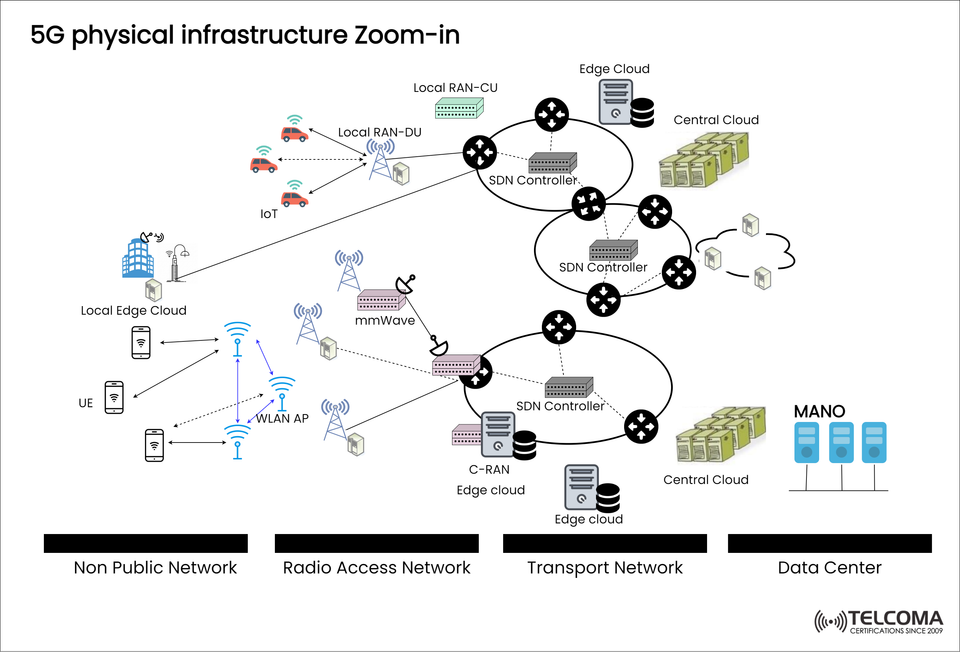

5G Physical Infrastructure Zoom-in: All the Parts of a 5G Network
As 5G rollout accelerates across the globe, it is necessary to understand how the physical infrastructure is helping enable it. The “5G Physical Infrastructure Zoom-in” diagram illustrates a layer cumulus architecture that can enable ultra-reliable low-latency communications across a wide variety of use cases, ranging from IoT to mmWave.
This blog will go through each item seen in the image – categorized by Non-Public Network, Radio Access Network, Transport Network, and Data Center, and explain how they are mutually dependent in a cloud-native, software-defined environment.
5G Physical Infrastructure Overview
Non-Public Network: The Localized Private Network Layer
Non-public networks (NPNs) provide enterprise-specific services such as industrial automation, smart city, and IoT.
Key Components:
UE (User Equipment): mobile phones, tablets, and IoT Devices
WLAN AP: Wi-Fi offload and local access
Local Edge Cloud: Allows compute to be moved closer to the UE for reduced latency
IoT & Connected Vehicles: used Localized RAN-DU for real-time applications.
Radio Access Network (RAN): Distributed & Disaggregated
The RAN is at the core of 5G and consists of distributed units (DU), centralized units (CU), and remote radio heads (RRH).
The elements:
Local RAN-DU & RAN-CU: Perform real-time radio processing and non-real-time.
mmWave Nodes: Ultra-high throughput, dense urban areas.
C-RAN Edge Cloud: CU functions centralized at edge site for efficiency.
Radio Towers: Provide wireless access across large territories.
Transport Network: SDN-enabled and high-capacity
The transport network connects the RAN components to the edge cloud and the central cloud with all native SDN voices to decouple traffic and control.
Components of the Transport Layer:
SDN Controllers: Indicate or influence the forwarding behavior of routers/switches through policies.
Routers/Switches: Provide backhaul flexibility and scalability.
Edge Cloud Nodes: Provide compute/storage to localize RAN functionality for processing low-latency applications.
Data Center: Core Network and Orchestration
The data center level provides centralized processing resources and associated orchestration platforms.
Centralized Functions:
Central Cloud: Provides core network functions and analytics as well as workloads related to AI/ML.
MANO (Management and Orchestration): Automates the lifecycle of Virtualized Network Functions (VNFs).
Distributed Data Centers: Implementing regions can provide for fault-tolerance, as well as scalability.
Visualizing the Layers
Layer Key Components Role
Non-Public Network UE, WLAN, IoT Devices, Local edge cloud Private connectivity, processing low-latency
Radio Access Network RAN-DU, RAN-CU, mmWave, Radio Towers Wireless access, distributed radio processing
Transport Network SDN controllers, Routers, switches, Edge cloud Backhaul routing and control plane routing
Data center Central cloud, MANO orchestration, AI, analytics, network slicing.
📊 Visual Layer Breakdown
Layer Key Components Function
Non Public Network UE, WLAN, IoT Devices, Local Edge Cloud Private connectivity, low-latency processing
Radio Access Network RAN-DU, RAN-CU, mmWave, Radio Towers Wireless access, distributed radio processing
Transport Network SDN Controllers, Routers, Switches, Edge Cloud Control plane and backhaul routing
Data Center Central Cloud, MANO AI, analytics, orchestration, network slicing
🚀 The Whole Picture: How the Layers Work Together
The uplink/downlink from UE goes to the closest RAN-DU.
Traffic flows over SDN-based backhaul to the CU in the C-RAN or edge cloud.
Packets then flow to the Central Cloud for core processing or a local edge cloud for faster latency.
MANO coordinates all VNFs and handles resource allocation and lifecycle management.
✅ Conclusion: The 5G Infrastructure of the Future
The physical infrastructure for 5G can be described as a multi-layered highly modular, software-defined, cloud-native architecture that also provides massive scalability and ultra-low latency characteristics. By separating functions across non-public networks, RANs, transport, and data centers, 5G can accommodate diverse application requirements—whether related to industrial IoT or immersive AR/VR—while providing flexibility and exceptional performance.
The telecommunications industry is making significant strides towards 6G, and the components that build this 5G infrastructure, edge convergence, disaggregation, and programmability, will continue to support the future of the telecommunications network.
🔍 Dive Deeper: Real-World Use Cases Mapped to Infrastructure Components
To better understand how each level of infrastructure relates to each other, let's relate them to practical 5G use cases:
Use Case Key Infrastructure Component(s) Utilized Benefit Achieved
Smart Manufacturing Local RAN-DU; Local Edge Cloud; SDN Controller Low latency control of robotic & sensor
Autonomous Vehicles IoT nodes; mmWave; Local Edge Cloud Real-time V2X communications
Mobile Broadband (eMBB) mmWave; RAN-CU; Transport Network High speed streaming and downloads
AR/VR Applications Edge Cloud; SDN optimized transport; MANO Ultra-low latency rendering
Enterprise NPNs WLAN AP; Local Edge Cloud; Private 5G Core (on premise) Private networks with privacy and customization
Network Slicing (Inter-operator scenarios) MANO; Central Cloud; SDN Controller Logical partitioning of resources for service SLAs
🧠 Technology Insights: Architectural Design Patterns
This zoom-in diagram can be mapped to several common best practice design principles within telecommunications today:
- Cloud-Native Infrastructure
Enables software component decoupling from hardware.
Enables scalable VNFs and CNFs hosted on off-the-shelf (COTS) hardware. - SDN Integration
Centralizes network control and facilitates automation and real-time reconfigurability.
Optimizes QoS and path management for latency-sensitive services. - Disaggregated RAN (Open RAN Principles)
Allows baseband and radio components (DU/CU/RRH) to be modularized.
Encourages vendor-neutrality and cost-savings. - Edge Computing Enablement
Brings computation to the user.
Essential for reliable latency-sensitive applications and use cases like AR/VR, industrial control, and smart city services.
🔐 Security & Operational Considerations
While this architecture provides powerful capabilities to end-users, there are also several operational and security considerations that telecom professionals will need to address:
Security Domains Across Layers: Each layer (e.g., RAN, Transport, and Core) has various vulnerabilities, such as an SDN controller being spoofed or an edge node being compromised (hijacked).
Lifecycle Management: MANO is fundamental to monitoring and automating tasks necessary for patching, scaling for capacity, and fault recovery.
Latency Budgeting: Strategically locating the edge clouds and DUs meeting strict latencies (e.g., sub-10 ms for URLLC).
🌐 Future Outlook: Pointing Towards 6G and Beyond
This physical infrastructure model is ideal for stepping into the future of innovation using:
AI-Informed Network Management: Predictive maintenance and self-optimizing,
Integrated Satellite-5G Network: Improved coverage for rural and/or maritime domains.
Hyper-Distributed Edge: Micro edge locations for super-localized services (e.g., Stadiums and hospitals).
As the technology matures (Open RAN, orchestration using AI, and advanced slicing), this architecture can be transformed into very flexible, dynamic topologies that allow for new opportunities in immersive media, connected intelligence, and ubiquitous computing.
🧾 Summary Checklist:
Key Points
✔️ 5G Infrastructure includes multiple domains (NPN, RAN, Transport, and Data Center)
✔️ SDN and MANO provide the ability to automate and program (inclusion of applications and storage)
✔️ Edge