
5G Policy Association and User Plane Setup Explained: AMF, PCF, and SMF Interactions
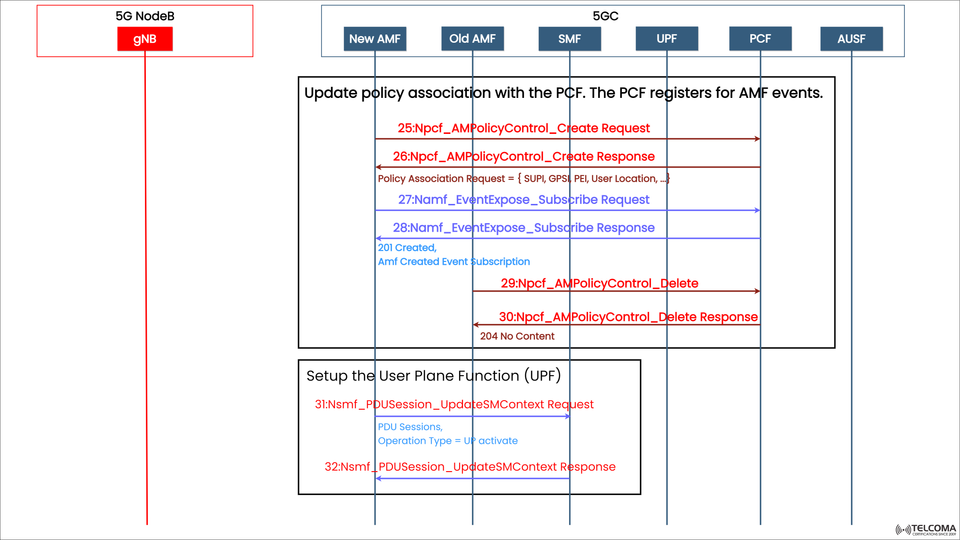

Understanding 5G Policy Association and User Plane Setup
In the architecture of the 5G Core (5GC), policy control and user plane setup play essential roles in managing data sessions effectively. After the User Equipment (UE) registers and is authenticated, the network needs to set up policies and routes to manage data flow.
The diagram above shows this process and highlights two key tasks:
Policy Association with the PCF (Policy Control Function)
User Plane Function (UPF) Setup through the SMF (Session Management Function)
These tasks work together to make sure subscriber sessions are optimized, adhere to Quality of Service (QoS) rules, and are directed correctly through the 5G network.
Overview of Policy Association in 5G
In 5G, the Policy Control Function (PCF) outlines how services are provided to users, enforcing rules that affect:
Session establishment and modification
QoS management
Access control and slicing policies
Event triggers for the AMF (like changes in mobility or location)
The Access and Mobility Management Function (AMF) interacts with the PCF via the Npcf_AM Policy Control interface to create and sustain this policy association.
Key Network Functions and Interfaces
Entity Full Name Primary Role in This Procedure gNB Next Generation Node B, provides 5G NR radio access to the UEAMF Access and Mobility Management Function, manages registration, mobility, and event exposure SMF Session Management Function, handles PDU session lifecycle and UPF configuration UPF User Plane Function, routes and forwards user data packets PCF Policy Control Function, provides policy rules and QoS parameters UDM Unified Data Management, maintains subscriber data (not directly involved here)
The Npcf_AM Policy Control and Nsmf_PDU Session interfaces operate as service-based interfaces (SBI) that utilize RESTful APIs according to 3GPP TS 29.512 and TS 29.503.
Step-by-Step Breakdown of the Policy Association Process
Step 25: Npcf_AMPolicyControl_Create Request
Message Direction: AMF → PCF
Purpose: To create a policy association for a particular UE.
The AMF sends this message to the PCF with a policy association request, including details like:
SUPI (Subscription Permanent Identifier)
GPSI (Generic Public Subscription Identifier)
PEI (Permanent Equipment Identifier)
User Location Information
Access Type (3GPP or Non-3GPP)
This request gives the PCF info about the user's identity, device type, and context so it can provide suitable policy rules.
Step 26: Npcf_AMPolicyControl_Create Response
Message Direction: PCF → AMF
When the PCF gets the request, it:
Validates the subscriber data.
Chooses the right AM Policy Control rules based on operator policies and network slice setup.
Sends back a response with policy specifics, event triggers, and QoS rules.
This association ensures the AMF follows the subscriber’s rules around service and mobility.
Step 27: Namf_EventExpose_Subscribe Request
Message Direction: PCF → AMF
Once the policy association is established, the PCF subscribes to specific AMF event notifications through the Namf_EventExposure service. These events could cover:
Changes in UE reachability
Location updates
Changes in the registration state
Mobility triggers
This setup allows the PCF to adapt policies in real time as the UE’s context shifts.
Step 28: Namf_EventExpose_Subscribe Response
Message Direction: AMF → PCF
The AMF confirms the event subscription with a 201 Created response, indicating that the event exposure context has been successfully created. Now, the PCF will receive asynchronous notifications whenever subscribed events occur.
Step 29: Npcf_AMPolicyControl_Delete
Message Direction: AMF → PCF
In cases of deregistration or session release, the AMF sends a delete request to terminate the policy association. This helps remove outdated or unnecessary policies from the PCF database, ensuring resource efficiency.
Step 30: Npcf_AMPolicyControl_Delete Response
Message Direction: PCF → AMF
The PCF acknowledges the deletion with a 204 No Content response, confirming that the policy association has been cleared.
This signals the conclusion of the policy management phase for that particular UE.
- Setting Up the User Plane Function (UPF)
After getting the policy control sorted, the next step is to set up the User Plane Function (UPF) to direct user data traffic as per those policies.
Step 31: Nsmf_PDUSession_UpdateSMContext Request
Message Direction: AMF → SMF
The AMF sends a PDU Session Update SM Context Request to the SMF. This message includes:
PDU Session Identifiers
Operation Type = UP Activate
The aim is to activate or modify user plane routes for the PDU sessions. This is crucial when:
A new PDU session starts.
A UE shifts to a different AMF region (like during a handover).
Updates in QoS or policy require changes to the user plane.
Step 32: Nsmf_PDUSession_UpdateSMContext Response
Message Direction: SMF → AMF
The SMF replies, confirming that:
The UPF has been set up.
Data forwarding rules (PDRs, FARs, QERs) have been applied successfully.
The operation completed without issues.
From here on out, data can flow through the UPF according to the QoS and policy parameters assigned to the subscriber.
Importance of Policy Control and UPF Setup in 5G
These procedures ensure that the 5G Core delivers efficient and personalized connectivity.
Benefits:
Dynamic Policy Enforcement: The PCF can adjust QoS rules in real-time based on user needs or network conditions.
Seamless Mobility: Coordination between the AMF and PCF guarantees consistent policies during handovers.
Optimized Resource Use: Removing outdated policy associations and freeing contexts helps prevent network congestion.
Data Path Control: The UPF is precisely configured to handle slicing, prioritization, and routing effectively.
Together, they build the backbone of 5G’s Service-Based Architecture (SBA), allowing for agility and programmability throughout the core.
Real-World Application Example
Think about a subscriber streaming 4K video while moving across different cells.
The AMF keeps track of mobility and updates the UE's location.
The PCF, subscribed to AMF events, gets this update.
It may tweak the QoS policies to keep video quality steady.
Meanwhile, the SMF makes sure the UPF directs packets through the best data path with the least latency.
This dynamic orchestration is what sets 5G apart from older architectures.
Conclusion
The Policy Association and User Plane Setup process in the 5G Core is vital for ensuring that every UE session follows operator-defined policies and optimized data routing.
Through the Npcf_AM Policy Control and Nsmf_PDU Session interfaces, the collaboration between AMF, PCF, and SMF allows them to:
Create, manage, and delete policy associations,
Subscribe to mobility and event notifications, and
Activate UPF paths for high-performance data delivery.
Grasping these interactions helps telecom professionals enhance 5G deployments for scalability, reliability, and service differentiation.