
5G Positioning in 3GPP Release 16: Architecture, Interfaces, and Enhancements

Introduction: The Evolution of 5G Positioning
Positioning technology has always been key to mobile communications, but 5G really takes it up a notch. Thanks to 3GPP Release 16, 5G rolls out advanced positioning systems that achieve sub-meter accuracy—which is crucial for things like self-driving cars, industrial automation, and emergency services.
This release leverages the flexible structure of 5G NR, allowing for real-time location tracking of user equipment (UE). It sets standards for several interfaces and components that work together smoothly to provide positioning information.
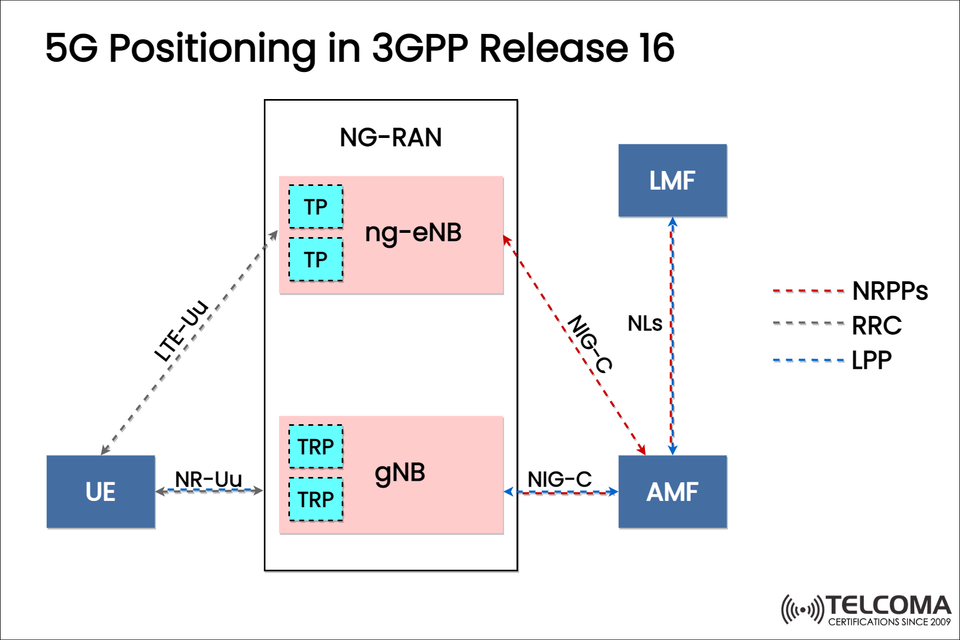
The image above gives a clear picture of how 5G positioning works in 3GPP Release 16, highlighting essential elements like UE, gNB, AMF, LMF, and how they connect.
Understanding the Key Network Components
- UE (User Equipment)
The UE kicks off the positioning process and engages with the network.
It sends and receives positioning messages via NR-Uu (5G NR interface) or LTE-Uu (4G LTE interface), depending on how the network is set up.
It uses RRC (Radio Resource Control) and LPP (LTE Positioning Protocol) for exchanging control and measurement data.
- NG-RAN (Next Generation Radio Access Network)
NG-RAN consists of the gNB (5G base station) and ng-eNB (enhanced LTE base station connected to the 5G core).
Each one has TRPs (Transmission Reception Points) or TPs (Transmission Points) that track signal timing, angle, and strength.
These details form the basis for estimating location using methods like:
Time Difference of Arrival (TDOA)
Angle of Arrival (AOA)
Enhanced Cell ID (E-CID)
- AMF (Access and Mobility Management Function)
The AMF acts as the control anchor between the UE and the core network.
It routes signaling between the UE, RAN, and LMF.
Plus, it handles mobility management, session context, and security of positioning data.
- LMF (Location Management Function)
The LMF is the main player in managing positioning sessions.
It gathers measurements from both RAN and UE to calculate or refine the device’s position.
It also communicates with the AMF through the Nls (Location Services Interface) regarding position-related tasks.
Positioning Methods in 3GPP Release 16
5G positioning offers a wide variety of techniques, allowing flexibility based on deployment and accuracy needs:
- DL-TDOA (Downlink Time Difference of Arrival)
This method measures the time difference between signals coming from multiple TRPs.
It provides high accuracy in dense urban and indoor settings.
- U-TDOA (Uplink Time Difference of Arrival)
Here, the UE sends out uplink reference signals and the network TRPs measure when they arrive.
This reduces the processing load on the UE, making it ideal for low-power IoT devices.
- Angle-Based Methods (AOA/AOD)
These techniques estimate the device's position using angle of arrival (AOA) or angle of departure (AOD) data.
They're particularly effective when antennas can do beamforming.
- Multi-RTT (Round Trip Time)
This method calculates the UE's position by looking at timing differences between various gNBs.
It's especially useful in situations where line-of-sight conditions aren’t ideal.
- GNSS and Hybrid Methods
This combines Global Navigation Satellite System (GNSS) data with network positioning.
Hybrid methods boost reliability and service continuity, especially indoors.
Role of LMF and AMF in 5G Positioning
The LMF and AMF are key players in managing 5G positioning workflows. Here’s a breakdown of how they interact:
Setting Up Measurement Control
AMF gets a location request and sends it over to LMF using the Nls interface.
LMF then sets up the measurement parameters for RAN nodes with help from AMF.
Collecting Positioning Data
TRPs and gNBs gather timing and angle measurements.
This data is then sent back to LMF via NRPPs messages over the Nlg-C interface.
Computing and Reporting
LMF calculates the device position based on the gathered data.
The findings are sent to the AMF, which forwards them to the service that requested it (like emergency services or network analytics).
This entire process makes sure that data collection is efficient and timely while being managed centrally.
Advantages of 5G Positioning in Release 16
- Enhanced Accuracy
It reaches decimeter-level accuracy thanks to beamforming, wide bandwidths, and high-frequency (mmWave) signals.
- Low Latency
Thanks to edge processing and distributed architectures, you get almost real-time location updates.
- Scalability
It can handle a huge number of IoT devices at once, each with different location needs.
- Flexibility Across Deployments
Works well with both Standalone (SA) and Non-Standalone (NSA) setups.
Plus, it’s backward compatible with older LTE positioning systems.
- Secure and Reliable
It uses encryption and authentication for all interfaces (NRPPs, LPP, Nls).
User identity is protected through mechanisms like the Subscription Concealed Identifier (SUCI) and Subscription Permanent Identifier (SUPI).
Use Cases Enabled by 5G Positioning
The precise positioning offered by 5G opens up new possibilities across various industries:
Autonomous Vehicles: Providing real-time location for safe navigation and collision avoidance.
Smart Manufacturing: Tracking robots and assets for optimized workflows.
Public Safety: Accurately pinpointing users for emergency call routing.
AR/VR Applications: Creating spatially aware experiences through precise tracking.
Telecom Network Optimization: Utilizing location analytics for better RAN planning and enhancement.
Comparison: 4G vs 5G Positioning
Feature4G LTE5G NR (Release 16)Accuracy50–150 meters<1 meter (urban)Bandwidth≤20 MHzUp to 400 MHz Positioning Methods GNSS, OTDOADL-TDOA, U-TDOA, AOA/AOD, Multi-RTT Protocols LPPLPP, NRPPs, RRC Latency High Ultra-low Integration Limited Deep integration with edge computing and AI
Conclusion: Paving the Way for Location-Intelligent 5G Networks
The 3GPP Release 16 positioning architecture represents a significant advancement in the evolution of 5G. By standardizing protocols like NRPPs, RRC, and LPP, and defining how LMF, AMF, and NG-RAN work together, it provides accurate, low-latency, and scalable location services.
As industries rely more on ultra-accurate and secure positioning, the built-in capabilities of 5G will form the backbone for a lot of new tech—think self-driving cars and smart cities.
In short, 5G positioning is about more than just knowing where a device is. It’s about making real-time, context-aware intelligence possible in our connected world.