
5G Radio Frequency Spectrum Explained: Low-Band, Mid-Band, and High-Band (mmWave)

Understanding the 5G Radio Frequency Spectrum: Low-Band, Mid-Band, and High-Band (mmWave)
The 5G revolution is changing the way we think about telecommunications, boasting remarkable speeds, incredibly low latency, and the capability to connect billions of gadgets. Central to this transformation is the radio frequency spectrum, which is split into low-band, mid-band, and high-band (mmWave) categories. Each of these bands serves a different role in balancing coverage, throughput, and network performance.
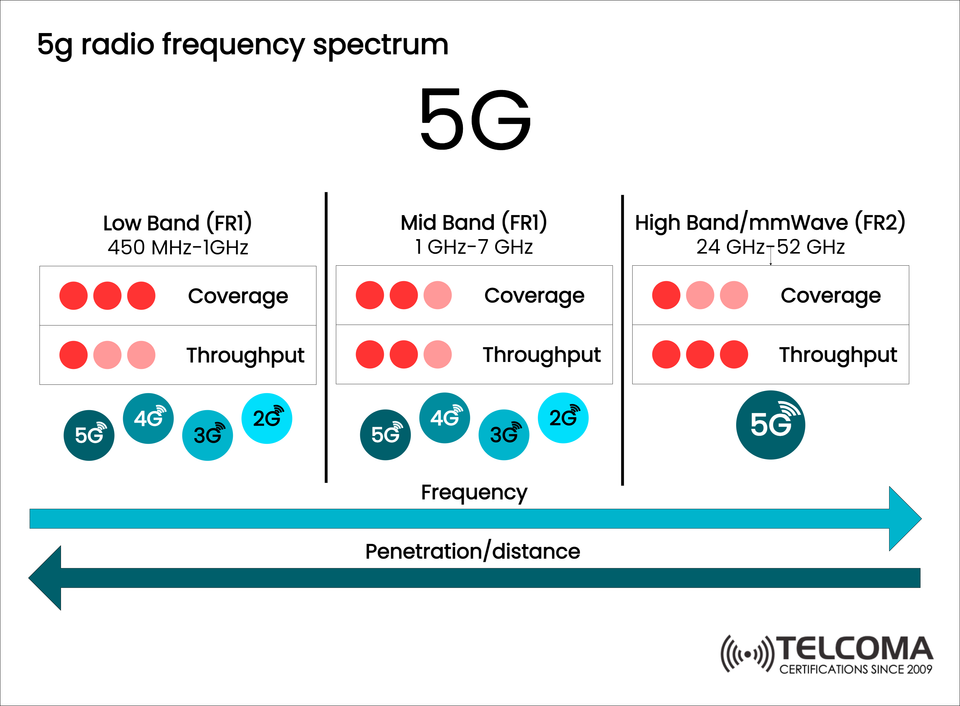
The image provided gives a great overview of how these frequency bands work and why their traits are important for telecom professionals and network engineers. Now, let’s dig into the details and see how they apply in the real world.
What is the 5G Frequency Spectrum?
The 5G spectrum refers to the specific range of radio frequencies set aside for 5G mobile networks. Unlike earlier generations, 5G needs a layered spectrum strategy because no single band is able to deliver wide-area coverage, high capacity, and ultra-fast speeds all at once.
Because of this, the spectrum is divided into three bands:
Low-Band (FR1: 450 MHz – 1 GHz)
Mid-Band (FR1: 1 GHz – 7 GHz)
High-Band / mmWave (FR2: 24 GHz – 52 GHz, and possibly up to 100 GHz)
Each band presents unique trade-offs regarding frequency, penetration, distance, coverage, and throughput.
Low-Band Spectrum (450 MHz – 1 GHz)
Characteristics:
Outstanding coverage and penetration.
Can travel far and easily get through walls, glass, and buildings.
Because of the lower frequency, it has lower capacity and throughput.
Technical Performance:
Coverage: The strongest of the three bands.
Throughput: Not as high compared to mid-band and mmWave.
Ideal for providing wide-area coverage in rural and suburban regions.
Use Cases:
Deploying rural 5G.
Expanding coverage in hard-to-reach spots.
Supporting basic IoT applications like smart farming and logistics.
Mid-Band Spectrum (1 GHz – 7 GHz)
Characteristics:
Good balance between coverage and throughput.
Offers faster speeds than low-band while still maintaining decent coverage.
Often seen as the “sweet spot” for 5G spectrum.
Technical Performance:
Coverage: Moderate, suitable for urban and suburban areas.
Throughput: Higher than low-band, enabling multi-gigabit speeds.
Latency: Low enough for real-time applications.
Use Cases:
Enhanced Mobile Broadband (eMBB).
Smart city initiatives (IoT, smart grids, surveillance).
Providing reliable connectivity in urban spaces.
High-Band / mmWave Spectrum (24 GHz – 52 GHz)
Characteristics:
Achieves ultra-high throughput and multi-gigabit speeds.
Limited coverage due to short propagation distances.
Struggles with penetration—walls, glass, and trees can hinder it.
Technical Performance:
Coverage: Poor, needs dense small-cell networks to function well.
Throughput: Extremely high, allowing for gigabit-level performance.
Latency: Almost zero, making it perfect for mission-critical applications.
Use Cases:
Environments like stadiums, airports, and busy urban centers.
Fixed Wireless Access (FWA) as an alternative to fiber.
Immersive tech experiences (VR/AR, holographic communications).
Critical IoT applications (self-driving cars, remote surgeries).
Spectrum Trade-Off: Coverage vs. Capacity
The image shows an essential point:
Low-band = Coverage champ, throughput underperformer.
Mid-band = Solid coverage and throughput.
High-band (mmWave) = Throughput champ, coverage underperformer.
This trade-off explains why 5G deployments depend on a multi-layer spectrum strategy. No single band can fulfill all requirements alone; instead, operators mix them for complementary advantages.
Comparative Overview
Spectrum Band Frequency Range Coverage Through put Best Use Cases
Low-Band (FR1)450 MHz – 1 GHz Excellent (long-range, high penetration)Low (tens to hundreds of Mbps)Rural coverage, IoT, nationwide reach
Mid-Band (FR1)1 GHz – 7 GHz Good (urban/suburban)High (multi-Gbps possible)Smart cities, eMBB, urban deployments
High-Band (FR2)24 GHz – 52 GHz (up to 100 GHz)Limited (short-range, weak penetration)Extremely High (10+ Gbps)Dense urban settings, VR/AR, FWA, self-driving cars
How 5G Spectrum Builds on 2G, 3G, and 4G
The diagram also illustrates how the spectrum overlaps with legacy networks:
2G/3G primarily used low-band frequencies for widespread coverage.
4G LTE expanded into the mid-band for better capacity.
5G incorporates all three—using low-band for coverage, mid-band for balance, and mm Wave for those ultra-fast speeds.
This layered approach ensures backward compatibility and helps maximize network efficiency.
Why Telecom Professionals Need to Know About 5G Spectrum
For telecom operators and engineers, grasping the frequency spectrum trade-offs is crucial for:
Network Planning: Figuring out optimal small-cell density and spectrum usage.
Spectrum Auctions: Allocating enormous funds across low-, mid-, and high-band.
Use Case Deployment: Matching spectrum to industry-specific needs like IoT, smart healthcare, or immersive entertainment.
Future Outlook: Beyond 5G
As 5G mm Wave pushes the limits at 52 GHz, research is already focusing on 100–300 GHz (the terahertz spectrum) for upcoming 6G networks. These high frequencies will support:
Holographic communications.
Ultra-precise sensing capabilities.
AI-driven spectrum management.
This shift guarantees that spectrum remains a key element of wireless innovation.
Deployment Strategies for 5G Spectrum
Each spectrum band has its own pros and cons, so telecom companies are taking a layered approach to roll out 5G:
Low-Band Anchoring
Offers extensive coverage.
Usually acts as the first layer for 5G coverage.
Makes sure rural and suburban areas stay connected without needing a lot of infrastructure.
Mid-Band as the Workhorse
Seen as the main driver of 5G performance.
Strikes a good balance between coverage and capacity.
Heavily utilized in both urban and suburban areas.
High-Band / mmWave for Hotspots
Used in busy city centers where high data capacity is essential.
Set up using small cells that are placed closely together.
Works alongside the other layers to provide real gigabit performance.
Challenges in Utilizing 5G Spectrum
There’s no doubt that 5G spectrum has enormous potential, but deploying it comes with its own set of challenges:
Spectrum Licensing and Auctions
Spectrum bands are tightly controlled by governments.
Companies have to spend billions to get access, which can affect rollout timelines.
Infrastructure Requirements
mmWave technology relies on dense networks of small cells.
There are obstacles in urban areas, like zoning regulations, backhaul connections, and power supplies.
Interference Management
Higher frequencies can easily get disrupted by things like trees, rain, and walls.
Advanced beamforming and MIMO tech are essential to prevent signal loss.
Device Compatibility
Not every smartphone or IoT device can handle each frequency band.
Variations in spectrum allocations around the world make universal device production tricky.
Industry Implications of 5G Spectrum
Grasping how spectrum works isn’t just for the tech-savvy—it affects business strategies, service quality, and chances for innovation across different sectors.
Telecom Operators
Need to manage their spectrum investments across low, mid, and high bands.
Compete on network performance, which largely hinges on the spectrum.
Enterprises
Tap into private 5G networks that use mid-band or shared spectrum.
Industries like manufacturing, healthcare, and logistics gain from dedicated low-latency, high-reliability spectrum slices.
Consumers
Enjoy faster mobile internet along with new services like cloud gaming, AR/VR, and 4K/8K streaming.
Also benefit indirectly from smarter city infrastructures powered by IoT.
Governments & Regulators
Responsible for setting rules around spectrum allocation and auctions.
Strive to find the right balance between innovation, affordability, and national security.
Real-World Applications by Spectrum Band
Here’s a look at how different spectrum ranges fuel various industries and use cases:
Low-Band
Smart farming (using IoT sensors to monitor crops).
Nationwide coverage for mobile broadband.
Tracking logistics and supply chains.
Mid-Band
Smart cities (connected vehicles and intelligent traffic systems).
Public safety communication networks.
Private enterprise 5G setups (factories and campuses).
High-Band (mmWave)
Stadiums filled with thousands of simultaneous users.
Airports and major transport hubs.
Virtual reality gaming and immersive live shows.
Smart factories with AI-driven robotics.
Spectrum as the Foundation of Network Evolution
Looking ahead from 5G, there’s already a roadmap leading to 6G. Research is underway on frequencies between 100 GHz and 1 THz (terahertz band). These could allow for:
Genuinely holographic communications.
The tactile internet (real-time haptic feedback).
Digital twins of cities and factories with live updates.
So, the strategy for 5G spectrum is more than just dealing with current issues; it’s also a step towards future innovations.
Conclusion
The 5G radio frequency spectrum isn’t a one-size-fits-all solution. Instead, it’s a carefully crafted blend of:
Low-band for coverage,
Mid-band for balance, and
High-band (mmWave) for extreme capacity and speed.
For telecom professionals, understanding the dynamics of the spectrum is critical for planning, deploying, and innovating. For tech fans, it highlights how the interplay of physics and engineering decisions shapes the future of connectivity.
In the end, the success of 5G—and the upcoming shift to 6G—depends on how well we utilize and optimize spectrum resources.