
5G RAN Architecture Explained: CU, DU, RU, and Their Role in NG-RAN

Understanding 5G RAN Architecture: CU, DU, RU, and Their Roles in NG-RAN
The 5G Radio Access Network (RAN) plays a vital role in providing fast, reliable wireless services with low latency. Unlike the older LTE networks, 5G brings a flexible and modular RAN architecture that's built to support a variety of use cases, including enhanced mobile broadband (eMBB), massive IoT (mMTC), and ultra-reliable low-latency communication (URLLC).
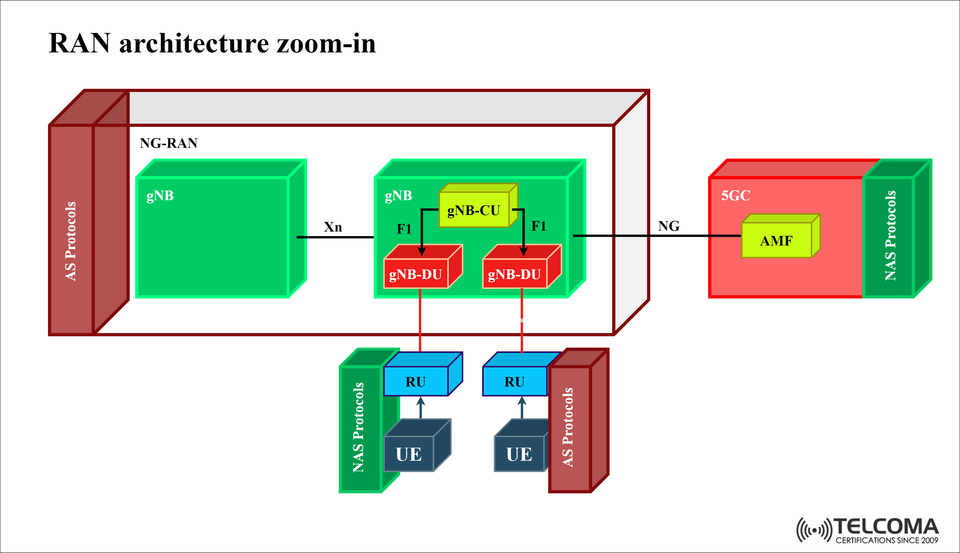
The image we've uploaded gives a detailed look at the RAN architecture, showing how the gNB-CU (Central Unit), gNB-DU (Distributed Unit), and RU (Radio Unit) work together with the 5G Core (5GC) and user devices (UE).
Let’s dive into this architecture, examining its components, how they connect, and their importance in real-world 5G implementations.
Key Parts of the 5G RAN Architecture
The 5G RAN, also known as NG-RAN, introduces a functional split to boost scalability, efficiency, and cloud-friendly deployments. Here’s what you need to know:
- gNB (Next-Generation NodeB)
This is the 5G counterpart to LTE’s eNB.
A gNB can be set up as a single unit or separated into a Central Unit (CU) and Distributed Unit (DU).
It provides radio access to User Equipment (UE).
- gNB-CU (Central Unit)
Manages the higher-layer protocols, which include:
Radio Resource Control (RRC)
Service Data Adaptation Protocol (SDAP)
Packet Data Convergence Protocol (PDCP)
Usually found in a centralized data center, which helps with resource efficiency.
Takes care of control plane signaling and overall mobility management.
- gNB-DU (Distributed Unit)
Handles real-time Layer 2 and lower Layer 3 functions like:
Radio Link Control (RLC)
Medium Access Control (MAC)
Physical Layer (PHY) scheduling
Positioned closer to the radio sites (cell towers) for reduced latency.
- RU (Radio Unit)
Situated at the cell site.
Responsible for analog-to-digital conversion, radio frequency (RF) processing, and managing antennas.
Collaborates closely with the DU for real-time communication.
- AMF (Access and Mobility Management Function – part of 5GC)
Manages NAS (Non-Access Stratum) protocols, including authentication, mobility, and connection management.
Acts as a bridge between the RAN and the 5G Core.
Interfaces in 5G RAN
The diagram showcases the key interfaces that allow communication between different components:
F1 Interface
Connects the gNB-CU and gNB-DU.
Offers flexibility for splitting CU and DU in centralized or distributed setups.
Xn Interface
Connects various gNBs for inter-gNB communication.
Supports mobility management and handovers between cells.
NG Interface
Links the gNB-CU with the 5G Core (5GC) through the AMF.
Transfers both control plane and user plane signaling.
NAS vs. AS Protocols
The image also distinguishes between:
NAS (Non-Access Stratum) Protocols
Function between UE and AMF (core network).
Manage authentication, mobility, and session management.
AS (Access Stratum) Protocols
Operate between UE and gNB.
Cover radio-specific tasks like scheduling, retransmissions, and error correction.
Why 5G RAN is Divided into CU, DU, and RU
Breaking down the gNB into CU, DU, and RU marks a significant advancement in 5G. Here’s why:
Scalability: Centralized CU resources can be utilized by multiple DUs.
Flexibility: Operators can keep CU in data centers and place DU and RU nearer to users.
Latency Optimization: DUs handle time-sensitive tasks to minimize latency.
Cloud-Native Deployment: CU functions can be virtualized (vCU), paving the way for cloud-based RAN (vRAN).
Cost Efficiency: Centralizing CU functions helps cut down hardware duplication.
Examples of Deployment Scenarios
Scenario 1: Dense Urban Areas
CU resides in a centralized data center.
DUs are placed near the cell sites.
RUs are at the towers.
This setup ensures high capacity and low latency for applications like AR/VR and 5G streaming.
Scenario 2: Rural Coverage
CU and DU integrated into a single gNB.
RU is co-located at the tower.
This lowers costs while keeping adequate coverage.
Scenario 3: Cloud-Native RAN (vRAN / Open RAN)
CU is fully virtualized and operates on standard commercial off-the-shelf (COTS) hardware.
DUs and RUs from various vendors work together using standardized interfaces.
This promotes vendor diversity and lessens CAPEX.
Benefits of 5G RAN Architecture
Improved Latency – With distributed functions, responses for time-sensitive applications are faster.
Higher Capacity – Resource pooling in CU makes utilization more efficient.
Seamless Mobility – The Xn interface facilitates smooth handovers between gNBs.
Energy Efficiency – Centralized management helps cut down on unnecessary hardware.
Support for Network Slicing – The separation of CU and DU allows for flexible slice management.
Comparing LTE RAN and 5G RAN
Feature LTE RAN (eNB)5G RAN (gNB)Architecture Monolithic (eNB)Split (CU, DU, RU)Core ConnectionEPC5GCFlexibilityLimitedHighly modular Latency Handling Centralized Distributed (DU near users)Cloud-Native No Yes (vRAN/Open RAN)
Challenges in 5G RAN Deployment
Despite its flexibility, there are hurdles:
Fronthaul Requirements: Need for high-bandwidth, low-latency connections between DU and RU.
Interoperability: Multi-vendor setups must stick to strict open standards.
Energy Costs: Operating several distributed units can increase power demands.
Complexity: More components mean greater management challenges.
Future Evolution of RAN
5G RAN is just the starting point. The future could bring:
Open RAN (O-RAN): Encourages vendor collaboration and cost reductions.
AI-Driven RAN: For smarter traffic management.
6G RAN Evolution: Potential further splits and enhancements for cloud-native setups.
Conclusion
The 5G RAN architecture signifies a major shift from LTE’s single-unit design to a flexible, scalable, and cloud-compatible framework. Splitting the gNB into CU, DU, and RU gives operators much more control over deployment strategies, latency management, and cost savings.
CU deals with control and higher layers.
DU focuses on real-time processing.
RU manages radio functions at the cell site.
Together, these components allow the NG-RAN to link smoothly with the 5G Core (5GC), ensuring the performance needed for next-gen applications.
For those in telecom, understanding how CU, DU, and RU interact is crucial for planning, deploying, and refining 5G networks. This architecture is essential for modern mobile connectivity, setting the stage for breakthroughs in IoT, Industry 4.0, AR/VR, and more.