
5G RAN Architecture Explained: gNB, CU, DU, RU, and Protocol Layers

The Radio Access Network (RAN) plays a vital role in mobile communication systems. With the shift to 5G networks, the RAN is set for significant changes to cater to vast connectivity, ultra-low latency, and flexible deployments.
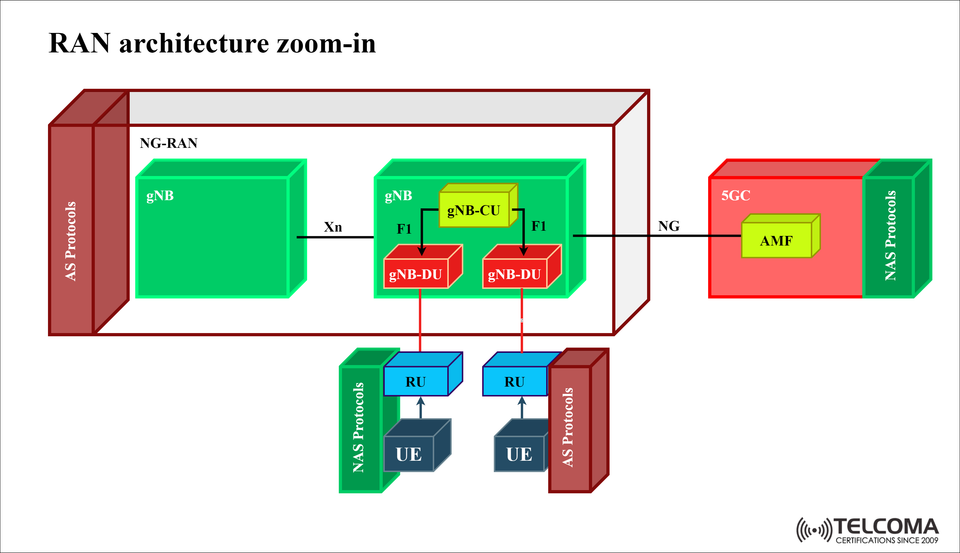
The accompanying image gives us a closer look at the architecture of the 5G RAN, showing how various logical and physical components—like gNB, CU, DU, RU, UE, and protocols—interact with each other and engage with the 5G Core (5GC).
This blog post will explore the essential components of the 5G RAN, their interfaces, and why this architectural setup is crucial for hitting 5G’s ambitious targets.
Overview of 5G RAN Architecture
Unlike LTE, where the eNodeB performed both control and user plane functions in a single setup, 5G brings in modularization and functional splits.
At its core, the 5G RAN comprises:
gNB (Next Generation NodeB): The primary base station in 5G.
gNB-CU (Centralized Unit): Manages higher-layer processing and control tasks.
gNB-DU (Distributed Unit): Deals with lower-layer processing and real-time operations.
RU (Radio Unit): Connects to the antennas and handles RF functions.
UE (User Equipment): Devices like smartphones, IoT gadgets, or connected vehicles.
5GC (5G Core): The network’s brain that oversees mobility, sessions, and user authentication.
The F1, NG, and Xn interfaces connect these components, allowing for a flexible and disaggregated deployment.
Key Components of the 5G RAN Architecture
- gNB (Next Generation NodeB)
Serves as the base station in 5G.
Can be structured as a single unit or split into CU and DU.
Links to other gNBs using the Xn interface.
Connects to the 5G Core (5GC) through the NG interface.
Function:
Provides wireless connectivity between UEs and the core network.
Supports various frequency bands, including sub-6 GHz and mmWave.
- gNB-CU (Centralized Unit)
Functionally located at the higher layers of the gNB.
Oversees RRC (Radio Resource Control), PDCP (Packet Data Convergence Protocol), and control-plane signaling.
Advantages of CU separation:
Centralized control enhances coordination among multiple DUs.
Simplifies the implementation of features like mobility management and dual connectivity.
Can be deployed in cloud environments for Centralized RAN (C-RAN).
- gNB-DU (Distributed Unit)
Manages the lower layers of the RAN stack, including RLC, MAC, and parts of PHY.
Positioned closer to the radio units (RU) to satisfy low-latency processing needs.
Key Roles:
Real-time scheduling of radio resources.
Executing HARQ (Hybrid Automatic Repeat Request).
Connecting with RU through standardized protocols.
- RU (Radio Unit)
Directly linked to the antenna.
Manages RF tasks, including digital front-end operations, filtering, and amplification.
Communicates with DUs using fronthaul links.
- UE (User Equipment)
Devices such as smartphones, IoT sensors, industrial robots, and self-driving cars.
Communicate with the RAN using air interface protocols.
Support both AS (Access Stratum) and NAS (Non-Access Stratum) protocols.
- 5GC (5G Core Network)
Encompasses network functions like AMF (Access and Mobility Management Function).
AMF deals with mobility management, registration, and authentication.
Connected to gNB-CU through the NG interface.
Interfaces in 5G RAN
- NG Interface
Links gNB to the 5G Core (5GC).
Facilitates signaling (control plane) and data transport (user plane).
- Xn Interface
Connects one gNB to another gNB.
Supports handovers, coordination, and balancing load.
- F1 Interface
Connects gNB-CU with gNB-DU.
Separates control-plane and user-plane tasks for added flexibility.
Protocol Layers in 5G RAN
The image also showcases protocol stacks that ensure effective communication among network nodes:
AS (Access Stratum) Protocols
Involved in communication between UE and gNB.
Manages radio resource allocation, scheduling, and reliability.
NAS (Non-Access Stratum) Protocols
Between UE and 5GC (like AMF).
Handles authentication, mobility, and session management.
This separation guarantees that radio-specific functions (AS) and core-related functions (NAS) are distinct, boosting overall flexibility.
Benefits of 5G RAN Functional Split
Flexibility in Deployment
Operators can set up CU in centralized data centers while placing DUs close to RUs for real-time processing.
Scalability
Resources can be dynamically adjusted based on traffic needs.
Low Latency
Keeping DU close to RU ensures that real-time functions can adhere to strict latency targets.
Efficient Coordination
Centralization of CU allows for advanced features like CoMP (Coordinated Multipoint).
Cloud-Native Evolution
CU and DU functions can be virtualized, paving the way for Open RAN (O-RAN) setups.
Real-World Deployment Scenarios
Urban Areas:
Densely packed setups with multiple gNBs linked via the Xn interface.
CUs centralized in data centers, while DUs are closer to users.
Rural Regions:
Fewer gNBs with combined CU+DU deployments to save costs.
Enterprise Networks:
Private 5G configurations often utilize split CU/DU for industrial IoT, ensuring low latency for robotics and automation.
Challenges in 5G RAN
Fronthaul Requirements:
High bandwidth and low latency fronthaul are essential between DU and RU.
Complexity of Virtualization:
Cloud-RAN demands sophisticated orchestration tools.
Interoperability:
Vendors must adhere to standards like O-RAN Alliance to guarantee compatibility.
Cost Considerations:
Setting up CU/DU splits can increase initial capital expenditure.
Comparison: LTE RAN vs. 5G RAN
Feature LTE RAN (eNB)5G RAN (gNB, CU/DU Split)Architecture Monolithic Modular & Flexible Core Connection EPC only EPC (NSA) / 5GC (SA)InterfacesS1, X2NG, Xn, F1Latency Support~10 ms<1 ms (URLLC scenarios)Cloud Readiness Limited Cloud-native, O-RAN ready
Future of RAN: Towards Open RAN and 6G
The modular approach of 5G RAN sets the stage for Open RAN (O-RAN), where CU, DU, and RU can come from different vendors, breaking away from vendor lock-in.
Open RAN: Fosters interoperability and innovation.
6G Evolution: Expands on 5G RAN splits with even more distributed intelligence, AI-driven resource management, and connections with non-terrestrial networks (satellites).
Conclusion
A closer look at the 5G RAN architecture illustrates the power of modularization—dividing the gNB into CU, DU, and RU, all tied together by well-defined interfaces and protocols. This design helps operators deliver low latency, enormous scalability, and cloud-native deployments.
For those in telecom, grasping the roles of CU, DU, and RU along with the NG, Xn, and F1 interfaces is crucial for crafting networks that can withstand the test of time. As we shift toward Open RAN and eventually 6G, the flexibility embedded in the 5G RAN layout will be foundational for the next wave of connectivity.