
5G RAN Connectivity Explained: gNB-CU, gNB-DU, and Key Interfaces

Understanding 5G RAN Connectivity: A Closer Look at CU-DU Split and Interfaces
The advent of 5G has brought about a major shift in how Radio Access Networks (RAN) are structured. Unlike the older LTE networks, where the eNodeB functioned as a singular unit, 5G RAN introduces various functional splits that distinguish control and user plane tasks. This change allows providers to create networks that are more scalable, flexible, and cost-efficient.
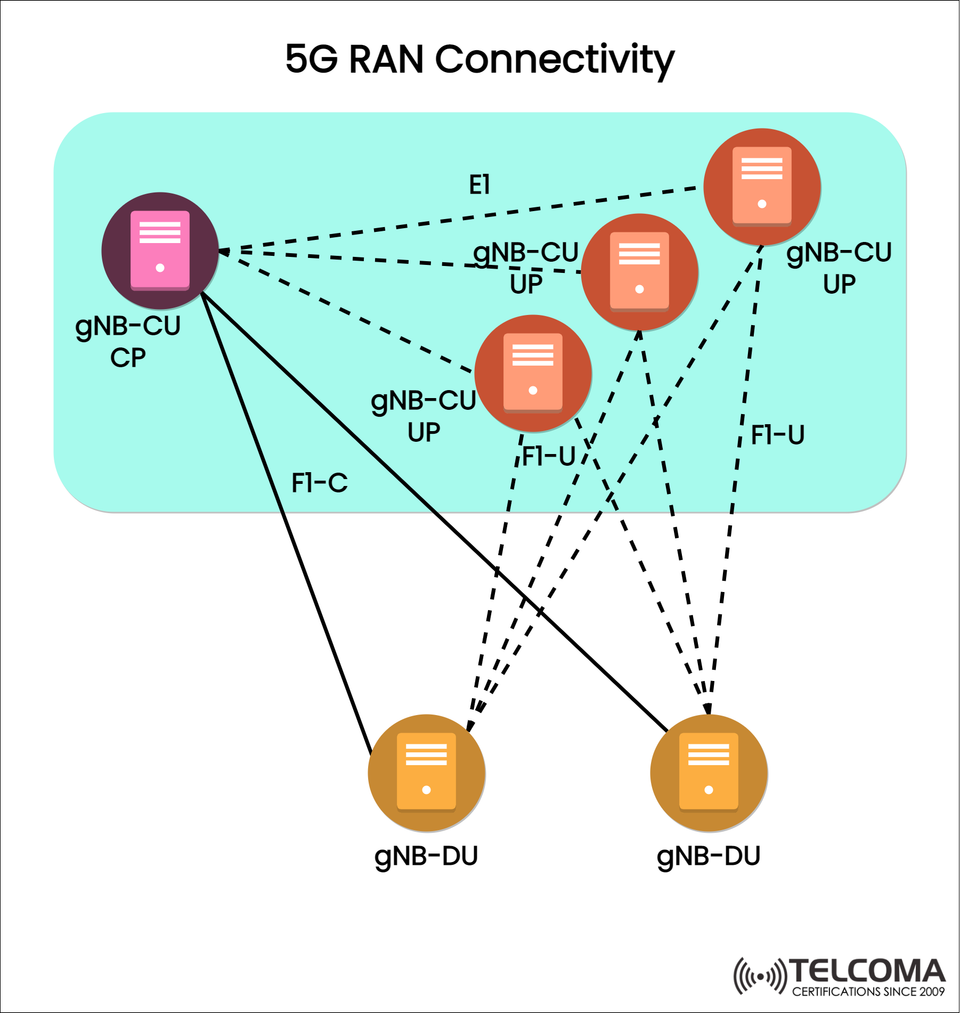
The accompanying diagram shows the essence of this concept: the gNB-Central Unit (gNB-CU) and the gNB-Distributed Unit (gNB-DU), along with their links via E1, F1-C, and F1-U interfaces. Let’s dive deeper into these components and how they interact.
What is 5G RAN?
The Radio Access Network (RAN) links user devices (UEs) to the core network through base stations, which in 5G are referred to as gNodeBs (gNBs).
In contrast to the monolithic design of LTE, the 5G gNodeB is divided into distinct logical components:
gNB-CU (Central Unit)
gNB-DU (Distributed Unit)
This division brings valuable features like cloud-native deployment, centralized management, and edge optimization into the mix.
gNB-CU: The Central Unit
The gNB-Central Unit (gNB-CU) acts as a logical node that contains the higher-level functions of the gNB. It is further categorized into two main parts:
gNB-CU-CP (Control Plane) – this part handles signaling, mobility management, and session controls.
gNB-CU-UP (User Plane) – this is responsible for user traffic, which includes activities like browsing the internet, streaming videos, and managing application data.
Key Functions of gNB-CU
Radio Resource Control (RRC): Oversees signaling between the UE and network.
PDCP Layer (Packet Data Convergence Protocol): Takes care of compression, encryption, and ensuring data integrity.
NG Interface Connections to Core: Directly links with the 5G Core (5GC).
Session & Mobility Management: Guarantees seamless handovers and maintains session continuity.
Typically, the CU is found in centralized cloud data centers, allowing operators to take advantage of virtualization and network slicing.
gNB-DU: The Distributed Unit
The gNB-Distributed Unit (gNB-DU) is situated nearer to the radio sites and is tasked with time-sensitive, lower-layer processing.
Key Functions of gNB-DU
RLC (Radio Link Control): Provides error correction and manages retransmissions.
MAC (Medium Access Control): Takes care of scheduling and multiplexing tasks.
PHY (Physical Layer): Handles encoding, modulation, and processing of radio signals.
Radio Control: Coordinates low-level radio resources.
The DU is generally located at the network edge (close to the antennas), which helps achieve low latency and quick responsiveness.
Interfaces in 5G RAN Connectivity
The diagram points out three main interfaces: E1, F1-C, and F1-U.
- E1 Interface
Links gNB-CU-CP (Control Plane) with gNB-CU-UP (User Plane).
Manages coordination of signaling and ensures proper separation between control and data functions.
Allows for scalability as one CU-CP can oversee multiple CU-UPs.
- F1-C Interface
Connects gNB-CU-CP to gNB-DU.
Handles control signaling between CU and DU.
Lets the CU manage mobility, sessions, and various signaling procedures.
- F1-U Interface
Links gNB-CU-UP to gNB-DU.
Transmits user data traffic (like internet activity, videos, app data) between DU and CU-UP.
Ensures that data transport is low-latency.
Why Split the gNB into CU and DU?
The CU-DU split stands out as one of the most significant advancements in 5G RAN architecture. Here’s why:
Flexible Deployment – Providers can place CU functions centrally in the cloud while positioning DUs nearer to the end users.
Scalability – Multiple DUs can connect to one CU, enhancing overall efficiency.
Cost Savings – Cuts down hardware costs by virtualizing CU functions.
Network Slicing Support – Facilitates varied services (like IoT, URLLC, eMBB) tailored to different industries.
Latency Improvement – Critical functions stay close to the edge, while centralized tasks benefit from cloud capabilities.
Example: Flow of 5G Connectivity
User Equipment (UE) kicks off a session (like a video call).
The DU manages physical and MAC-layer tasks.
F1-C interface manages signaling from DU to CU-CP.
F1-U interface carries user data from DU to CU-UP.
E1 interface ensures coordination between CU-CP and CU-UP.
The CU connects with the 5G Core (via NG interfaces), completing the end-to-end flow.
This modular setup guarantees performance, resilience, and flexibility.
Advantages of 5G RAN Connectivity
For Operators:
Centralized Operations: Easier management and automation.
Cloud-Native Deployment: CU functions can be virtualized to allow dynamic scaling.
OPEX Reduction: Fewer hardware updates, more software improvements.
Multi-Vendor Support: Open RAN initiatives let CU and DU come from different vendors.
For Users:
Lower Latency: Essential for applications like AR/VR, gaming, and autonomous vehicles.
Higher Throughput: Better mobile broadband (eMBB) service.
Seamless Mobility: Smooth transitions between DUs and CUs.
Consistent Quality of Experience (QoE): Optimized data flow across various devices and applications.
Comparison Table: gNB-CU vs gNB-DU
Component Functions Deployment Location Interfaces Best For gNB-CU-CP Control signaling, RRC, session management Central cloudE1, F1-CMobility & signaling control gNB-CU-UP User plane processing, PDCP Central cloud / edgeE1, F1-UUser data transport gNB-DURLC, MAC, PHY, radio control Edge / radio siteF1-C, F1-UReal-time, low-latency tasks
Challenges in 5G RAN Connectivity
While this split architecture is quite powerful, it does come with a few challenges:
Transport Network Needs: High-capacity, low-latency fronthaul is a must.
Synchronization Issues: CU and DU need to stay closely synchronized.
Multi-Vendor Compatibility: Open RAN offers flexibility but necessitates standardization.
Operational Complexity: More components mean more complexity in managing operations.
The Future of 5G RAN Connectivity
The CU-DU split is setting the stage for advanced architectures like:
Open RAN (O-RAN): Vendor-agnostic interoperability for more adaptability.
Cloud RAN (C-RAN): Centralized CU deployment in virtual settings.
Edge Computing Integration: Bringing computing resources closer to the DU to achieve ultra-low latency.
AI-Driven Optimization: Employing machine learning models with CU/DU data for proactive enhancements.
These developments will help 5G networks become more adaptable, smarter, and ready to support new use cases like smart cities, IoT, and self-driving technology.
Key Takeaways
The 5G RAN splits into gNB-CU (Control/User Plane) and gNB-DU for enhanced flexibility.
E1, F1-C, and F1-U interfaces facilitate connections between CU-CP, CU-UP, and DU.
The CU centralizes control and higher-level processing, while the DU focuses on latency-sensitive tasks.
This split enhances scalability, efficiency, and improves user experiences.
Future advancements like Open RAN, Cloud RAN, and AI-optimized networks will leverage this connectivity framework.
Conclusion
The 5G RAN connectivity model featuring the CU-DU functional split marks a pivotal change in mobile network architecture. By distinguishing between control and user plane functions, operators can better optimize their networks for performance, flexibility, and cost-effectiveness.
The interfaces like E1, F1-C, and F1-U ensure smooth collaboration between the various units, providing a solid foundation for 5G services. Whether it’s enhancing broadband, ultra-reliable low-latency communications, or massive IoT, this structure is designed to be scalable and adaptable.
As 5G progresses toward 6G, the CU-DU split and principles of open connectivity will continue to form the backbone of next-gen networks.