
5G RAN Deployment Options Explained: Standalone vs Non-Standalone Architectures
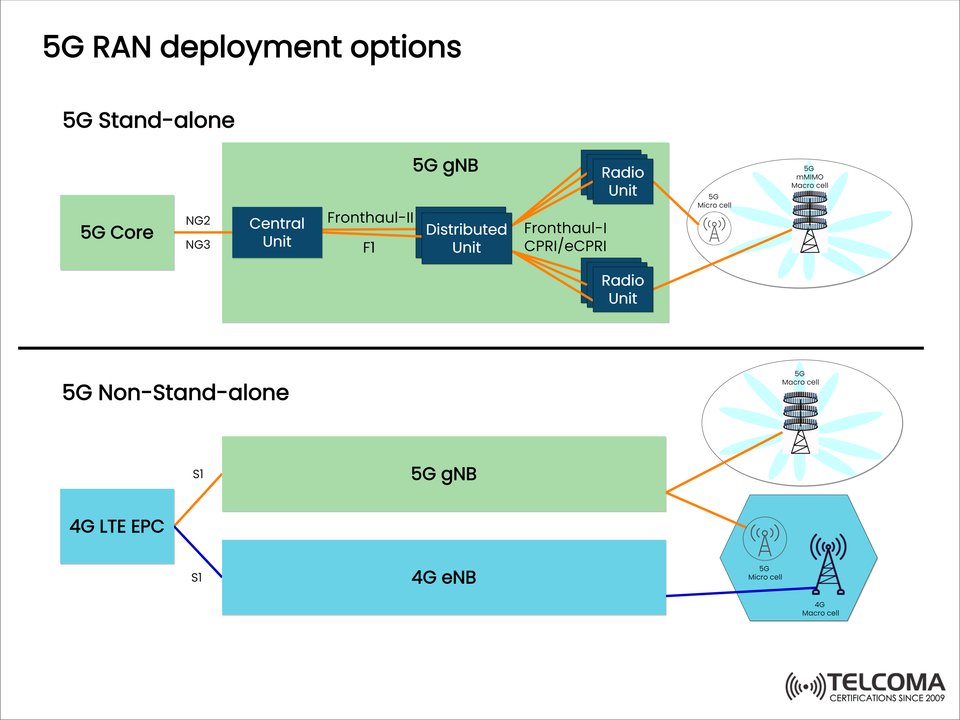

5G RAN Deployment Options: Standalone versus Non-Standalone Architectures
As telecommunications evolve and the world shifts to 5G networks, there are two major deployment options: Standalone (SA) and Non-Standalone (NSA) architectures. Both of these options define the way that 5G architecture integrates with existing infrastructure, and how it progresses.
In this blog post, I will also describe the core components, interfaces, and use cases of both deployment models using a visual representation, so telecom experts and those interested in technology as a passion can understand how 5G will be deployed around the globe.
What is 5G RAN?
5G Radio Access Network connects User Equipment (UE) such as smartphones and IoT devices to the core network known as the G - Core. 5G RAN is fundamentally different than previous generations in that RAN is more disaggregated and flexible than ever before. Components such as massive MIMO, beamforming, and ultra-low latency become possible.
The diagram provides an overview of deployment types.
5G Standalone (SA)
5G Non-Standalone (NSA)
5G Standalone (SA) Deployment
In a standalone network architecture, the whole end-to-end architecture (5G Core, 5GC, and 5G New Radio, or NR) is 5G ONLY.
🔷 Key Components:
5G Core (5GC): Contains control and user plane functions (NG2, NG3).
Central Unit (CU): Higher-level functions in RAN (PDCP, RRC).
Distributed Unit (DU): Low-layer functions in RAN (RLC, MAC).
Radio Unit (RU): Low-layer direct processing, radiating.
🧠 Highlights:
Direct connection from 5G NR to 5G Core
All 5G features exploited: slicing, low latency, ultra-reliable communications.
Applicable to greenfield 5G and, private enterprise deployments.
📶 RAN Architecture:
kotlin
Copy
Edit
UE → Radio Unit → Distributed Unit → Central Unit → 5GC
5G Non-Standalone (NSA) Deployment
NSA mode facilitates fast deployment by leveraging 4G infrastructure (EPC and eNB) and placing 5G NR in place for quick delivery of data throughput.
🔷 Key Components:
4G EPC - Core for LTE (valid for both LTE and 5G gNB sessions)
4G eNB - The master node that controls RRC and mobility functions
5G gNB - Secondary node that only merges in user plane data.
S1 Interface - From eNB to EPC, S1 is shared between the eNB and gNB.
🧠 Highlights:
Expedites rollout by using existing LTE infrastructure.
Can provide 5G data speeds with 4G control.
Ideal for early 5G network launches and evolving 4G coverage.
📶 RAN Architecture:
nginx
Copy
Edit
UE → 5G gNB + LTE eNB → 4G EPC
Key differences between SA and NSA
Feature 5G Standalone (SA) 5G Non-Standalone (NSA)
Core Network 5G Core (NG2/NG3) 4G EPC (S1)
Control Plane 5G native - 4G eNB
Deployment Complexity Higher Lower
Speed of Rollout Slower Faster
Use of LTE No Yes
Use Cases Smart
When do you use SA vs NSA?
✅ Use NSA when:
Speed to deploy is critical.
Utilizing their existing LTE infrastructure is critical.
The objective for the deployment is Enhanced Mobile Broadband (eMBB).
✅ Use SA when:
You want to take full advantage of 5G capabilities (URLLC, slicing).
You are developing a private 5G network from scratch.
You need a future-proof, scalable, low-latency infrastructure.
Conclusion
The journey to 5G adoption begins with understanding how 5G can be deployed. Standalone and Non-Standalone architectures provide different paths that depending on the types of deployment you want to enable, the maturity of your infrastructure, and the features you need.
NSA serves as a first step to 5G, providing the capability for large 5G speeds with backward compatibility to LTE, while SA provides the framework to unlock the native 5G network capabilities. There is no 'winner' here, rather, 5G networks will transition to SA over time while both SA and NSA deployment models are critical parts of the telecom infrastructure ecosystem.
Keywords: 5G RAN deployment, 5G Standalone, 5G Non-Standalone, 5G SA vs NSA, 5G Core, 4G EPC, 5G architecture, 5G CU DU RU, 5G fronthaul
Real-World Use Cases of SA and NSA Deployments
🏙️ Smart Cities with Standalone 5G
Use Case: SA 5G deployed in city locations for autonomous traffic systems, high-volume surveillance, and public services-related surveillance networks.
Why SA? it affords enough capacity with ultra-reliable low-latency communications (URLLC)
🏥 Healthcare Powered by Private 5G SA
Use Case: Hospitals use Standalone 5G to connect critical medical devices and provide real-time diagnostics.
Why SA? End-to-end 5G core can provide strict SLAs and private slices.
📱 Mobile broadband with NSA
My Use Case: Operators can deploy 5G services through NSA, without upgrading the core.
Why NSA? It is more economical and provides instant bandwidth enhancements to applicable devices.
🏗️ Industrial IoT (IIoT) with SA
Use Case: Factories can incorporate robotic automation and AR with private 5G SA networks.
Why SA? It enables deterministic performance and on-promises data handling.
Deployment Examples from Operators Around the World
Operator Region Deployment Type Notes
Verizon USA NSA → SA Migration Started with NSA, and now and migrating to SA
Rakuten Mobile Japan SA Built a greenfield 5G SA network on the cloud
Vodafone Europe NSA Used 4G EPC and added 5G gNBs
Reliance Jio India SA Deployed SA with indigenous 5G core
Deutsche Telekom Germany NSA → SA Dual mode with intent to go fully SA
Final Thoughts on How to Decide on the Right Deployment Model
5G cannot apply the same deployment models everywhere. Your network strategy, infrastructure maturity, and user expectations will guide you whether NSA or SA are the right decision, depending on your deployment situation.
Industry Insights: What's in Store
As 5G matures, we are starting to see the blurring of boundary lines in industry trends that are leading to support and deployment of 5G Standalone, allowing operators and industry sectors to take advantage of all the true benefits of what 5G can deliver: ultra-low latency communications, massive IoT capacity, and intelligent automation.
What to Watch For:
🌐 SA will be the backbone of Industry 4.0: Industry sectors such as manufacturing, energy, logistics, will seek and depend on SA deployments for their private 5G use cases.
☁️ Cloud-native 5G Core: Operators are prioritizing migration to cloud-native, containerized architectures for their core networks, which will ultimately enable SC scalability.
📡 Open RAN + SA: Many of the larger future deployments will include combinations of Open RAN architectures with SA deployments, which will provide compatibility, choice and flexibility, as well as intelligent orchestration.
📈 Slicing and Monetization: With SA, operators will be able to implement different tiers via network slicing, driving enterprise-centric business models.