
5G RAN Evolution: Key Technologies Transforming Wireless Networks

Introduction: The Road to 5G RAN Evolution
The telecom industry is experiencing a major shift with the introduction and ongoing development of 5G. At the center of this change is the Radio Access Network (RAN)—the crucial part that connects end-user devices like smartphones, IoT systems, and vehicles to the core network.
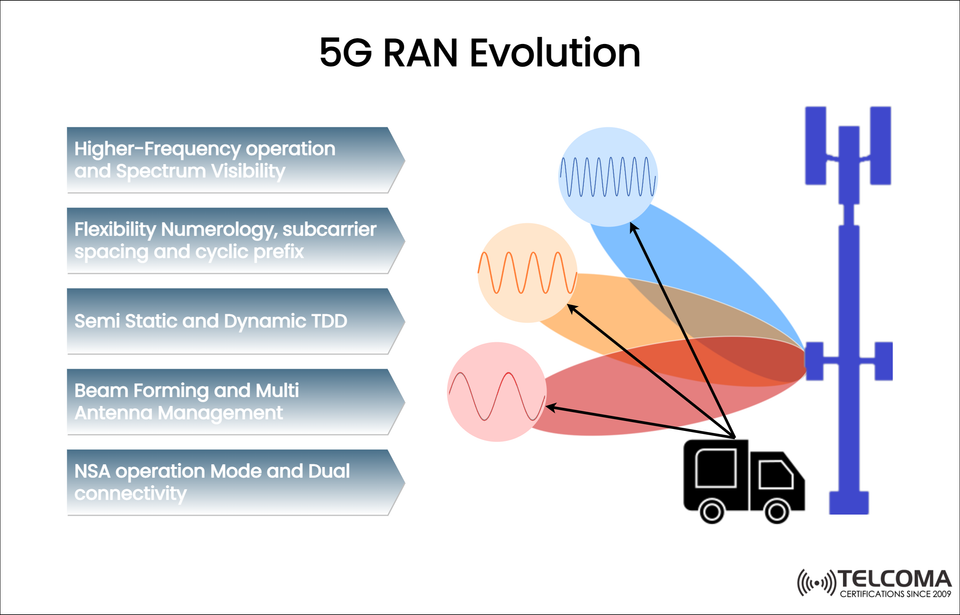
Unlike earlier generations, the 5G RAN evolution brings some groundbreaking enhancements aimed at achieving ultra-low latency, massive connectivity, and super-fast data speeds. The image uploaded illustrates five key aspects of the advancements in 5G RAN:
Higher-frequency operation and improved spectrum visibility
Flexible numerology and management of subcarriers
Semi-static and dynamic Time Division Duplexing (TDD)
Beamforming coupled with multi-antenna management
NSA (Non-Standalone) mode featuring dual connectivity
This article will delve into these features, unpacking how each one plays a role in creating a smarter, more resilient telecom infrastructure that's ready for the future.
Higher-Frequency Operation and Spectrum Visibility
One of the standout differences between 5G and its predecessors is the adoption of higher-frequency bands, including millimeter waves (mmWave).
Spectrum Expansion: While traditional 4G LTE primarily operated in sub-6 GHz bands, 5G opens up frequencies that reach up to 100 GHz. This expansion means larger bandwidths, resulting in faster data rates and reduced latency.
Spectrum Visibility: Enhanced visibility enables operators to dynamically identify, allocate, and optimize spectrum usage, ensuring efficient operation even in crowded network scenarios.
Use Cases: High-frequency operation is essential for urban deployments, augmented reality (AR), virtual reality (VR), and applications like autonomous driving where speed and reliability are critical.
Even though higher frequencies bring huge capacity, they also have a shorter range and can be affected by obstacles like buildings. That’s why complementary technologies such as beamforming and massive MIMO (Multiple Input Multiple Output) play a vital role.
Flexible Numerology, Subcarrier Spacing, and Cyclic Prefix
5G introduces flexible numerology, enabling operators to tweak the parameters of the Orthogonal Frequency-Division Multiplexing (OFDM) waveform based on specific use cases.
Subcarrier Spacing Options: Instead of sticking to the fixed 15 kHz spacing used in LTE, 5G offers scalable subcarrier spacing choices of 15, 30, 60, 120, and 240 kHz.
Cyclic Prefix Variability: The length of cyclic prefixes can also be adjusted to strike a balance between robustness against interference and spectral efficiency.
Adaptive Design: This flexibility supports a wide range of requirements—from ultra-reliable low-latency communications (URLLC) for industrial automation to enhanced mobile broadband (eMBB) for high-speed streaming.
Why is this important? Because flexible numerology means a single 5G network can effectively handle diverse use cases, truly making it a unified communications platform.
Semi-Static and Dynamic TDD (Time Division Duplexing)
Another essential innovation in 5G RAN evolution is the shift toward semi-static and dynamic TDD.
Semi-Static TDD: Here, fixed time slots are assigned for uplink and downlink communications. This method is predictable and works well in more stable environments.
Dynamic TDD: This allows for real-time adjustments of time slots based on traffic demands. So, if more users are downloading content, the network can temporarily allocate more downlink resources.
Benefits of Dynamic TDD:
Makes the best use of available spectrum
Adjusts to sudden changes in traffic
Cuts down on latency and boosts overall efficiency
Dynamic TDD is especially beneficial in busy urban areas and enterprise private networks, where the demands for uplink and downlink can change all the time.
Beamforming and Multi-Antenna Management
Technologies like beamforming and multi-antenna, particularly massive MIMO (multiple input, multiple output), are key to boosting 5G’s performance.
Beamforming Explained
Instead of spreading signals in all directions, beamforming directs the radio signals toward specific users or devices. Think of it as shining a flashlight beam instead of having a bulb light up a whole room.
Directional Accuracy: This boosts signal strength while cutting down on interference.
Capacity Boost: It’s possible to have multiple beams serving multiple users at the same time.
Range Extension: It helps tackle the challenges presented by high-frequency mmWave signals.
Multi-Antenna Management
Massive MIMO: This tech can use dozens or even hundreds of antennas at the base station.
Benefits: It leads to higher throughput, better spectrum efficiency, and more reliable connections.
Smart Antenna Coordination: Networks can manage multiple antennas to optimize coverage and performance, adapting to conditions as needed.
Together, these technologies enable strong connectivity, even in dense urban environments where interference and obstacles are common.
NSA Operation Mode and Dual Connectivity
When rolling out 5G, many strategies involve a Non-Standalone (NSA) mode, which lets 5G operate alongside existing 4G LTE infrastructure.
How NSA Works
The control plane (which manages signaling and mobility) is handled by the LTE network.
Meanwhile, the user plane (which deals with actual data transfer) takes advantage of 5G’s faster speeds.
Dual Connectivity
Dual connectivity lets devices maintain connections to both 4G and 5G networks simultaneously.
Pros:
Faster deployment of 5G services without waiting for complete standalone infrastructure.
Seamless transition for users, ensuring connectivity isn’t interrupted.
Enhanced reliability since devices can revert to LTE if 5G coverage is weak.
As networks evolve, operators will move toward a Standalone (SA) 5G model that features fully independent 5G infrastructure, delivering even lower latency and advanced network slicing capabilities.
Key Benefits of 5G RAN Evolution for Telecom Professionals
The combined impact of these innovations is reshaping how networks are built, managed, and experienced:
Ultra-fast Speeds: Higher frequencies and flexible numerology enable gigabit-level speeds.
Reduced Latency: Dynamic TDD and readiness for SA minimize communication delays.
Massive Capacity: Beamforming and MIMO allow for millions of devices to connect with ease.
Scalability: Flexible spectrum management and NSA deployments allow for gradual evolution.
Future-Proofing: Network slicing, IoT optimization, and AI-driven management will continue to enhance this foundation.
Table: 5G RAN Evolution Highlights
Feature Benefit to Networks Key Use Cases Higher-Frequency Operation Larger bandwidth, ultra-fast speeds AR/VR, autonomous driving Flexible Numerology & Subcarrier Spacing Adaptability to diverse requirements eMBB, URLLC, mMTC Semi-Static & Dynamic TDD Optimized spectrum use, lower latency Urban hotspots, enterprise Beamforming & Multi-Antenna Management Stronger signals, higher capacity Smart cities, dense areas NSA Mode & Dual Connectivity Smooth 5G rollout, reliable transitions Nationwide 5G adoption
Conclusion: The Future of 5G RAN Evolution
The evolution of 5G RAN goes beyond just faster mobile internet—it’s about laying a network groundwork that can support the upcoming wave of digital transformation. With higher frequencies, flexible numerology, dynamic TDD, beamforming, and NSA dual connectivity, telecom operators can provide exceptional performance, scalability, and reliability.
For tech enthusiasts and telecom professionals alike, grasping these advancements is crucial for gearing up for the 6G horizon, where the innovations of today will become the core of tomorrow’s hyper-connected world.