
5G Release 15: Standalone and Non-Standalone Deployment Options Explained

📡 5G Release 15 Deployment Options: NSA vs SA
3GPP Release 15 provides a number of deployment pathways to successfully evolve the transition from 4G LTE to 5G NR (New Radio). Below are the two ways to deploy NR:
Non-Standalone (NSA): LTE and NR are co-sited together, with LTE as the anchor.
Standalone (SA): NR with 5G Core (5GC) without any LTE dependency.
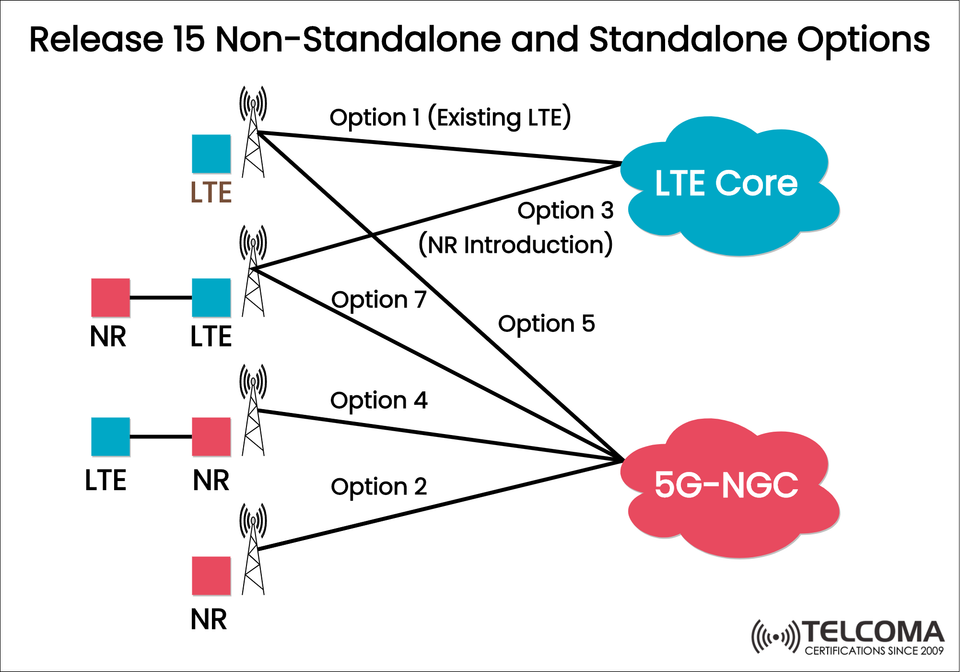
To better visualize the approach, below is an image that indicates how these deployment paths work with the LTE Core (EPC) and 5G Next Generation Core (5GC).
🧩 Deployment Option Overview
Option Radio Access Core Network About
Option 1 LTE LTE Core (EPC) Current LTE deployment.
Option 3 LTE + NR (NSA) LTE Core (EPC) First NR introduction with LTE anchor.
Option 7 NR + LTE (NSA) LTE Core (EPC) NR leads with LTE adjunct.
Option 4 NR + LTE (NSA) 5G Core (NGC) NR leads with LTE adjunct, proceeds to 5GC.
Option 5 LTE only 5G Core (NGC) Legacy 4G LTE upgrade to 5G Core platform.
Option 2 NR only (SA) 5G Core (NGC) Pure 5G NR to native 5GC.
🧱 Standalone (SA): Full 5G Configurations
➤ Choice 2: NR + 5GC
Most future proof architecture.
Enables network slicing, ultra-low latency, and URLLC.
There is not even an LTE dependency; just 5G.
➤ Choice 5: LTE with 5GC
It gives the legacy LTE the capability to connect to new 5GC.
Early migration will have limited 5G capabilities compared to SA.
🔁 Hybrid NSA with 5G Core
➤ Choice 4: NR as anchor with LTE - connected to 5GC.
NR capability enables early deployment and transition from LTE.
Useful in an environment where spectrum is at a premium.
🔧 Technical considerations when determining deployment option
Consideration Implications
Spectrum Availability NSA is easier to deploy where low/mid-band LTE is available.
Device Compatibility NSA allows for backwards compatibility with LTE devices.
Investment Strategy NSA allows an investment to be made in phases. Standalone requires an major investment all at one time.
Latency and Speed is the goal Standalone (Choice 2) can give real 5G features like URLLC and eMBB.
🎯 Strategic recommendations for deploying new networks
Initial Launch: The preferred choice is Choice 3. LTE useable.
Transition phase: operators can investigate Choice 4, and Choice 5.
Leading to the future capable networks: The goal for all operators is to have Choice 2 (SA) means the future.
🔀 Non-Standalone (NSA) Options: bridging the gap in LTE and NR
➤ Option 3: LTE + NR (NSA) with EPC
LTE is the master.
NR allows for increased data throughput.
Minimal disruption to current core infrastructure.
➤ Option 7: NR as Anchor with EPC
NR allows LTE as an adjunct.
The path is transitory, and typically are not deployed.
🧠 Deep Dive: Image Diagram
The image diagram makes it easy to summarize:
Radio Access Combinations (NR, LTE, or both) which go to either:
LTE Core (EPC) for legacy or NSA deployments
5G Next Generation Core (5GC) for advanced, standalone deployments
The arrows shown between the combinations and the cores are valid migration/deployment paths per 3GPP Release 15 describing that:
LTE can remain functional across the two cores.
NR can either be primary (using Option 2, 4) or supplementary (3, 7).
Operators have flexibility to evolve at their own pace.
🧮 Some Key Differences Between NSA and SA Options
Feature Non-Standalone (NSA) Standalone (SA)
Core Network EPC (4G) or 5GC (5G) 5GC only
Anchor Technology LTE (generally speaking) NR
Cost of Deployment Lower initial investment Higher (but more future proof)
Latency Moderate Ultra-low (<1ms possible)
Use Cases enabled eMBB eMBB, URLLC, mMTC
Readiness for Slicing Limited capability Full support for slicing
🛠 For developers and network architects
📌 Considerations in design
When considering 5G applications or services:
If you want access to early 5G capabilities with existing LTE infrastructure, use either Option 3 or 7.
If you are designing for Latency-sensitive or critical IoT applications (e.g., medical, automotive, etc.), you should consider Option 2 (SA).
If your applications require high data rates although you want nothing architectural to be different from LTE (you want only to rely on high hourly throughput), you can consider NSA Options.
📡 Network Evolution Strategy (Recommended Pathway - Built on Everyone's)
- Start with Option 1 (what they already have LTE).
- The first step to introducing the NR is through Option 3 (NSA with EPC).
- From Option 3. introduce the Option 5 or Option 4 (NR/LTE with 5GC) stage).
- From either Option 5 or Option 4 (NR/LTE with 5GC), transition to complete Option 2 (pure 5G NR + 5GC).
To recap, the stepwise migration option provides an avenue onto 5G while still evolving LTE capabilities to minimize disruption while enabling next-gen opportunities.
📘 Summary
The Release 15 NSA and SA options layout a deployment framework for 5G evolution with operators being able to choose deployment based on technical capability, cost, spectrum assets, and market readiness.
🔍 NSA provides a pathway to 5G by leveraging already existing LTE
infrastructure while SA takes full advantage of 5G capabilities including, URLLC, mMTC, and network slicing.
For telecom decision-makers (CXOs), engineering/architecture teams (IT, CIS, Telecom, Networks, Design), and developers, understanding the possibilities behind these options is critical to building scalable, efficient, 5G-ready networks of the future.
📌 Conclusion
Release 15 deployment architecture provides operators with options to design a way to offer 5G capabilities with little disruption, but still be able to design towards a complete Standalone future. Whether Non-Standalone (NSA) or Standalone (SA) architectures, transitioning from these should take into account the desired business outcomes, readiness of the organization and organization’s infrastructure, and demand from end users.