
5G Residential Gateway Explained: Bridging 5G and Fixed Networks for Seamless Home Connectivity
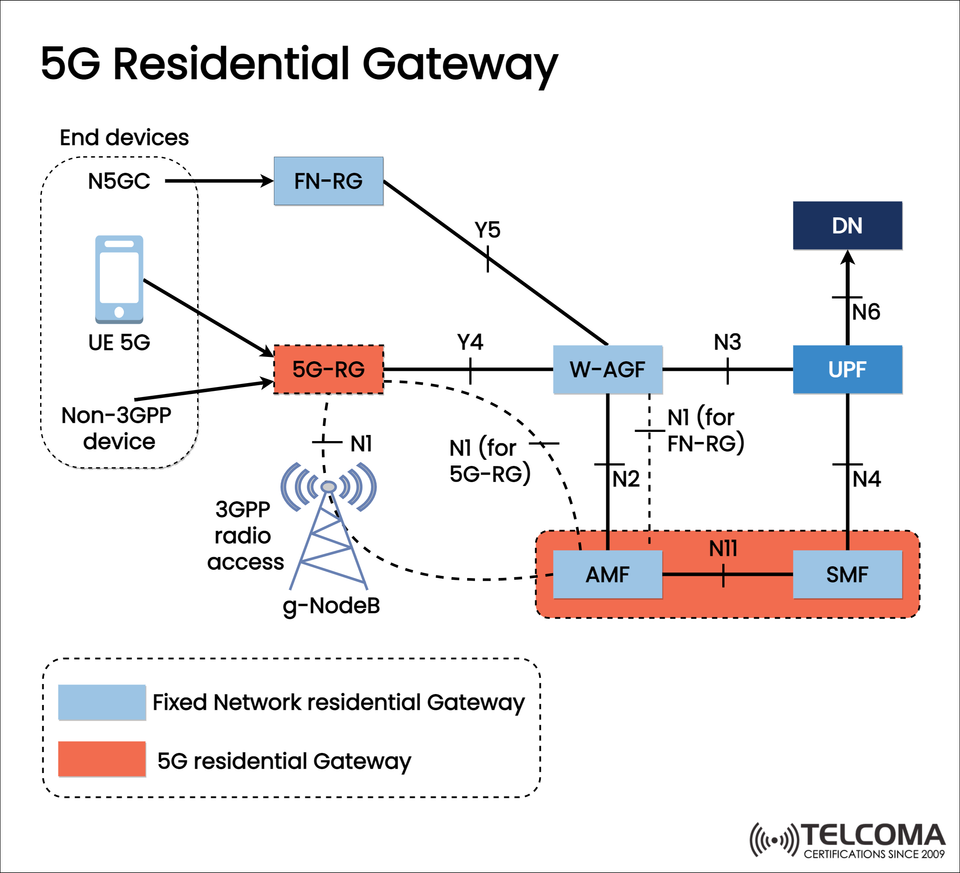

5G Residential Gateway: Bringing Together Fixed and 5G Networks for the Future of Home Connectivity
As more people seek super-reliable broadband and constant connectivity at home, operators are re-evaluating how residential networks connect with the 5G Core (5GC). Central to this change is the 5G Residential Gateway (5G-RG), which allows homes to connect easily through both fixed and wireless (5G) access.
The diagram above shows the architecture of the 5G Residential Gateway, illustrating how Fixed Network Residential Gateways (FN-RG) and 5G-RG devices work with the 5G Core, ensuring reliable service delivery across both 3GPP and non-3GPP access technologies.
Understanding the 5G Residential Gateway
What’s a 5G Residential Gateway (5G-RG)?
A 5G Residential Gateway serves as the communication hub for homes, linking local devices—like smart TVs, IoT gadgets, and Wi-Fi routers—to the 5G network. It accepts both wireless 5G radio access (3GPP) and fixed broadband access (non-3GPP) technologies.
This versatility allows for converged broadband experiences, so users can easily switch between fixed and mobile networks without any hiccups.
Key Components of the 5G Residential Gateway Architecture
The 5G Residential Gateway's structure, as depicted in the image, weaves together several network functions and interfaces based on 3GPP Release 16 and BBF TR-456 specifications.
5G-RG (5G Residential Gateway)
Functions as a user equipment (UE) for the 5G Core network.
Connects via 3GPP radio access (gNodeB) or through wireline access (using W-AGF).
Sets up the N1 interface with the Access and Mobility Management Function (AMF) for control signaling.
Handles 3GPP authentication, mobility management, and QoS settings.
Example use case: A 5G-enabled Customer Premises Equipment (CPE) that provides home internet through mobile 5G coverage when fiber isn't an option.
FN-RG (Fixed Network Residential Gateway)
Represents a classic fixed broadband gateway, linked via DSL, fiber, or cable.
Does not directly support 5G Core signaling. Instead, it connects through a Wireline Access Gateway Function (W-AGF) using the Y5 interface.
The W-AGF acts as a bridge between the fixed access network and the 5G Core (5GC), converting fixed-access protocols to 5G-friendly control and data messages.
Example use case: A fiber-based home router that connects with the 5G core for unified management and QoS policies.
W-AGF (Wireline Access Gateway Function)
The W-AGF is essential for converged access.
It ends fixed access sessions and interacts with the 5G Core (UPF, AMF, SMF) via standard 5G interfaces.
Supports:
N2 (Control Plane) connection to AMF
N3 (User Plane) connection to UPF
N1 interfaces for both FN-RG and 5G-RG signaling
This setup ensures that both 5G and fixed users can tap into the same 5G Core features like network slicing, policy control, and QoS management.
- 5G Core Network (5GC)
The 5G Core serves as the backbone that manages sessions, policies, and user traffic for both fixed and wireless networks. Its key functions include:
Function Full Form Role AMF Access and Mobility Management Function Handles connection setup, authentication, and mobility management for both 5G-RG and FN-RG.SMF Session Management Function Manages IP sessions, QoS, and policy control. UPF User Plane Function Routes user data between access networks and the Data Network (DN) (like the internet).
Interfaces:
N11: Between AMF and SMF for control signaling
N4: Between SMF and UPF for session management
N6: Between UPF and external data networks (internet or service platforms)
- Data Network (DN)
The DN is where data services end up—be it the public internet, operator-managed services, or enterprise VPNs—connected via the N6 interface from the UPF.
Key Interfaces in 5G Residential Gateway Architecture
InterfaceConnectsDescriptionN1UE/5G-RG ↔ AMF Signaling interface for control and authenticationN2W-AGF ↔ AMF Control plane connection for fixed accessN3W-AGF ↔ UPF User plane for data transportN4SMF ↔ UPF Session and policy controlN6UPF ↔ DN Interface to external data networksY45G-RG ↔ W-AGF Connection for hybrid fixed-wireless accessY5FN-RG ↔ W-AGF Fixed network access for non-3GPP devices
This detailed interface setup allows for both wireless and wired convergence—a cornerstone of the 5G Core architecture.
5G Residential Gateway Operation: Step-by-Step
Device Connectivity: End devices can connect to either 5G-RG (through 5G radio) or FN-RG (via fixed access).
Access Establishment:
The 5G-RG links directly to AMF using the N1 interface.
The FN-RG connects through W-AGF, which bridges communication to AMF/SMF through N2/N3 interfaces.
Authentication & Session Management:
The AMF authenticates devices.
The SMF sets up user sessions and QoS settings.
The UPF lays out the user plane route to the Data Network (DN).
Data Flow:
User data moves through W-AGF → UPF → DN for both fixed and mobile paths.
Seamless switching guarantees uninterrupted service as users transition between fixed and 5G access.
Benefits of the 5G Residential Gateway
- Unified Fixed-Mobile Access
Bringing together fixed and mobile access under the 5G Core eliminates barriers, letting operators manage all residential connections through a unified architecture.
- Streamlined Network Management
Centralized control via AMF/SMF simplifies policy management, authentication, and QoS enforcement across different access types.
- Improved QoS and Slicing
5G Core features like network slicing extend to residential networks, offering tailored service tiers (think gaming, remote work, or IoT).
- Cost and Operational Efficiency
By sharing core network resources across fixed and mobile services, operators can cut costs, speed up deployment, and lower maintenance expenses.
- Future-Ready for Smart Homes
Supports the growth of IoT by enabling various devices—both wired and wireless—to connect through a single gateway with uniform security and QoS policies.
Comparison: 5G-RG vs. FN-RG
Feature5G-RGFN-RGAccess Type5G Radio (3GPP)Fixed Broadband (non-3GPP)Core Connectivity Direct to 5G Core via N1Through W-AGF Mobility Support Full 5G Mobility Static (fixed)Authentication3GPP 5G-AKAManaged by W-AGF Use Case5G CPE, wireless home broad band Fiber/DSL/Cable residential gateways
Industry Standards and Specifications
The 5G Residential Gateway framework is based on:
3GPP TS 23.316 – 5G Fixed Mobile Convergence (FMC) architecture.
Broadband Forum TR-456 – Integration of fixed access into the 5G system architecture.
3GPP Release 16/17 – Outlines W-AGF and its role in enabling connecting non-3GPP access to the 5G Core.
These standards make sure that there's compatibility and open interfaces between different vendor gateways, access nodes, and core networks.
Conclusion: The Future of Residential Connectivity
The 5G Residential Gateway is shaping the next generation of broadband architecture, smoothly combining fixed and 5G wireless access. By linking both FN-RG and 5G-RG through the Wireline Access Gateway Function (W-AGF) into the 5G Core, operators can provide blended, high-performance broadband to all homes.
This structure offers:
Unified access management
Better QoS and network slicing
Easier infrastructure management
Scalable support for smart homes and IoT ecosystems
As 5G evolves toward 5G Advanced and 6G, the Residential Gateway will continue to be essential for achieving reliable, intelligent, and future-ready home connectivity—effectively merging mobile and fixed networks like never before.