
5G SDAP Downlink and Uplink Architecture Explained

In 5G NR (New Radio), one of the standout features is how the network manages Quality of Service (QoS). Unlike LTE, which linked QoS directly to EPS bearers, 5G brings in the Service Data Adaptation Protocol (SDAP) as a dedicated layer to handle QoS flows.
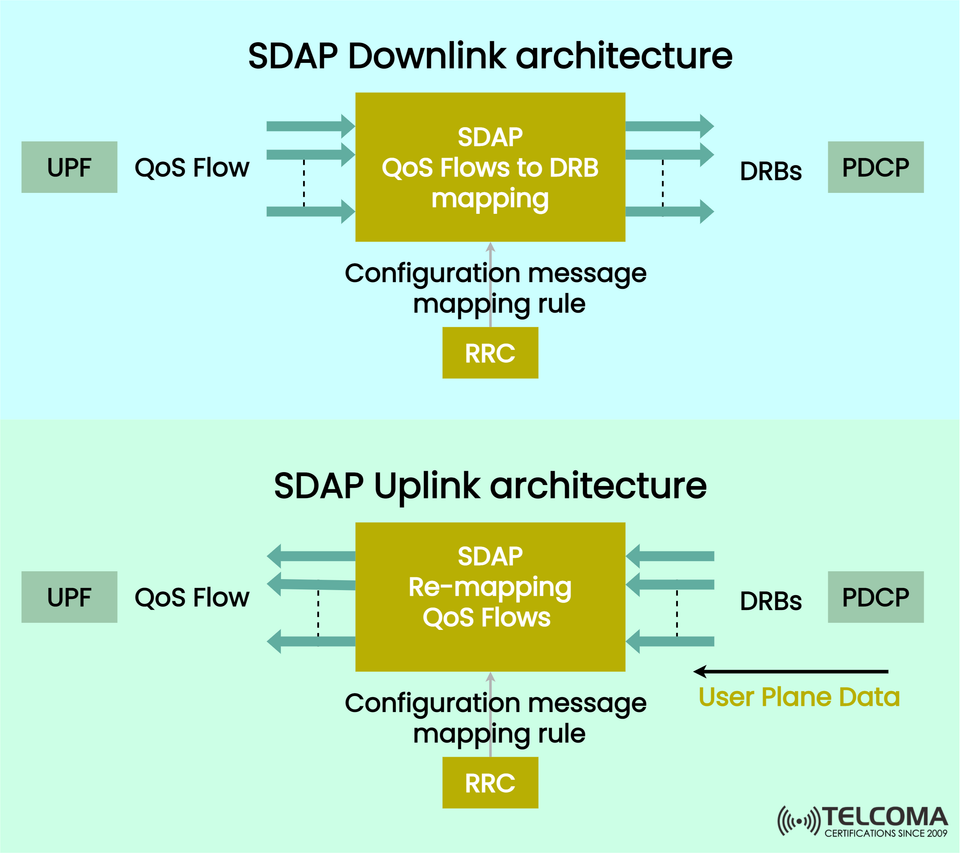
The diagram included shows how SDAP downlink and uplink architecture works, mapping or re-mapping QoS flows to Data Radio Bearers (DRBs) according to RRC (Radio Resource Control) rules. This setup makes sure that various applications—everything from video streaming to critical IoT tasks—receive the quality of service they need.
This blog will take a closer look at SDAP’s architecture, its functions, and why it’s important in the 5G world.
What is SDAP in 5G?
SDAP (Service Data Adaptation Protocol) is a Layer 2 sublayer that’s unique to 5G NR, designed specifically to manage QoS flows.
It operates only in the user plane, positioned above the PDCP (Packet Data Convergence Protocol).
Its main role is to map QoS flows from the 5G Core (UPF - User Plane Function) onto DRBs (Data Radio Bearers), ensuring that data is transmitted efficiently and with the right priority.
Key Point: SDAP is something new in 5G. In LTE, there wasn’t a separate SDAP; QoS was part of EPS bearers.
SDAP Downlink Architecture
The downlink involves traffic moving from the 5G Core (UPF) to the User Equipment (UE).
According to the diagram:
QoS Flows Enter from UPF: * Applications (like video, VoIP, IoT) create QoS flows that get sent from the UPF to the RAN.
SDAP Maps QoS to DRB: * Each QoS flow is assigned to the right DRB. * Configuration messages and mapping rules are set by RRC signaling.
DRBs Forward Data to PDCP: * Once mapped, DRBs deliver the QoS flows to PDCP for further processing (like security and compression).
Key Functions of SDAP in Downlink:
Mapping QoS Flows to DRBs: Makes sure the right bearer is chosen.
Priority Handling: Real-time data (like VoIP and gaming) gets priority over non-real-time stuff (like downloads).
Configuration Management: Works according to RRC instructions for mapping rules.
Example: Picture a user watching Netflix while on a Zoom call. Netflix requires high throughput and is less sensitive to delays, getting one DRB, while Zoom needs low latency and is prioritized with another DRB.
SDAP Uplink Architecture
The uplink is about traffic going from the UE to the 5G Core (UPF).
From the diagram, we see:
User Plane Data from PDCP: * Applications on the device create uplink packets that go through PDCP first.
SDAP Re-Maps QoS: * SDAP adjusts the uplink packets into the right QoS flows. * Again, mapping rules come from RRC signaling, just like in the downlink.
QoS Flows Go to UPF: * Packets get tagged with QoS identifiers before reaching the UPF.
Key Functions of SDAP in Uplink:
Re-Mapping QoS Flows: Makes sure data fits into the correct QoS categories.
Bearer Selection: Uplink DRBs handle traffic with the needed priority.
QoS Enforcement: Guarantees end-to-end QoS from UE to Core.
Example: Imagine a user who’s uploading a 4K video to YouTube while making a WhatsApp call. SDAP ensures the call is prioritized (for low latency), while the video upload happens in the background.
QoS Flows and DRBs: The Core of SDAP
QoS Flows
Each QoS flow is a stream of packets that follows a specific QoS profile.
Identified by the QFI (QoS Flow Identifier).
QoS parameters cover priority, packet delay budget, and packet loss rate.
DRBs (Data Radio Bearers)
These are logical channels between the UE and gNB for user plane data.
A DRB can handle one or more QoS flows, based on its configuration.
Managed by RRC signaling.
📌 Relationship:
Downlink: QoS flows from UPF → SDAP → DRBs → PDCP.
Uplink: PDCP → DRBs → SDAP re-mapping → QoS flows → UPF.
RRC Role in SDAP
The diagram shows how RRC (Radio Resource Control) is involved:
Configuration Messages: Establishes mapping rules between QoS flows and DRBs.
Bearer Setup: Decides which DRBs apply to each QoS flow.
Dynamic Updates: Adjusts mapping rules during mobility events, handovers, or network changes.
Example: During a handover, RRC reconfigures DRBs to keep ongoing calls or streams meeting their QoS needs without interruptions.
Table: SDAP Downlink vs. Uplink Functions
Aspect Downlink (Core → UE)Uplink (UE → Core)Input QoS flows from UPF User plane data from PDCP Main Action QoS-to-DRB mapping QoS flow re-mapping Control RRC provides mapping rules RRC provides mapping rules Output DRBs toward PDCP QoS flows toward UPF Goal Deliver traffic with correct QoS Enforce uplink QoS consistency
Why SDAP Matters in 5G
SDAP’s introduction in 5G tackles the issues posed by varied use cases needing different service qualities.
Key Benefits of SDAP:
Fine-Grained QoS Management: Can handle multiple QoS flows for each PDU session.
Flexibility: Can map several services to one DRB or multiple DRBs.
Scalability: Supports a range of services like eMBB, URLLC, and mMTC all at once.
QoS Differentiation: Prioritizes essential flows (like emergency services) over background applications.
Seamless Mobility: Keeps QoS consistent during handovers and roaming.
📌 Real-Life Example:
An application for remote surgery (URLLC) demands ultra-low latency.
At the same time, streaming video on a smartphone (eMBB) requires high throughput.
SDAP makes sure both get their respective QoS without clashing.
SDAP in Multi-Connectivity Scenarios
5G networks frequently use Dual Connectivity (EN-DC) or Carrier Aggregation. SDAP is key here because it:
Keeps QoS consistency across various carriers.
Makes sure that traffic split between LTE and 5G NR (like in EN-DC) adheres to QoS flow priorities.
Re-maps QoS flows during handover between LTE and 5G anchors.
Challenges and Considerations
While SDAP enhances flexibility, it does add some complexities:
QoS Flow-DRB Overhead: More mapping rules can mean increased signaling overhead.
Resource Allocation: Needs effective scheduling at MAC to go along with SDAP mapping.
Interoperability: Different vendors need to ensure SDAP behaves consistently.
Conclusion
The SDAP downlink and uplink architecture in 5G is crucial for how the network provides reliable and varied services. By mapping and remapping QoS flows to DRBs, SDAP guarantees that each application—whether it involves low latency, high throughput, or IoT—receives the appropriate level of service.
Downlink: QoS flows from UPF are mapped to DRBs for the UE.
Uplink: User plane data from PDCP is re-mapped into QoS flows for delivery to the UPF.
RRC rules: These define and update the mappings on the fly.
Basically, SDAP allows for true 5G flexibility, powering everything from Netflix streaming to critical remote surgeries. For telecom professionals, understanding SDAP concepts is key to optimizing network performance and ensuring QoS throughout the 5G ecosystem.