
5G SMF — Understanding Session Management Function Interactions in the 5G Core Network
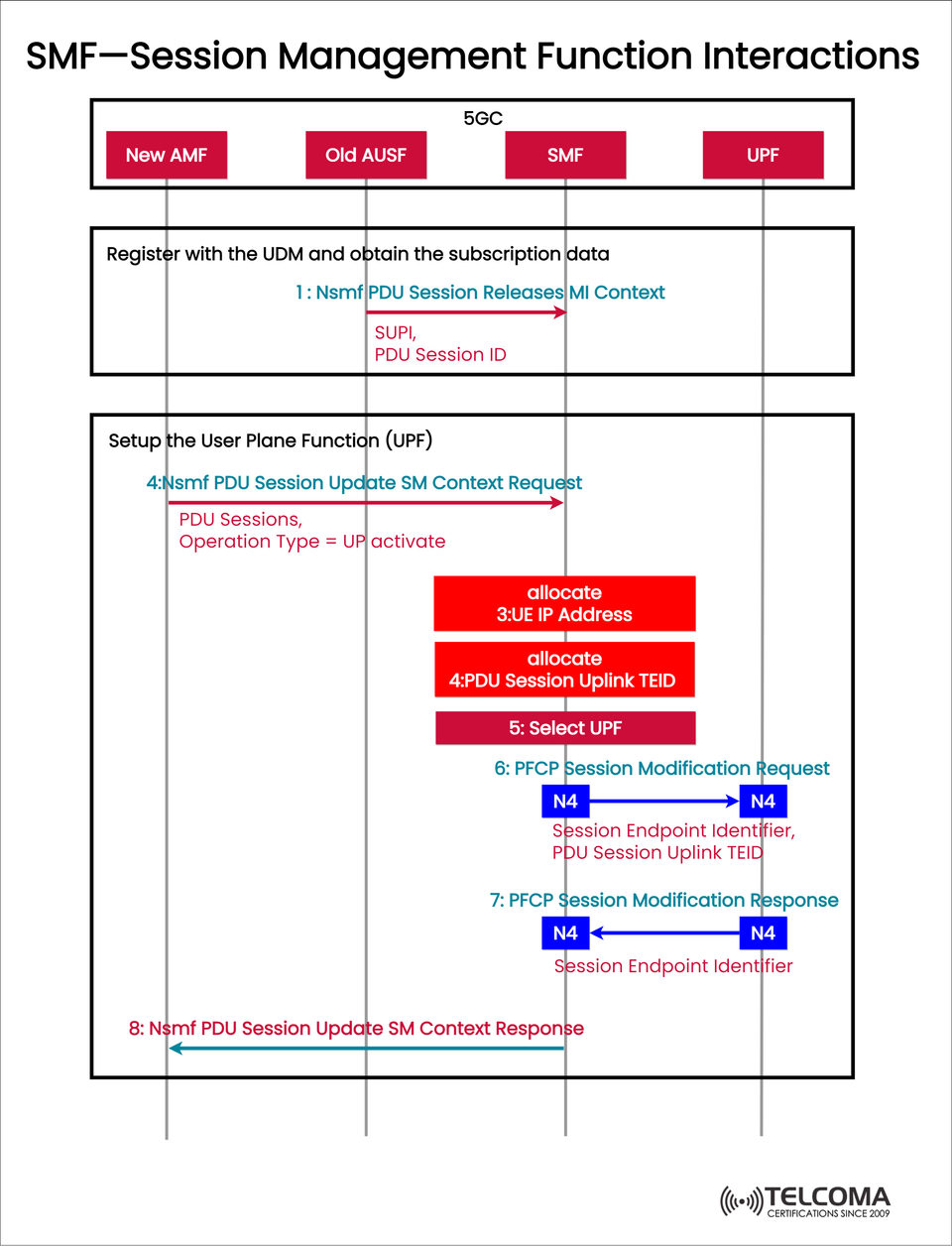

SMF — Interactions of Session Management Function in 5G Core
The Session Management Function (SMF) is a key component of the 5G Core (5GC) network. It's mainly responsible for overseeing PDU (Protocol Data Unit) sessions, managing IP address allocation, and establishing connections through the User Plane Function (UPF).
The illustration above outlines the step-by-step interactions between SMF, AMF, AUSF, and UPF as they work together to create, update, and maintain session contexts for a user's data connection.
In this detailed guide, we’ll go over how these parts interact, what each message signifies, and how this whole process guarantees reliable 5G data sessions.
The SMF serves as the control plane brain for user sessions. It communicates with:
AMF through the N11 interface to receive commands regarding session management.
UPF via the N4 interface to handle connectivity in the user plane.
PCF for making policy control decisions.
UDM to access subscriber data.
Step-by-Step Breakdown of SMF Interactions
The image showcases two main phases:
Registration and Subscription Data Retrieval
User Plane Function Setup
Step 1: Nsmf PDU Session Releases MI Context
Sender: SMF
Receiver: AMF
Purpose: Release old session context information and get ready for new session setup.
The Nsmf PDU Session Release MI Context message carries identifiers such as:
SUPI (Subscription Permanent Identifier) – uniquely pinpoints the subscriber.
PDU Session ID – identifies the specific data session instance.
This message ensures that any previous PDU session context (from another AMF or older session) is cleared out to prevent duplication or stale data before starting a new session.
Phase 2: Set Up the User Plane Function (UPF)
Once the old context is cleared, the SMF moves on to configure the User Plane Function (UPF) — which is in charge of routing user traffic between the 5G network and the internet or other external networks.
Step 4: Nsmf PDU Session Update SM Context Request
Sender: SMF
Receiver: UPF
Purpose: Create or update the session context for the user plane.
The Operation Type is usually set to UP Activate, signaling that it needs to establish the user plane. This request carries:
Details about the PDU session
QoS and policy parameters
Instructions for setting up data forwarding
During this part, the UPF prepares to allocate essential parameters.
Step 3: Allocate UE IP Address
A vital task during session setup is allocating a unique IP address for the UE (User Equipment).
This IP address identifies the UE within the data network.
It can either be IPv4, IPv6, or dual-stack, depending on network setup.
The SMF manages the IP address assignment, making sure each UE gets the right address pool allocation based on its subscription and network slice.
Step 4: Allocate PDU Session Uplink TEID
The Tunnel Endpoint Identifier (TEID) is used in the GTP-U (GPRS Tunneling Protocol – User Plane) to route packets correctly through the user plane.
Uplink TEID identifies the tunnel for uplink data traffic (UE → Network).
SMF directs UPF to allocate this TEID for proper traffic forwarding.
These allocations are crucial to ensure that data packets are correctly steered to the user’s session.
Step 5: Select UPF
The SMF decides which UPF instance will manage this user’s data based on:
UE’s location
Network slice
Service type
Operator policy
Picking the right UPF enhances latency, bandwidth, and routing efficiency — especially important for 5G applications like edge computing or IoT traffic management.
PFCP (Packet Forwarding Control Protocol) Interactions
Once the UPF is chosen and session details lined up, the SMF and UPF talk through the N4 interface using PFCP messages.
Step 6: PFCP Session Modification Request
Sender: SMF
Receiver: UPF
Purpose: Configure the user plane session.
This message includes:
Session Endpoint Identifier – identifies the PFCP session.
PDU Session Uplink TEID – helps UPF map user traffic tunnels.
This setup guarantees that user data flows through the right UPF path.
Step 7: PFCP Session Modification Response
Sender: UPF
Receiver: SMF
Purpose: Confirm successful modification of the PFCP session.
The response includes:
Session Endpoint Identifier indicating the session setup.
A success code showing that user plane resources are primed to go.
After this, the UPF is fully equipped to handle the UE’s data packets.
Step 8: Nsmf PDU Session Update SM Context Response
Sender: SMF
Receiver: AMF
Purpose: Notify AMF that the user plane setup is complete.
The SM Context Update Response marks the successful end of the session setup procedure. Now, the AMF can inform the UE that its PDU session is active, and it can start sending data.
Key Takeaways from SMF Interactions
Dynamic Session Control: SMF manages the session lifecycle dynamically, from creation through release.
Efficient Resource Allocation: By overseeing IP allocation, UPF selection, and TEID management, the SMF ensures optimal resource use.
Scalable and Policy-Aware: SMF’s connection with PCF lets it apply network policies and QoS rules on the fly.
Seamless User Experience: Users can maintain connectivity even during handovers, thanks to smooth SMF-AMF coordination.
Simplified Summary Table
StepInterfaceMessageFunction1NsmfPDU Session Release MI Context Clear old session info4NsmfPDU Session Update Request Set up user plane3—Allocate UE IP Address Assign IP to UE4—Allocate Uplink TEID Assign TEID for tunneling5—Select UPF Choose data routing node6N4PFCP Session Modification Request Configure UPF7N4PFCP Session Modification Response Confirm setup8NsmfPDU Session Update Response Finalize session setup
Real-World Importance of SMF in 5G Networks
The SMF paves the way for service agility in 5G networks. It enables:
Network slicing: Different SMFs can handle specific slices (like IoT, URLLC, eMBB).
Policy enforcement: Works with PCF to apply QoS and data control.
Roaming management: Takes care of session continuity across network borders.
It’s a fundamental player in data path automation and subscriber-centric service delivery in 5G.
Conclusion
The Session Management Function (SMF) is like the command center for handling user data sessions in the 5G Core. Through precise interactions with AMF, AUSF, and UPF, it guarantees smooth session control, efficient resource use, and policy-driven connectivity.
From IP allocation to PFCP configuration, every step in this interaction helps ensure that 5G delivers the high-speed, low-latency, and intelligent connectivity that modern networks need.
As 5G develops, the SMF’s role in automation, network slicing, and edge computing is only going to grow — shaping the foundation for next-generation digital communication.