
5G Standalone Access Registration: Complete Flow Explained for Telecom Engineers

5G Standalone Access Registration — Complete Flow Explained
With the ongoing roll-out of 5G Standalone (SA) networks worldwide, grasping their inner signaling and registration processes is essential for telecom engineers. One key operation within the 5G Core (5GC) architecture is Access Registration — the first step that allows a user device (UE) to connect to the 5G network without relying on LTE or EPC components.
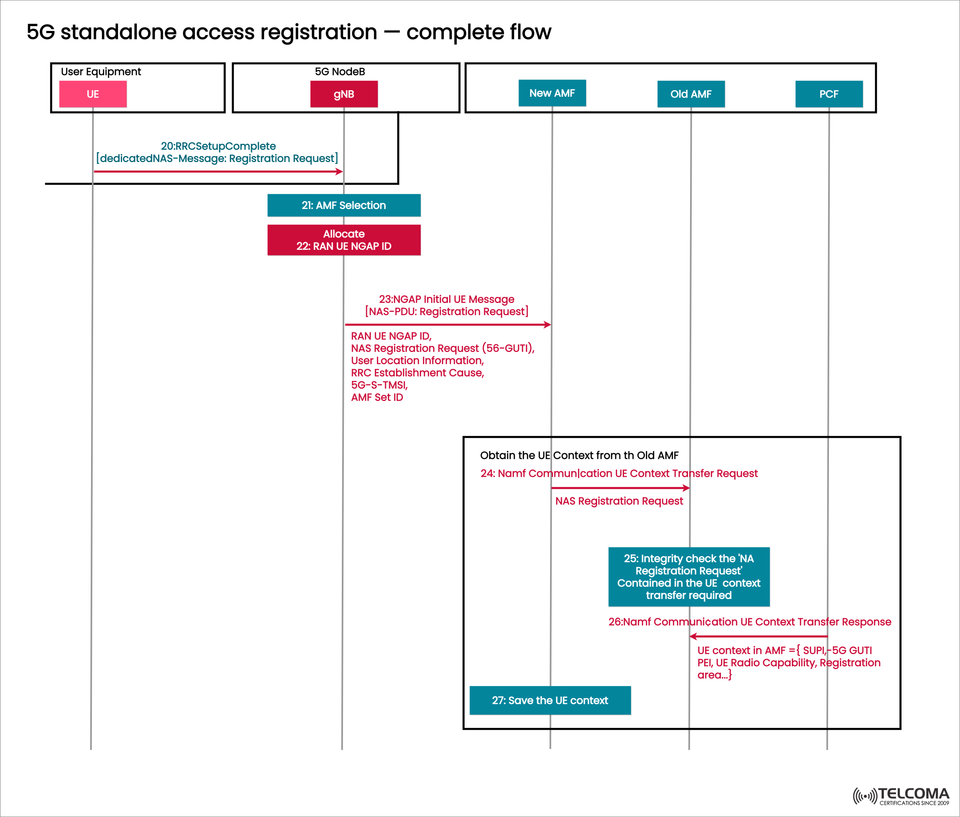
This guide takes you through the complete 5G Standalone Access Registration flow, using the signaling diagram provided to clarify each step involving the User Equipment (UE), gNodeB (gNB), Access and Mobility Management Function (AMF), and Policy Control Function (PCF).
Understanding 5G Standalone (SA) Registration
5G SA mode operates solely on 5G NR (New Radio) and 5G Core (5GC), as opposed to Non-Standalone (NSA), which needs LTE EPC for control signaling. The Access Registration procedure makes sure that the UE is authenticated, authorized, and connected to the right AMF, all to enable 5G services and data sessions.
Key Network Elements in the Flow
Network Element Function UE (User Equipment)The mobile device initiating the registration. gNB (5G Node B)The base station handling radio access and sending messages to the AMF.AMF (Access and Mobility Management Function)Manages registration, mobility management, and UE context. PCF (Policy Control Function)Oversees policy rules regarding QoS, session management, and access.
Step-by-Step: 5G Standalone Access Registration Flow
Step 20: RRC Setup Complete — UE Sends NAS Registration Request
The registration process kicks off when the UE wraps up the RRC (Radio Resource Control) setup with the gNB. Once the RRC Setup Complete message is done, it carries the dedicated NAS message that includes the Registration Request.
Purpose:
The UE notifies the network of its intention to register on 5G.
Essential NAS info is included to identify itself to the 5GC.
Included Information:
NAS Registration Request (like 5G-GUTI or SUCI)
UE security parameters
Optional location and mobility details
This sets the stage for further signaling between the UE and AMF.
Step 21–22: AMF Selection and RAN UE NGAP ID Allocation
Once the gNB gets the RRC Setup Complete message, it moves on to AMF selection following the configuration and network policies.
Step 21: AMF Selection The gNB picks the right AMF based on network layout, UE identity, or load balancing factors.
Step 22: RAN UE NGAP ID Allocation The gNB provides a RAN UE NGAP ID (a unique identifier for the UE within the gNB) to keep the context intact during communication with the selected AMF.
This ensures a smooth connection between RAN and Core Network identifiers.
Step 23: NGAP Initial UE Message (NAS-PDU: Registration Request)
The gNB sends the NGAP Initial UE Message to the AMF, which includes the NAS-PDU (Registration Request) from the UE. This message also contains critical info like:
RAN UE NGAP ID
NAS Registration Request (with 5G-GUTI)
UE Location Information
RRC Establishment Cause
5G-S-TMSI
AMF Set ID
Function: This message essentially passes the UE’s registration request along with associated identifiers to the 5G Core network for authentication and context setup.
Step 24: Namf Communication UE Context Transfer Request
If the UE was registered with a different AMF (the Old AMF), the New AMF starts a Namf Communication UE Context Transfer Request to retrieve the UE context.
This step involves pulling previous UE-specific data such as:
NAS Registration Request
UE Radio Capabilities
SUPI (Subscription Permanent Identifier)
5G-GUTI
Registration Area
Purpose: This helps avoid redundant authentication and boosts handover efficiency by reusing valid context info.
Step 25: Integrity Check on ‘NA Registration Request’
The New AMF conducts an integrity check on the ‘NA Registration Request’ received from the old AMF. This confirms that the UE registration request is authentic and aligns with the UE’s known identity and subscription parameters.
Key Tasks:
Validate NAS message integrity.
Confirm UE identity and registration type.
Ensure the context transfer was completed successfully.
If everything checks out, the AMF moves forward to accept and create the new UE context.
Step 26: Namf Communication UE Context Transfer Response
After the validation is a success, the Old AMF sends a UE Context Transfer Response back to the New AMF. This message carries all the relevant UE context data, ensuring continuity and lowering registration delays.
Included Information:
UE Context (SUPI, 5G-GUTI, PEI, UE Radio Capabilities, Registration Area)
Security parameters
Subscription profile
Now, the New AMF has all the UE context info it needs to finalize the registration.
Step 27: Save the UE Context
In the last step, the New AMF saves the UE context into its local database. At this point:
The UE is deemed successfully registered with the new AMF.
The AMF is ready for authentication, authorization, and policy control.
The PCF can later be called for policy association and QoS management.
Summary Table — Key Message Exchanges
StepMessageDescriptionDirection20RRCSetupCompleteUE sends NAS Registration Request UE → gNB21AMF Selection g NB selects appropriate AMF g NB internal22RAN UE NGAP ID g NB allocates unique ID for UEgNB23NGAP Initial UE Message NAS-PDU (Registration Request) sent to AMF g NB → AMF24Namf UE Context Transfer Re q Obtain UE context from old AMF New AMF → Old AMF25Integrity Check Validate UE registration integrity AMF internal26Namf UE Context Transfer Res p Old AMF sends UE context Old AMF → New AMF27Save UE Context New AMF stores UE data AMF internal
Why the Registration Flow Matters
This registration process is more than just signaling — it’s fundamental for user onboarding in a 5G network. It lays out how:
Mobility is managed when transitioning between AMFs,
UE authentication is carried out securely,
Policy and QoS are applied uniformly across the network.
Grasping this flow enables engineers to troubleshoot registration issues, refine AMF selection algorithms, and ensure quicker user attachment to the 5G Core.
Key Takeaways
5G Standalone (SA) registration allows direct access to the 5G Core without relying on LTE.
The AMF is pivotal in UE registration, mobility management, and context transfer.
NGAP and NAS messages are vital for UE identification, authentication, and session setup.
Context transfer between old and new AMFs enhances efficiency and minimizes service interruptions.
The final step ensures a persistent UE context, ready for authentication and session establishment.
Conclusion
The 5G Standalone Access Registration flow is a key part of 5G Core operations, ensuring secure and efficient onboarding of devices. Every message — from the RRC Setup Complete to the UE Context Save — is crafted to boost signaling efficiency, manage mobility, and ensure service continuity.
For telecom engineers, mastering this flow not only helps in troubleshooting and optimization but also provides a more profound understanding of how the 5G Core intelligently handles user mobility and session context.
As networks transition to fully virtualized and cloud-native 5G architectures, grasping these signaling interactions is becoming ever more crucial for maintaining strong, scalable, and high-performing 5G systems.