
5G Standalone Registration Request Procedure Explained: From RRC Setup Complete to NAS Registration

5G Standalone Access: How to Register
Once the 5G User Equipment (UE) finishes the RRC Connection Setup, it shifts into an active state, allowing it to send and receive control and NAS messages with the core network. The next important step in the 5G Standalone (SA) registration process is dispatching the NAS Registration Request. This step registers the UE with the 5G Core (5GC), helping establish its identity, location, and capabilities.
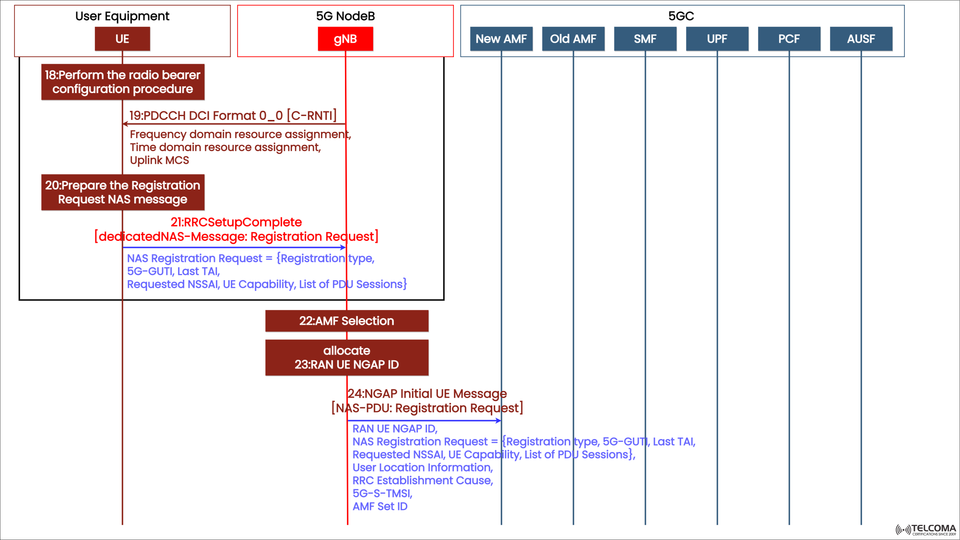
This article breaks down the Registration Request Procedure into easy-to-follow steps, based on the accompanying image, and shows how the UE interacts with the gNB and 5GC in this process.
Overview: What the Registration Request Does in 5G SA
The NAS Registration Request is key to the initial access and mobility management. It's the first Non-Access Stratum (NAS) message that carries important info about the UE to the Access and Mobility Management Function (AMF) within the 5G Core.
Purpose:
To register the UE in the 5GC network.
To share UE identification, capabilities, and session requests.
To kick off AMF selection and authentication procedures.
This marks the official start of the 5G registration process, allowing the UE to connect with the core network for service.
Recap: Steps Before Registration
Before getting here, several essential steps were completed:
Random Access Procedure (Msg1–Msg2): UE syncs with gNB.
RRC Connection Setup (Msg3–Msg4): UE goes from RRC_IDLE to RRC_CONNECTED.
RRC Setup Complete Preparation: UE prepares to send its first NAS message — the Registration Request.
The diagram begins right after the RRC Connection Setup is done.
Message Flow Overview
Here’s a look at the messages presented in the image:
Step Message Name Direction Description
18 Perform Radio Bearer Configuration UE internal UE configures radio bearers per RRC setup
19 PDCCH DCI Format 0_0 [C-RNTI] gNB → UE Schedules uplink transmission for NAS message
20 Prepare NAS Registration Request UE internal UE builds NAS Registration Request message
21 RRC Setup Complete (NAS: Registration Request) UE → gNB UE sends NAS Registration Request within RRC Setup Complete
22 AMF Selection gNB internal gNB selects suitable AMF in the core
23 Allocate RAN UE NGAP ID gNB internal gNB assigns NGAP ID for UE
24 NGAP Initial UE Message gNB → AMF gNB forwards NAS Registration Request to 5GC
Step-by-Step Breakdown
Let's dive into each stage in detail.
Step 18: Perform the Radio Bearer Configuration Procedure
Once the RRC Setup message comes in, the UE applies the configuration parameters given by the gNB. This involves:
SRB1 (Signaling Radio Bearer 1) for control messages.
RLC/MAC/PHY setups for reliable communication.
These bearers are critical for both RRC and NAS signaling.
Step 19: PDCCH DCI Format 0_0 [C-RNTI]
The gNB sends Downlink Control Information (DCI) through the Physical Downlink Control Channel (PDCCH) using Format 0_0.
Purpose: Allocates uplink resources to the UE.
Addressed To: The C-RNTI (Cell Radio Network Temporary Identifier).
Contents: * Frequency domain assignment * Time domain assignment * Uplink Modulation and Coding Scheme (MCS)
This ensures that the UE understands when and where to send its NAS Registration Request message.
Step 20: Preparing the NAS Registration Request Message
Before sending, the UE prepares the NAS Registration Request message. This NAS layer message includes vital information like:
Registration Type: Initial registration, mobility update, or periodic update.
5G-GUTI (Globally Unique Temporary UE Identity): Temporary ID for the UE.
Last TAI (Tracking Area Identity): UE's last known location.
Requested NSSAI (Network Slice Selection Assistance Information): Desired network slice(s) for services.
UE Capability Information: Details supported 5G features and radio capabilities.
List of PDU Sessions: Specifies required data session setups.
The message is then wrapped within the RRC Setup Complete message.
Step 21: RRC Setup Complete [Dedicated NAS Message: Registration Request]
This message goes from the UE to the gNB. It signifies two things:
The RRC connection setup is complete.
Begins NAS layer communication with the 5G Core.
Structure:
RRC Setup Complete message body
Dedicated NAS Message: Encapsulated Registration Request
Purpose:
Confirms successful RRC setup.
Starts the UE registration in the core network with the NAS Registration Request.
This dual-layer message allows smooth transition between RRC (access stratum) and NAS (core layer) communication.
Step 22: AMF Selection
After the gNB gets the RRC Setup Complete message, it checks the NAS message to decide on the right Access and Mobility Management Function (AMF).
AMF Selection Criteria:
PLMN (Public Land Mobile Network) ID
UE’s Tracking Area (TA)
Network policies
Slice preferences (NSSAI)
The gNB makes sure the UE’s NAS request goes to the appropriate AMF for registration and mobility management.
Step 23: RAN UE NGAP ID Allocation
Once the AMF is chosen, the gNB allocates a unique identifier called the RAN UE NGAP ID.
This ID uniquely identifies the UE context at the RAN (gNB) level.
It will later pair with the AMF UE NGAP ID for session tracking.
This step is crucial for linking NAS messages between the RAN and the Core Network.
Step 24: NGAP Initial UE Message [NAS-PDU: Registration Request]
The gNB sends the NAS Registration Request to the AMF using the NGAP (NG Application Protocol) over the N2 interface.
NGAP Initial UE Message contains:
RAN UE NGAP ID
NAS-PDU (Registration Request)
RRC Establishment Cause
UE Location Information
5G-S-TMSI (Temporary Mobile Subscriber Identity)
AMF Set ID
This action marks the first direct signaling interaction between the RAN and the 5G Core.
The Importance of the NAS Registration Request
The NAS Registration Request fulfills several roles in the 5G SA architecture:
Function Description
UE Authentication Initiates identity verification via AUSF.
Mobility Management Registers UE’s location and tracking area.
Capability Reporting Informs the core of UE’s supported features.
Network Slice Request Asks for specific network slices for services.
Session Initialization Lists desired PDU sessions for data connectivity.
After this step, the AMF triggers authentication and security setup, wrapping up the core registration phase.
Integration with the 5G Core Network
Once the AMF receives the NAS Registration Request:
It consults the AUSF (Authentication Server Function) for UE authentication.
It collaborates with the SMF (Session Management Function) to prepare for session establishment.
It engages with the PCF (Policy Control Function) to implement user-specific policies.
The UPF (User Plane Function) will take care of actual data traffic once sessions are set up.
This entire process links the access stratum (gNB) with the core network (5GC), enabling end-to-end communication.
Common Snags During Registration Request
Even if the procedure is well-outlined, some operational issues might pop up:
AMF Selection Failure: Configuration errors or overloads in the AMF pool.
NAS Message Corruption: Interference or poor uplink conditions.
UE Capability Mismatch: Unsupported NSSAI or unavailable slices.
Timing Issues: If RRC timers (like T300) aren’t managed well, retries might be necessary.
Keeping an eye on NGAP signaling and NAS KPIs is crucial for network engineers to maintain a strong 5G registration process.
Technical Insights
NAS-PDU Encapsulation: Lets NAS signaling (core layer) be carried over RRC (radio layer).
C-RNTI Addressing: Ensures UE-specific downlink/uplink scheduling.
NGAP Initial UE Message: The first handshake between RAN and 5GC over the N2 interface.
Conclusion
The 5G Standalone Registration Request Procedure is where the UE officially kicks off its journey into the 5G Core. Through the RRCSetupComplete message carrying a dedicated NAS Registration Request, the UE introduces itself, shares its capabilities, and requests access to network slices and data sessions.
This part connects the RAN (gNB) with the 5GC (AMF, AUSF, SMF, PCF, UPF) — setting the stage for authentication, security, and service delivery.
Grasping these message flows is crucial for telecom professionals involved in 5G deployment, optimization, and troubleshooting.