
5G System Architecture for V2X Applications: Understanding PC5 and Uu Interfaces
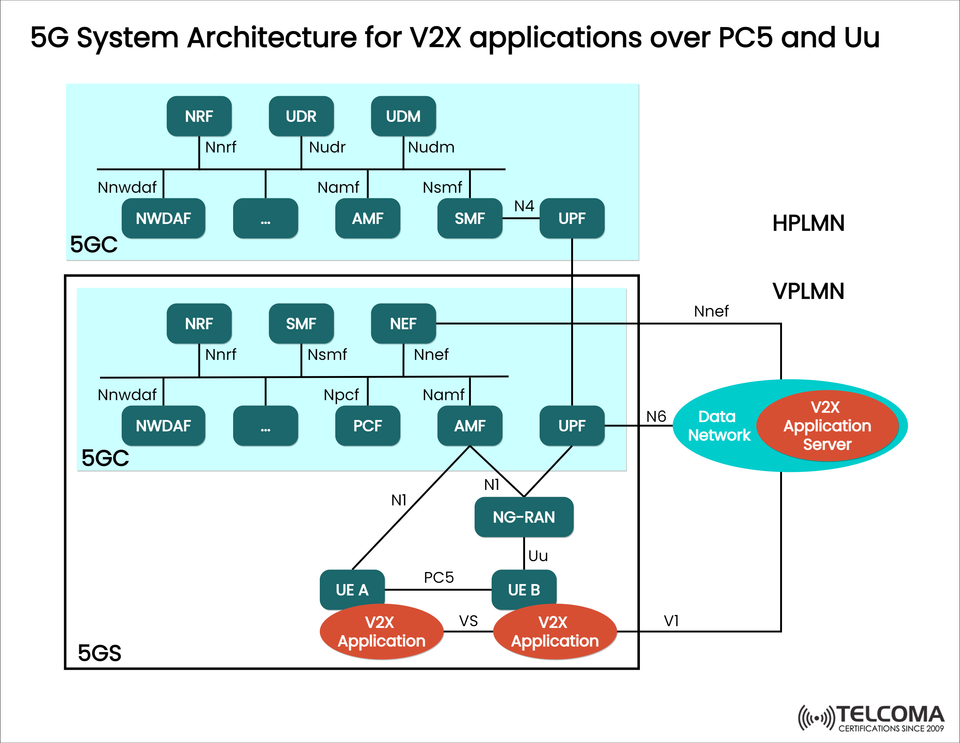

5G System Architecture for V2X Applications Over PC5 and Uu Interfaces
The development of 5G networks is significantly transforming the automotive and transportation sectors by facilitating Vehicle-to-Everything (V2X) communication. This groundbreaking technology enables vehicles to directly connect with one another, roadside infrastructure, pedestrians, and the wider network, ultimately enhancing road safety, improving traffic management, and boosting autonomous driving features.
The 5G system architecture tailored for V2X applications using the PC5 and Uu interfaces, illustrated in the diagram above, outlines how 3GPP sets the groundwork for secure and smooth V2X communication across various network domains — including User Equipment (UE), the 5G Core (5GC), and the V2X Application Server.
What is V2X in 5G?
V2X (Vehicle-to-Everything) communication refers to different ways vehicles interact with their surroundings, which include:
V2V (Vehicle-to-Vehicle): Direct exchanges between vehicles to avoid collisions and enable cooperative driving.
V2I (Vehicle-to-Infrastructure): Communication with roadside units (RSUs) for information on traffic signals or speed limits.
V2P (Vehicle-to-Pedestrian): Alerts sent between vehicles and pedestrians through mobile devices.
V2N (Vehicle-to-Network): Connections between vehicles and cloud services for navigation, entertainment, or software updates.
5G makes these modes possible through two primary interfaces:
PC5 (Direct interface)
Uu (Cellular interface)
Overview of the 5G V2X System Architecture
The diagram provided gives a detailed look at how 5G facilitates V2X communication through both PC5 and Uu interfaces.
This architecture is generally divided into three key sections:
5GS (5G System)
5GC (5G Core Network)
V2X Application Server and Data Network
It also shows two vehicles (UE A and UE B) that can communicate directly or via the 5G network, depending on the situation.
Let’s break down the main components and their functions.
Key Components of the 5G V2X Architecture
- User Equipment (UE) with V2X Applications
Each UE (User Equipment) represents a vehicle equipped with a V2X application.
Vehicles can communicate either:
Directly through the PC5 interface,
Or through the cellular network via the Uu interface (NG-RAN and 5G Core).
The V2X application is responsible for creating messages, ensuring security, and managing cooperative awareness and driving assistance.
- PC5 Interface – Direct Communication
The PC5 interface allows direct V2X communication between nearby vehicles (UE A and UE B) without using the cellular network.
Characteristics:
Low latency and high reliability, which is perfect for urgent use cases like avoiding collisions.
It supports sidelink communication, enabling UEs to send data directly.
Functions under either network coverage (mode 3) or out of coverage (mode 4).
Advantages:
Less reliance on network availability.
Crucial for autonomous driving in both remote and crowded areas.
- Uu Interface – Network-Assisted Communication
The Uu interface connects UEs to the 5G network via the Next Generation Radio Access Network (NG-RAN).
Functions:
Facilitates network-controlled communication between UEs.
Enables broader message distribution (V2N) and access to cloud-based services.
Supports long-range communication and coordination through the V2X Application Server.
Use Cases:
Systems for managing traffic.
Remote vehicle diagnostics.
Cooperative driving support needing centralized decision making.
5G Core Network (5GC)
The 5GC is the backbone of the 5G system, managing signaling, session oversight, policy control, and data routing.
In the diagram, several essential network functions appear:
FunctionAcronymPurposeNetwork Repository FunctionNRFKeeps track of service discovery and registration of network functions.Network Data Analytics FunctionNWDAFOffers analytics for optimizing network performance and quality assurance.Unified Data ManagementUDMOversees subscriber data and authentication.User Plane FunctionUPFManages data transfers between UEs and external networks.Session Management FunctionSMFHandles session setup and policy regulations.Access and Mobility Management FunctionAMFManages registration, mobility, and connection oversight.Policy Control FunctionPCFSets QoS and network policy guidelines.Network Exposure FunctionNEFProvides APIs for integrating third-party services (like V2X apps).
All these functions work together to ensure seamless V2X communication with optimal performance and security.
- V2X Application Server (V2X AS)
The V2X Application Server, hosted in the data network, is where the application-level logic operates.
It supports:
Data aggregation from various UEs.
Traffic coordination (like hazard alerts or traffic management).
Service provision across different operators and network domains.
This server could be located in either the Home PLMN (HPLMN) or Visited PLMN (VPLMN) and connects with the core network using the Nnef and N6 interfaces.
Inter-PLMN Interaction
The architecture illustrates two network domains:
HPLMN (Home Public Land Mobile Network)
VPLMN (Visited PLMN)
Vehicles can move between these networks. The NEF (Network Exposure Function) guarantees that the V2X Application Server from one PLMN can securely interact with network entities in another through Nnef, maintaining service continuity and security while traveling across borders or between operators.
How PC5 and Uu Work Together
The PC5 and Uu interfaces both play important, complementary roles in V2X communication.
FeaturePC5 InterfaceUu InterfaceCommunication TypeDirect (sidelink)Network-assistedLatencyUltra-lowModerateRangeShort (local)Wide-areaNetwork DependencyIndependentDependentUse CasesCollision warning, platooningCloud updates, infotainment, remote diagnostics
Together, they allow vehicles to switch between direct and network-assisted modes based on coverage, service needs, and mobility.
Operational Flow of V2X Communication
This is typically how communication flows in a 5G V2X setup:
Vehicle A (UE A) starts a V2X message using its V2X application.
Depending on the situation:
It either sends it directly to another vehicle (UE B) using PC5,
Or it transmits data through the Uu interface to the 5GC.
The 5G Core Network processes or forwards the message to the V2X Application Server via N6.
The V2X Application Server reviews and redistributes the information to relevant vehicles or infrastructure.
Vehicle B (UE B) gets the message either directly (PC5) or through the network (Uu).
This adaptable hybrid approach ensures reliable, low-latency communication, even when network conditions vary.
Advantages of 5G-Based V2X Architecture
Integrating 5G into V2X systems brings a host of benefits:
🚗 Ultra-Reliable Low Latency Communication (URLLC): Essential for real-time vehicle coordination.
🌐 Massive Connectivity: Can support thousands of connected vehicles per cell.
🔒 Enhanced Security: With authentication, encryption, and key management through the 5GC.
⚙️ Network Slicing: Creates dedicated slices for V2X applications to ensure QoS.
🚦 Interoperability: Facilitates cross-operator and cross-border V2X communication via NEF and VPLMN integration.
Use Cases Enabled by 5G V2X
Autonomous Vehicle Platooning – A group of vehicles drives together with synchronized brakes and acceleration.
Intersection Collision Avoidance – Vehicles share their real-time position data to avoid crashes.
Emergency Vehicle Alerts – Ambulances or police vehicles inform nearby traffic of their priority routes.
Remote Driving – Cloud-assisted vehicle control utilizing ultra-low latency connections.
Smart Traffic Management – Real-time analytics help improve traffic flow and minimize congestion.
Conclusion
The 5G System Architecture for V2X applications over PC5 and Uu signifies a significant advancement towards fully connected and autonomous transport systems.
By blending direct sidelink communication (PC5) with network-assisted communication (Uu), this architecture guarantees seamless, secure, and high-performance connectivity across various driving scenarios.
From self-driving cars to intelligent highways, this 3GPP-defined framework sets the stage for a safer, smarter, and more efficient transportation ecosystem—powered by 5G V2X.