
5G System Integration as a Bridge with TSN Explained | Telecom Guide

Introduction: Why We Need a 5G Connection to TSN
As more industries gear up for Industry 4.0, there's been a huge uptick in the need for ultra-reliable, low-latency communication (URLLC). Whether it’s smart factories or self-driving cars, these systems rely on deterministic networking, which means every data packet needs to arrive right on time.
This is where Time-Sensitive Networking (TSN) comes in. TSN is basically an extension of Ethernet designed by IEEE for real-time communication. But getting TSN to work smoothly in wireless settings like 5G isn’t as easy as it sounds.
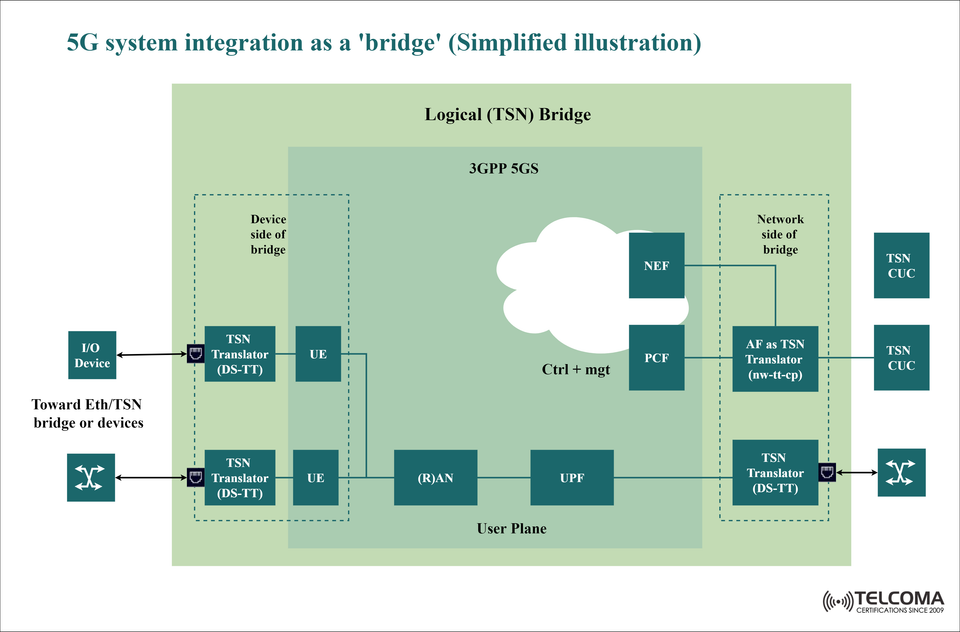
So what's the answer? We can think of the 5G system (5GS) as a “logical TSN bridge,” which allows for smooth connectivity between Ethernet/TSN devices and wireless networks.
Understanding 5G as a Logical TSN Bridge
5G’s main job when it comes to TSN integration is to act as a bridge between Ethernet/TSN devices and the IP-based wireless world. This logical bridge keeps those deterministic data flows intact, which is super important for automation and industrial uses, across both wired and wireless networks.
Key Components in the Diagram
Device Side of Bridge:
I/O Devices: Things like sensors, actuators, or industrial machines sending out real-time data.
TSN Translator (DS-TT): This translates Ethernet/TSN traffic into formats that 5G can understand.
UE (User Equipment): This serves as the wireless endpoint, passing data into the 5G system.
5G System (5GS):
(R)AN (Radio Access Network): This provides the wireless link to the UE.
UPF (User Plane Function): This takes care of packet forwarding and user plane traffic.
NEF (Network Exposure Function): It connects with external applications for control and exposure.
PCF (Policy Control Function): This manages QoS (Quality of Service) and network policies.
Network Side of Bridge:
AF as TSN Translator (nw-tt-cp): The Application Function that translates network-side TSN control.
TSN CUC (Centralized User Configuration): The main entity that sets up TSN streams from end to end.
TSN Translator (DS-TT): This provides Ethernet/TSN output to other TSN bridges or devices.
How the 5G-TSN Bridge Works (Step by Step)
To really grasp how this all fits together, let’s walk through the data flow:
Data Generation: Industrial I/O devices kick things off by creating deterministic traffic (like control commands or telemetry).
Translation at Device Side:
The data streams through the TSN Translator (DS-TT).
This ensures that TSN time synchronization, scheduling, and QoS settings are maintained.
After that, it goes to the UE (User Equipment).
5G System Handling:
The UE sends data through the Radio Access Network (RAN) to the UPF.
The Policy Control Function (PCF) makes sure the right QoS is applied (like guaranteed latency).
Meanwhile, the Network Exposure Function (NEF) connects with external applications and TSN controllers.
Network Side Translation:
The AF (Application Function) works as a translator for TSN-specific commands and synchronization.
Another TSN Translator (DS-TT) sends the data out to Ethernet/TSN devices.
TSN Centralized Control:
The TSN CUC is responsible for setting up and managing the TSN flows, making sure communication is deterministic in both wired and 5G environments.
Benefits of 5G Integration with TSN
Bringing 5G as a logical TSN bridge comes with several advantages:
Deterministic Latency: Ensures crucial packets arrive on time (sometimes as quick as 1 ms).
High Reliability: Supports essential industrial processes with an impressive 99.9999% uptime.
Interoperability: Easily connects Ethernet-based TSN devices with 5G networks.
Scalability: Can handle millions of devices per square kilometer, which is perfect for environments rich in IoT.
Flexibility: Lets industries mix wired and wireless communication without losing determinism.
Real-World Applications of 5G-TSN Integration
This bridge model is vital for sectors where time-sensitive communication is a must:
Industrial Automation: Think of real-time robotics, machine control, and factory automation.
Automotive Networks: Covers vehicle-to-infrastructure (V2I) and in-vehicle communication.
Smart Grids: For real-time monitoring and control of power distribution.
Healthcare: Important for remote surgeries and precision medical robotics.
Aerospace & Defense: Needed for secure, real-time communication in unmanned vehicles and critical operations.
5G-TSN Bridge Summary
Here’s a simplified overview of the components:
Component Role in 5G-TSN Bridge TSN Translator (DS-TT)Converts Ethernet/TSN frames for 5G transport UE (User Equipment)Serves as the endpoint for TSN-enabled devices into 5G(R)AN Provides wireless access to the 5G system UPF Manages user plane packet forwarding NEF Exposes network services to external applications PCF Oversees Q o S and network policies AF (TSN Translator)Acts as a network-side translator for TSN control TSN CUC Centralized oversight and setup of TSN flows
Challenges of 5G-TSN Integration
While it holds a lot of promise, this integration does come with its own set of challenges:
Synchronization: It’s tough to achieve precise time sync across both wireless and wired domains.
Complexity: The system becomes more complicated due to various translators and control functions.
QoS Scalability: Keeping deterministic performance consistent as the number of devices increases is tricky.
Standardization: There’s ongoing effort from 3GPP and IEEE to make sure everything works together smoothly.
Conclusion: Building a Bridge Between Wired and Wireless
5G’s function as a logical TSN bridge is a game-changer for sectors that rely on real-time, deterministic communication. By facilitating the integration of Ethernet-based TSN devices with 5G networks, telecom operators and businesses can achieve new heights in automation, reliability, and scalability.
This integration is particularly important for Industry 4.0, smart factories, autonomous transport, and mission-critical healthcare systems.
For telecom pros, getting a handle on the TSN-5G bridge architecture is key for building and managing networks that are ready for the future. For tech lovers, this showcases how 5G goes far beyond just smartphones, forming the backbone of connected industries.
The future of networking is about more than just speed; it’s about precision and reliability—and with 5G acting as a bridge, we’re getting closer to that vision.