
5G System Service-Based Architecture (SBA): Functions, Interfaces & Workflow

Understanding 5G System Service-Based Architecture (SBA) for Professionals
The 5G System Service-Based Architecture (SBA) represents a major leap forward in mobile core networks. Unlike the older 4G EPC (Evolved Packet Core) that used point-to-point connections, 5G brings in a cloud-native, service-oriented architecture that's all about flexibility, scalability, and interoperability.
In this article, we’ll break down what SBA is all about, dive into its components, their roles, and the key interfaces that keep everything connected. This should help telecom pros and tech fans grasp why SBA is so vital for the success of 5G.
What Does Service-Based Architecture Mean in 5G?
With 5G, SBA moves away from the old network setup, introducing service-based interfaces (SBI) that let network functions (NFs) communicate with one another using HTTP/2 and REST APIs. Think of it as creating a microservices environment where each NF can be developed, deployed, and scaled on its own.
Some big perks of SBA include:
Interoperability: Standard APIs make it easier to integrate different vendors.
Scalability: Each network function can ramp up or down based on demand.
Cloud-Native Deployment: This supports virtualization and containers, with tools like NFV and Kubernetes.
Faster Innovation: It simplifies the process of adding new network functions and services.
Core Network Functions in 5G SBA
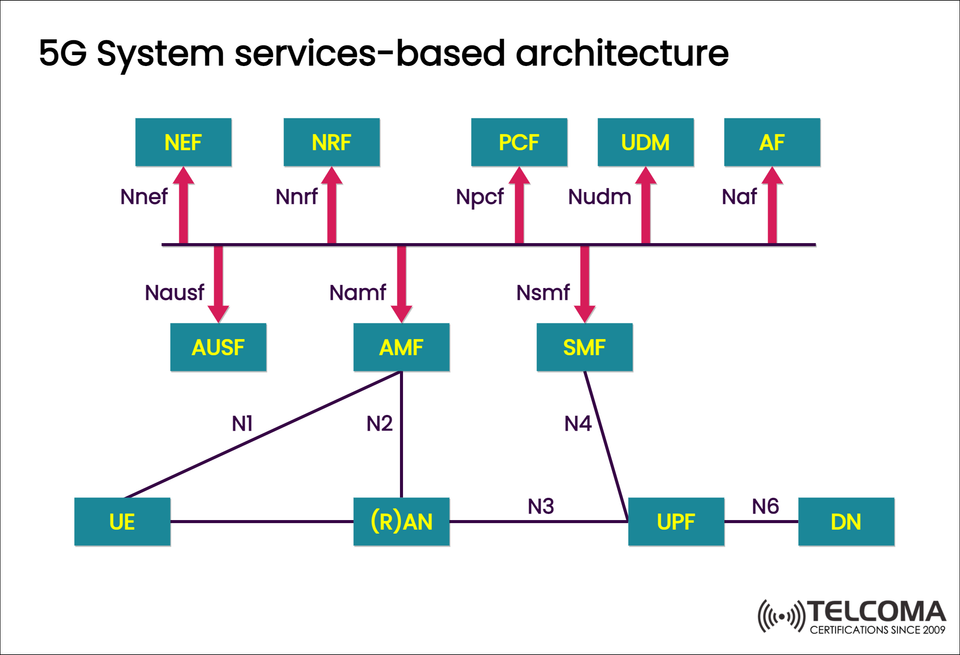
The visuals display the main Network Functions (NFs) within the 5G Core (5GC) and how they connect. Here’s a quick rundown of what each one does:
Nef (Network Exposure Function): Safely shares network capabilities with external apps through APIs, enabling network slicing and third-party service integration.
Nrf (Network Repository Function): Acts like a registry for all the NFs, detailing their features and locations to help with service discovery.
Pcf (Policy Control Function): Manages policy rules for Quality of Service (QoS), data prioritization, and subscriber-specific offerings.
Udm (Unified Data Management): Takes care of subscriber data, authentication info, and profile details.
Af (Application Function): Gives app-specific info that can influence network behavior, like directing traffic.
Ausf (Authentication Server Function): Handles the main authentication tasks for subscribers and devices.
Amf (Access and Mobility Management Function): Deals with user equipment (UE) registration, mobility, connection set-up, and session context.
Smf (Session Management Function): Responsible for establishing sessions, allocating IP addresses, and picking User Plane Functions.
Upf (User Plane Function): Forwards user data between UE and external data networks.
Ue (User Equipment): Refers to the devices (like smartphones or IoT gadgets) that access 5G services.
(R)an (Radio Access Network): Provides wireless links between UE and the 5G core network.
Dn (Data Network): Covers external networks such as the internet and private enterprise networks.
Getting to Know the Key Interfaces
Each NF talks to others through service-based interfaces or reference points. Here are the key ones shown in the diagram:
Nnef: The interface connecting NEF to the service bus.
Nnrf: Used for service discovery through NRF.
Nausf: Connects AMF with AUSF for authentication.
Namf: Lets other NFs tap into AMF services for managing mobility and sessions.
Nsmf: Links AMF and SMF for session setups.
N1: The interface for UE and AMF NAS signaling.
N2: The interface for control plane signaling between (R)AN and AMF.
N3: Connects (R)AN and UPF for user plane traffic.
N4: The link between SMF and UPF to manage user plane resources.
N6: Connects UPF to external Data Networks (DN).
SBA's Impact on Network Efficiency
The traditional EPC setup was mostly monolithic, meaning if you needed to scale one function, you had to scale the entire network. SBA changes that by allowing each NF to operate independently.
Here’s how SBA enhances network performance:
Dynamic Scaling: As traffic demand rises, you can scale up the SMF or UPF without impacting AMF or PCF.
Efficient Resource Use: APIs mean NFs can request services only when necessary, which cuts down on wasted resources.
Quicker Service Rollouts: Operators can introduce new NFs or upgrade current ones without long downtimes.
Network Slicing Support: SBA is crucial for implementing network slicing, letting operators dedicate resources for specific services or customer segments.
Example Workflow: UE Registration and Session Setup
Let’s walk through a basic example to show how SBA functions:
UE Registration:
The UE sends a registration request to AMF through N1/N2.
AMF reaches out to AUSF over Nausf for the authentication process.
AMF pulls the subscriber profile from UDM using Nudm.
Session Establishment:
AMF connects with SMF via Nsmf to kick off a PDU session.
SMF picks a suitable UPF and sets up rules through N4.
UPF begins forwarding data between UE and DN over N3/N6.
Policy Enforcement:
PCF sends policy rules (like QoS and slicing) to SMF using Npcf.
The network operates according to the subscriber profile and service needs.
This whole process runs smoothly, thanks to SBA’s modular setup and standardized APIs.
Benefits for Operators and Enterprises
5G SBA is more than just a technical upgrade — it’s a key enabler for business.
Multi-Vendor Flexibility: Operators can mix and match NFs from various suppliers.
Edge Computing Compatibility: Makes it easier to deploy distributed solutions closer to users.
New Revenue Opportunities: NEF allows the exposing of network services to developers, which can lead to innovative apps.
Improved Security: Each NF can be individually secured with API-level authentication and authorization.
Challenges in SBA Implementation
Even though SBA offers plenty of advantages, operators face some hurdles:
Integration Complexity: Multi-vendor setups need thorough testing to work together.
Latency Considerations: Optimizing HTTP/2 for real-time services like URLLC is essential.
Security Concerns: APIs can be vulnerable if not properly secured.
Operational Changes: Cloud-native skills and DevOps practices are vital for telecoms.
Wrapping Up
The 5G System Service-Based Architecture (SBA) serves as a fundamental part of next-gen mobile networks, delivering the kind of flexibility, scalability, and openness that was lacking in 4G EPC. By breaking down the core into modular, service-based network functions, SBA enables dynamic scaling, diverse vendor landscapes, and fresh business models like network slicing and API monetization.
For those in the telecom field, getting a grip on SBA isn’t just important for rolling out 5G networks; it’s also key to tapping into their full potential for powering things like IoT, AR/VR, and high-reliability low-latency communications.