
5G Technology Evolution Explained: From 3GPP Release 15 to Release 18+
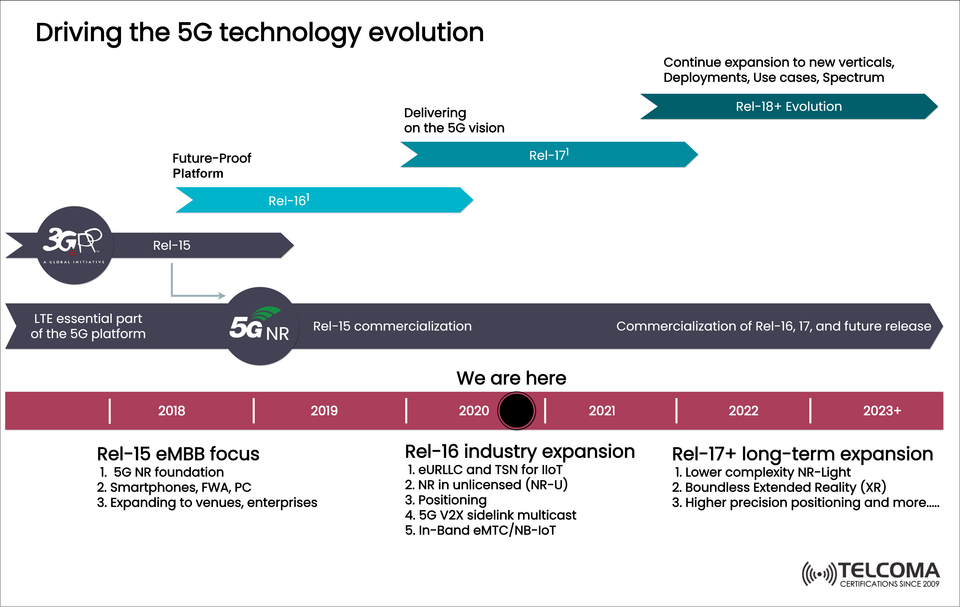

📶 Guiding the evolution of 5G Technology: A depiction of 3GPP Releases 15-18+
The evolution of 5G is about more than speed. It is about revolutionizing connectivity across industries, devices and applications. From its early beginnings in 3GPP Release 15 to its future in 3GPP Release 18+, the 5G journey contains years of innovative developments, standardization and deployment. This blog will showcase the evolution of 5G releases, their importance and what it means to telecom professionals and technologists alike.
🔍 Understanding the 3GPP Release points in time
📅 Release 15 (2018-2019): The foundation of 5G was laid
3GPP Release 15 laid out the basic framework for 5G New Radio (NR), with the primary focus on enhanced Mobile Broadband (eMBB):
5G NR foundation: Core radio features to deliver faster mobile broadband.
Device enablement: 5G NR enabled smartphones, fixed wireless access (FWA), and PCs.
Enterprise slide into 5G: 3GPP established the initial foray into venues and private networks.
🔑 LTE was still the anchor for early 5G deployments.
🚀 Release 16 (2020): Industrial Expansion
Release 16 is known as the "5G Phase 2" release, and involved important advancements for vertical applications such as manufacturing, automotive, and logistics:
eURLLC (enhanced Ultra-Reliable Low Latency Communications)
Time-Sensitive Networking (TSN) for Industrial IoT (IIoT)
NR-U (NR-Unlicensed) for indoor and outdoor applications that required the use of licensed and unlicensed spectrum to address spectrum demands
Positioning improvements
Vehicle-to-Everything (V2X) and sidelink multicast for connected vehicles
In-band eMTC and NB-IoT specifications to support high MASSIVE IOT application connectivity.
Release 16 made a significant progress in 5G, with the introduction of an opened proposed architecture that established the 5G standard beginning for markets beginning to understand 5G deployment.
🌐 Release 17 (2022): Long-Term Expansion
Release 17 focused on scaling and specialization and opened possibilities for new and emerging use cases:
NR-Light (RedCap), lower-complexity 5G for wearables and industrial sensors.
Extended Reality (XR), support for immersive AR / VR / XR applications.
Higher-precision positioning for things like smart factories and autonomous systems.
Release 17 started to bridge the divide between consumer-grade 5G and advanced, industry-tailored deployments.
📈 Release 18+ (2023 and Beyond): Evolving into 6G territory
Release 18 and beyond are continuing to build momentum on these topics, particularly with:
New vertical expansions (e.g., healthcare, agriculture, mining, etc.).
Diverse deployments (e.g., public and private networks, satellite-5G convergence).
New use cases: AI-driven RAN, automating network slicing, etc.
Spectrum flexibility, including the use of sub-THz frequencies.
Release 18 is often regarded as the "first" of the "5G-Advanced" standards, laying the groundwork for future innovations in 6G.
🗂 Key Milestones at a Glance
| Release | Focus Area | Key Technologies |
|---|---|---|
| Rel-15 | eMBB, Consumer 5G | 5G NR, LTE architecture |
| Rel-16 | Industrial IoT | URLLC, NR-U, V2X, TSN |
| Rel-17 | IoT & XR expansion | NR-Light, XR, High precision positioning |
| Rel-18+ | 5G-Advanced | AI-native RAN, New verticals, Beyond-5G capabilities |
🔄 We Are Here: Phase 3 - Commercialization
As illustrated above, we are currently in a phase of commercialization with Releases 16 and 17. Operators and enterprises
🧠 Implications for Telecom Professionals
Engineers: Will need to adopt modular, cloud-native network competencies to provide for dynamic slicing and support edge computing.
Network Architects: Research areas will mostly be low-complexity and high-density deployments, with Release 17 on upward compatibility.
Enterprises: With NR-Light for XR Applications and within URLLC, can create smart factories or XR capability training modules.
Vendors' compliance: Must remain agile for 3GPP roadmaps and dedicated device chipsets.
✅ Conclusion: 5G has only Just Begun
The full 5G journey from Release 15 to 18+, represent a progression towards a fully intelligent and immersive, industrial-grade connectivity. We are now transitioning from speculation and hype, to commercializing the standards, and preparing for 5G-Advanced with collaboratives of both industry and academics, to move forward with 5G innovations.
Whether you optimizing your networks from private 5G connectivity or exploring the potential of the XR within immersive technology, it's important to keep in mind the 3GPP release roadmap to future-proof your 5G strategic technology investment.
📡 Future Trend Outlook: What can we expect after 5G and 5G-Advanced
Although, 5G continues to grow the wireless ecosystem and technologies, Release 18+ anticipates it to also extended into the 6G era of research and standardization. With preliminary research set to begin shortly, there are multiple trends to watch:
Terahertz (THz) spectrum.
AI-native RAN automation.
Integrated sensing and communication (ISAC).
Quantum-safe security communication.
Zero energy and ambient IoT communications.
These areas will extend the lifecycle and durability of 5G technology, and contribute to 5G/6G potential!
✅ Summary: Key Points on 5G Evolution
Release Focus Keynotes
Rel-15 eMBB Foundation Initial deployment of 5G NR, FWA, PC, and Smart-phone support
Rel-16 Industry Expansion URLLC, IIoT, NR-U, sideline, in-band NB-IoT
Rel-17 Long term Expansion NR-Light, XR, precise positioning, vertical-specific enhancements
Rel-18+ Future-Robustness / Evolution to 6G New spectrum, higher level of automation and intelligent RAN with more enterprise ability.
📣 Get Involved: Future-Proofed Telecom Career
Regardless if you are a network architect, RAN engineer, IoT solution designer, or students of new wireless technologies, now is the time to invest in knowledge and skills,
Sign-up for 5G & Open RAN Certification Programs
Attend industry forums and Standards committees (3GPP, ETSI, O-RAN Alliance)
Play around with open-source stacks (ONAP, OAI)
Follow the discussion on vendor-neutral technologies (Open RAN, vRAN)
💬 Let Us Discuss
What are your thoughts on the evolution of 5G? Are you working on Release 17 deployments or already looking at Release 18? I would love to hear your challenges, thoughts or questions.
👉 Comment below or connect with me for a personalized briefing or team training Sesh.