
5G Technology Metrics Explained: Base Station, Uplink, and User Equipment Comparison
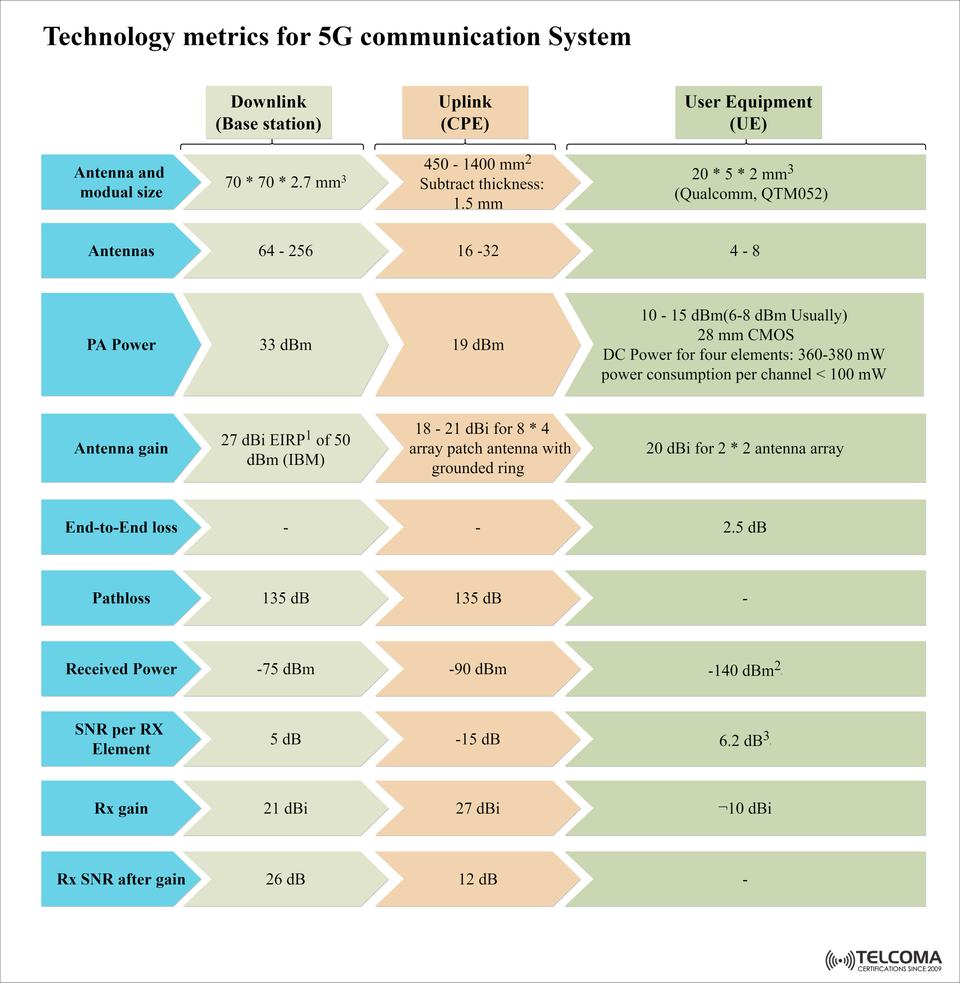

📡 Comprehensive Overview of 5G Communication System Measures
As 5G networks progress, it is becoming important to understand the hardware specifications and performance measures throughout the 5G communication chain. This will be applicable with performance measures at the Downlink (Base Station), Uplink (CPE), and User Equipment (UE).
In the image above, we see a comparative list of the measures side-by-side for an easy comparison. Below, we provide an analytical breakdown.
📊 Technology Measures Tabular Overview
Parameter Downlink (Base Station) Uplink (CPE) User Equipment (UE)
Antenna Module size 70 × 70 × 2.7 mm³ 450–1400 mm² (Thickness: 1.5 mm) 20 × 5 × 2 mm³ (Typical: Qualcomm QTM052)
Antennas 64–256 16–32 4–8
PA Power 33 dBm 19 dBm 10–15 dBm (Often typical 6–8 dBm) CMOS; Power/channel<100 mW
Antenna Gain 27 dBi EIRP1 of 50 dBm (IBM) 18–21 dBi (8×4 patch antenna with grounded ring) 20 dBi for 2×2 antenna array
End-to-End Loss - - 2.5 dB
Pathloss 135 dB 135 dB -
Received Power -75 dBm -90 dBm -140 dBm²
SNR per RX Element 5 dB -15 dB 6.2 dB³
Rx Gain 21 dBi 27 dBi ~10 dBi
Rx SNR After Gain 26 dB 12 dB -
🔍 Technical Thoughts by Segment
📶 1. Downlink (Base Station)
High Number of Antennas (64-256): Supports beamforming and MIMO implementations.
PA Power of 33 dBm: Can power large transmissions.
Antenna Gain: 27 dBi with extended coverage and realised transmission in one direction.
SNR and Rx Gain: Higher values (Rx gain 21 dBi, and SNR 26 dB) enhance the Rx quality even under pathloss of 135 dB.
📤2. Uplink (CPE)
Compact antennas (16-32): Designed for residential/enterprise-grade devices.
Lower PA power (19 dBm): Using part of the radio spectrum keeps power low.
Antenna efficiency: 18-21 dBi - From this, used with an 8×4 patch antenna, designed for moderate coverage.
SNR after Gain (12 dB): Good enough for uplink on a normal basis.
📱3. User Equipment (UE)
Small antenna modules (20×5×2 mm³): Embedded into smart phones - Qualcomm’s QTM052.
Low Power CMOS (360-380 mW for 4 elements, < 100 mW per channel): Key to battery performance.
Moderate efficiency gain of radiation pattern (20 dBi): Search for a balance between (packing) form factor and goal.
Received Power (~-140 dBm): A basic requirement for smartphones, devices expected to work in very weak signal conditions.
SNR (6.2 dB³): Sufficient for performing as intended as a receiver in mobile scenarios.
🧠 Why the metrics matters
Gaining an understanding of these metrics can help one in:
Network and base station planning - Place base stations and determine density of base stations.
Hardware design - Hardware product design to optimize antennas, amplifiers, and receivers to maximize performance/tuning for 5G performance.
Power budget - Energy/Power efficiency for battery life especially in mobile and IoT devices.
Link budget analysis - Total signal loss and assessment of total signal loss and performance from base station to user.
📌Key Takeaways
5G is eclectic, meaning each device type has different hardware capabilities.
Base stations are designed to maximize power, gain, and antenna array to achieve range and capacity.
User equipment is focused on power efficiency, size (form factor), and mobility (range of use) while being sensitive to receive weak signals.
CPEs will have a mix or balance of base stations and user equipment attributes.
🧩 Recommended Future Reads
🔗 Beamforming in 5G: How Particle Required Resources On Beamforming in 5G, Why it is Important
📡 MIMO vs Massive MIMO in 5G Networks
⚡ Power Consumption Trends Across 5G NR Devices
🧠 AI-driven Optimization In-Hardware Design for 5G
✅ Conclusion
The 5G communication system presents a paradigm shift in the layers of the network - from large base stations to small but powerful user equipment. Being familiar with the performance metrics of antenna, power, gain and SNR helps not only with the hardware solutions to be developed, but also achieving the best performance in every deployment which must satisfy the design criteria established for real-world networks built on the original system responsible for 5G technology. These metrics will serve as a fundamental basis of future systems like 6G, IoT, and AI-driven telecom solutions.
📡 Real-world Requirement: Importance of These Metrics in a Deployment Context
Understanding technology metrics is not an academic exercise; it is a real-world requirement when deployments occur! Every stakeholder in the 5G ecosystem has something they get from understanding these metrics:
🏗️ 1. Network Operators
Utilize pathloss and Rx gain figures to perform cell planning and coverage maps.
Establish a relative base station density difference between urban and rural areas.
Use antenna gain and SNR values to achieve a balance between backhaul and fronthaul links.
🧪 2. Device Manufacturers
Design RF modules and antennas in smartphones (CPEs use the same approach) with the physical constraints illustrated (module sizes, power consumption).
Determine battery requirements based on PA power and overall sensor use; use hybrid solutions if possible.
- System Integrators and Engineers
Use SNR per RX Element and Rx SNR after gain to evaluate how reliable the link is under different environmental conditions.
You will also use QoS (Quality of Service) metrics with knowledge of the received power and end to end losses.
Future Outlook: Scaling from 5G
This document has outlined current 5G metrics, but future generations such as 6G have some big ideas:
Tiny antennas optimized using AI
Lower power consumption at the edge
Use of terahertz spectrum which will have implications around the materials and form factors of antennas.
SNR optimizations at quantum levels.
The data shared today will help lay the foundation for networks of tomorrow.
Final Thoughts
The comparative metrics for the 5G base station (Downlink), CPE (Uplink) , and User Equipment (UE) deliver a detailed understanding of how performance is maximized at every point in the communications chain.
With an understanding of these specifications, professionals will be able to:
Enhance network performance
Design 5G hardware that is optimized
Maximize energy consumption
Enhance the user experience
Download & Resources (Optional Add-ons)
Would you like this blog post converted into:
PDF Technical Brief
PPT/Slides for your team training
Printable comparison table
Infographic Poster for your office.
If any or all of the above, please let me know, and I will get that for you.