
5G UDM and PCF Registration Flow Explained: Subscription Data Retrieval and Policy Association in 5G Core
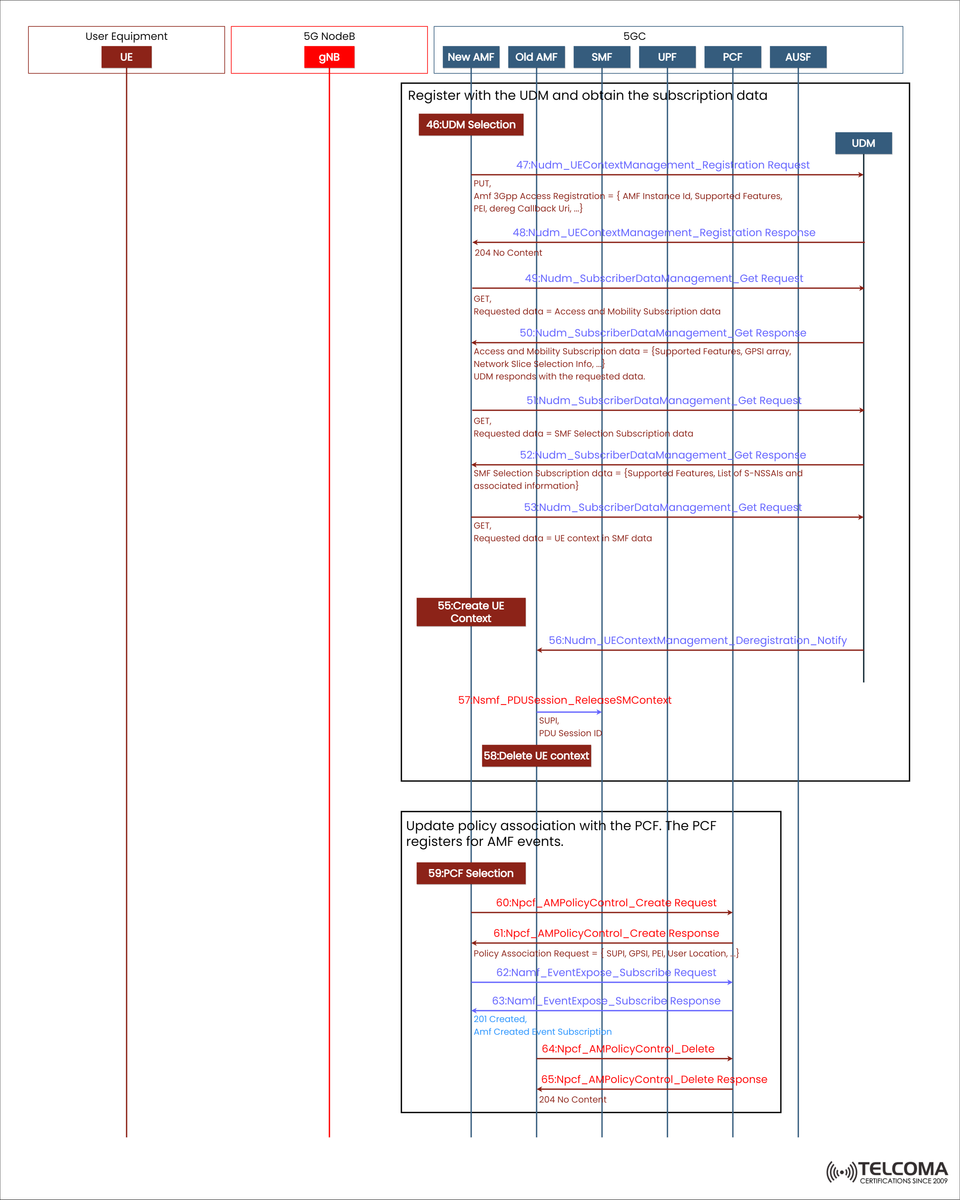

5G UDM and PCF Registration Flow: A Detailed Technical Overview
Once the 5G User Equipment (UE) finishes the NAS authentication and security setup, the next key step is to register with the UDM (Unified Data Management) and update the policy association with the PCF (Policy Control Function).
This process makes sure that:
The user’s subscription information is retrieved and updated throughout the core network.
Policy rules are enforced for mobility, managing sessions, and ensuring Quality of Service (QoS).
The context for the UE is created and properly maintained for effective session handling.
The diagram provided shows this multi-step interaction involving UE, gNB, AMF, SMF, UDM, and PCF within the 5G Core (5GC).
Key 5G Core Entities Involved
Entity Full Form Function UE User Equipment The device that registers to access the networkgNB5G Node B Acts as the radio access point between UE and 5GCAMFAccess and Mobility Management Function Manages mobility, registration, and authentication signaling SMF Session Management Function Oversees PDU sessions and assigns IP addresses UDM Unified Data Management Stores subscriber, authentication, and policy info PCF Policy Control Function Sets QoS, policy rules, and charging parameters
Section 1: Registration with UDM and Fetching Subscription Data
After completing NAS authentication, the AMF needs to make a connection with the UDM to get subscriber-specific details needed for setting up the network configuration and authorizing services.
Step 46: UDM Selection
The AMF identifies the correct UDM instance for the subscriber using the SUPI (Subscription Permanent Identifier) and routing policies within the network. This UDM instance will anchor the subscriber’s data profile.
Step 47: UDM Context Management – Registration Request
The AMF sends a Nudm_UEContextManagement_Registration Request to the UDM containing:
AMF Instance ID
Supported features
PEI (Permanent Equipment Identifier)
Deregistration callback URI
This request registers the UE in the UDM database, making sure session continuity is maintained.
Step 48: UDM Context Management – Registration Response
The UDM replies with a 204 No Content, confirming that the registration went through successfully. At this point, the subscriber is officially linked to this AMF instance.
Step 49: Request for Subscription Data
The AMF sends a Nudm_SubscriberDataManagement_Get Request to the UDM in order to get Access and Mobility Subscription Data. This request includes parameters that dictate how the UE connects and roams within the network.
Step 50: UDM Response – Access and Mobility Data
The UDM responds with a Nudm_SubscriberDataManagement_Get Response, which includes:
Supported Features
Network Slice Selection Info (NSSAI)
Access & Mobility Policies
This information enables the AMF to figure out which network slices and services the user can access.
Step 51: SMF Subscription Data Request
Next, the AMF requests SMF Selection Subscription Data from the UDM. This data outlines:
The SMF instance that will handle the user’s session.
Specific rules for establishing sessions based on the subscription.
Step 52: UDM SMF Subscription Data Response
The UDM sends back the requested SMF data, which includes Supported Features and Session Associations, crucial for the SMF’s management of future PDU sessions.
Step 53: UE Context in SMF Data
A final request (Nudm_SubscriberDataManagement_Get Request) is made to obtain the UE Context in SMF Data, which helps the network understand the UE’s current or past sessions. Once this is retrieved, the AMF can accurately create a UE context in the network.
Step 55: Create UE Context
The AMF now constructs a UE Context that consolidates:
Subscription details
Mobility data
SMF and PCF linkages
Event subscription connections
This context is essential for the UE’s 5G session management and mobility processes.
Step 56: UDM Deregistration Notification
If the UE shifts to a different AMF or deregisters, the UDM sends a Nudm_UE Context Management_Deregistration_Notify to remove or transfer the registration context.
Step 57: Release SM Context
In the event of session release or mobility, the SMF notifies the AMF with Nsmf_PDU Session_Release SM Context, marking the end of the PDU session. Consequently, the AMF cleans up the UE’s local data to avoid stale sessions.
Step 58: Delete UE Context
Lastly, the AMF deletes the UE context to ensure a fresh slate in the network database when the UE disconnects.
Section 2: Updating Policy Association with PCF
After the UE registration and subscription sync with UDM are wrapped up, the AMF moves forward to establish or refresh the policy association with the PCF (Policy Control Function).
The PCF is responsible for managing service policies, mobility management parameters, and event triggers to enhance user experience.
Step 59: PCF Selection
The AMF determines the right PCF instance based on:
SUPI or UE location
Network Slice Selection Information (NSSAI)
Policies defined by the operator
Step 60: AM Policy Control Create Request
The AMF sends a Npcf_AMPolicyControl_Create Request to the PCF that includes:
SUPI
GPSI (Generic Public Subscription Identifier)
PEI
UE location and network slice data
This request notifies the PCF of the UE’s registration and asks for the relevant AM (Access and Mobility) policy rules.
Step 61: AM Policy Control Create Response
The PCF responds with a Npcf_AMPolicyControl_Create Response, including:
Policy Association ID
Event triggers (e.g., mobility, location shifts)
Access and mobility control policies
These policies guide how the AMF manages mobility events and updates to user sessions.
Steps 62–63: Event Exposure Subscription
The AMF subscribes to event notifications using:
Namf_Event Exposure_Subscribe Request
Namf_Event Exposure_Subscribe Response
This setup allows the PCF to receive updates on AMF-related events (like UE movements, handovers, or registration changes).
Steps 64–65: Policy Control Deletion Procedure
When the UE deregisters or disconnects, the AMF initiates:
Npcf_AMPolicyControl_Delete Request
Npcf_AMPolicyControl_Delete Response
This action cleanly removes the policy association and ensures the PCF doesn’t keep any outdated UE data.
Benefits of UDM and PCF Coordination
Centralized Data Management: UDM ensures all subscriber data is cohesive and accessible.
Dynamic Policy Control: PCF can adjust QoS and mobility policies on a per-subscriber basis.
Optimized Resource Allocation: Accurate UE context allows for smarter session and resource management.
Reduced Latency: Faster session setup by caching UE data in the AMF.
Enhanced Security: Consistent validation across multiple core functions.
Troubleshooting Tips for Engineers
Here are common issues that can arise during UDM/PCF associations:
UDM Unreachable: Check DNS settings and NRF registration status.
PCF Policy Creation Issues: Ensure SUPI/NSSAI mapping and policy schema are correct.
Delayed Responses: Verify that there’s low latency between AMF, SMF, and UDM.
Context Deletion Errors: Align deregistration events to avoid resource leaks.
Conclusion
The 5G UDM and PCF registration flow is crucial to the 5G Core framework. It facilitates the synchronization of subscriber data, manages mobility policies, and offers a seamless user experience across various network slices.
By bringing together UDM for data retrieval and PCF for fluid policy enforcement, 5G networks can deliver the flexibility, scalability, and intelligence needed for next-gen connectivity.
Grasping this signaling flow—from UDM Registration to PCF Policy Control—enables telecom professionals to effectively design, monitor, and optimize 5G Core operations.