
5G UDM Registration and Subscriber Data Management Explained | 5G Core Access and Mobility Flow

Understanding 5G UDM Registration and Subscriber Data Retrieval
In the 5G Core (5GC) framework, the Unified Data Management (UDM) plays a vital role in managing subscriber identities, subscription data, and service authorization. After a User Equipment (UE) gets authenticated, the Access and Mobility Management Function (AMF) registers with the UDM to collect the subscriber’s details necessary for ensuring continuity of service and effective mobility management.
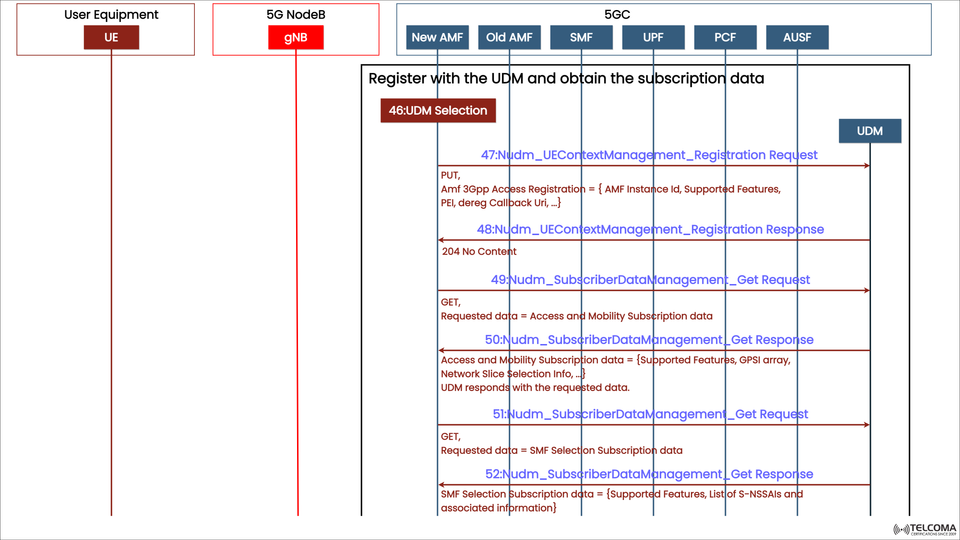
This blog takes a closer look at the UDM registration phase and the subscriber data management interactions, as outlined in the accompanying diagram. We will go through each message and discuss its significance during the 5G Standalone registration process.
The UDM's Role in 5G Networks
The Unified Data Management (UDM) acts as the main repository for all subscriber-related information in 5G. It has replaced the Home Subscriber Server (HSS) previously used in LTE networks and adds more advanced features to enhance flexibility in 5G.
Key Functions of the UDM include:
Managing subscriber IDs (SUPI, SUCI).
Storing and sharing subscription profiles.
Handling authentication data via the ARPF (Authentication Credential Repository and Processing Function).
Supporting Network Slice Selection and configuration data for the SMF (Session Management Function).
Ensuring user mobility and service continuity through AMFs.
By engaging with AMF, SMF, and AUSF, the UDM makes sure that subscribers are efficiently authenticated, authorized, and set up for their services.
Overview of the UDM Registration Procedure
After completing the NAS Authentication phase, the AMF needs to:
Register with the UDM to signal that it's handling the UE’s mobility context.
Retrieve subscriber information such as:
Access and mobility subscription details.
Information on Network Slice Selection.
Subscription data for SMF selection.
This process guarantees the AMF has what it needs to allocate the right slices and set up sessions for the subscriber.
Detailed Breakdown of the UDM Registration Process
The signaling flow shown in the image outlines this sequence:
Step | Message / Procedure | Direction | Purpose
46 | UDM Selection | AMF | Chooses UDM for the subscriber
47 | Nudm_UE Context Management_Registration Request | AMF → UDM | Registers the AMF for this UE
48 | Nudm_UE Context Management_Registration Response | UDM → AMF | Confirms the registration
49 | Nudm_Subscriber Data Management_Get Request | AMF → UDM | Requests access and mobility subscription data
50 | Nudm_Subscriber Data Management_Get Response | UDM → AMF | Returns access and mobility subscription data
51 | Nudm_Subscriber Data Management_Get Request | AMF → UDM | Requests SMF selection subscription data
52 | Nudm_Subscriber Data Management_Get Response | UDM → AMF | Returns SMF selection subscription data
Step 46: UDM Selection
Once authentication is done, the AMF decides which UDM instance will look after the UE. The selection is based on:
The SUPI (Subscriber Permanent Identifier).
The Home PLMN ID.
Network layout and load balancing considerations.
After the UDM is selected, all subscriber-related operations for this UE will be directed to that UDM.
Step 47: Nudm _UE Context Management _Registration Request
Following UDM selection, the AMF sends a UE Context Management Registration Request through the Nudm_UE Context Management_Registration API.
This message registers the AMF with the UDM as the serving AMF for that specific subscriber.
The request generally contains:
AMF Instance ID — uniquely identifies the AMF within the 5GC.
Supported Features — capabilities that the AMF supports.
PEI (Permanent Equipment Identifier) — identifies the UE hardware.
Deregistration Callback URI — enables the UDM to notify AMF if deregistration is required.
This procedure ensures that the UDM is aware of which AMF is currently managing the subscriber for mobility and session-related updates.
Step 48: Nudm _UE Context Management _Registration Response
The UDM processes the AMF's request and updates its internal records to show the connection between the subscriber and the AMF.
It then sends back a 204 No Content response, which confirms the registration was successful. This acknowledgment means that the UE’s AMF context has been properly saved and can now be used for mobility, slicing, and session management queries.
Step 49: Nudm _Subscriber Data Management _Get Request
Once registered, the AMF needs to get the subscriber’s Access and Mobility Subscription Data (AM Data) through the Nudm_Subscriber Data Management_Get API call.
Requested data includes:
Features supported for AM operations.
GPSI (Generic Public Subscription Identifier) array.
Network Slice Selection Information (NSSI).
Any mobility restrictions on the subscriber.
This information helps the AMF manage mobility and registration acceptance procedures tailored to the subscriber’s profile.
Step 50: Nudm _Subscriber Data Management _Get Response
The UDM replies with the requested Access and Mobility Subscription Data, which includes:
Supported Features: Capabilities available to the subscriber (such as voice over NR, roaming, etc.).
GPSI Array: Identifiers linking the subscriber’s SUPI to public identities like MSISDN or SIP URI.
Network Slice Selection Information (NSSI): Details on the network slices the subscriber is allowed to access, enabling configuration of network slicing.
This way, the AMF can effectively manage registration acceptance and later set up the right slices and policies through the Network Slice Selection Function (NSSF).
Step 51: Nudm _Subscriber Data Management _Get Request (for SMF Data)
After getting the mobility data, the AMF requests SMF Selection Subscription Data to figure out which Session Management Function instances can be authorized for this subscriber.
This GET request specifies a need for PDU session management configuration data.
Step 52: Nudm _Subscriber Data Management _Get Response (for SMF Data)
The UDM provides the SMF Selection Subscription Data, typically containing:
Supported features for session management.
A list of S-NSSAIs (Single Network Slice Selection Assistance Information) linked to the subscriber.
Related information for session setup and policy control.
With this information, the AMF can then interact with the SMF and PCF (Policy Control Function) to configure user-plane sessions based on subscriber entitlements.
The Importance of Managing Subscriber Data
Effective management of subscriber data is essential for:
Handling mobility efficiently: The AMF knows how to best serve and track the UE.
Allocating slices accurately: Ensures the UE connects to the right network slice based on their subscribed service.
Ensuring security and authorization: Only registered AMFs can access subscriber data, thus ensuring integrity and privacy.
Enforcing policies: Allows the PCF to apply service-specific QoS and charging policies based on UDM data.
Relationship with Other 5G Core Functions
With AUSF: The UDM supplies authentication vectors.
With SMF: Provides SMF selection subscription data.
With PCF: Supplies user-specific information for policy management.
With NSSF: Offers slice-related data for better selection.
This interconnected system ensures that all network functions have a unified and consistent understanding of subscriber information.
Conclusion
The UDM Registration and Subscriber Data Retrieval phase is fundamental to the 5G registration process. It connects the authenticated subscriber to the right AMF and guarantees the AMF has the information it needs for managing mobility, slicing, and sessions.
Through APIs like Nudm_UEContextManagement and Nudm_SubscriberDataManagement, the 5G Core achieves dynamic and secure subscriber management, setting the stage for network slicing, QoS differentiation, and advanced policy control.
For professionals in telecom, understanding this interaction is key to mastering 5G Core operations and ensuring reliable service delivery across various user and application profiles.