
5G UE Context Transfer and Deregistration Explained | AMF Reallocation and SMF Context Release in 5G Core
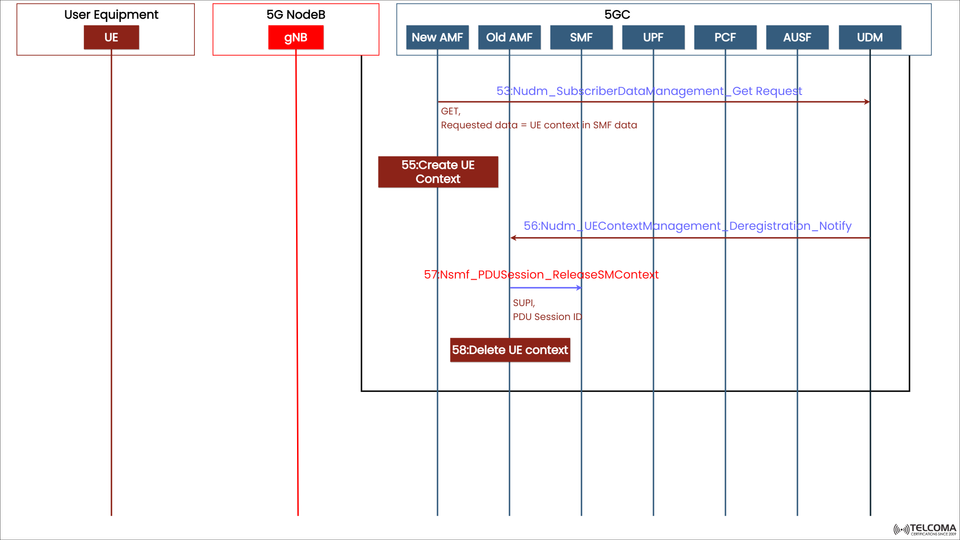

Understanding the 5G UE Context Transfer and Deregistration Process
In the 5G Core (5GC) setup, the Access and Mobility Management Function (AMF) is crucial for keeping track of and transferring the context of User Equipment (UE) when they change locations or deregister. Whenever a UE shifts between different AMFs or deregisters, the 5GC makes sure that all relevant subscriber, session, and context information is either moved or properly released.
This whole process involves the Unified Data Management (UDM), Session Management Function (SMF), and AMF working hand-in-hand to maintain network consistency and use resources efficiently.
The diagram you shared shows how these components interact during the phases of UE Context Creation, Deregistration, and Context Deletion. Let's dive into the details step by step.
Overview: The Importance of UE Context Transfer and Deregistration
When a UE travels across different tracking areas or switches between AMFs, its context needs to be transferred smoothly. This context includes identifiers, registration info, session details, and the mobility state of the UE.
Here are some key goals of this process:
Keeping session continuity intact as users move between AMFs.
Making sure to deregister inactive or relocated UEs correctly.
Freeing up SMF contexts and user plane resources to prevent any resource leakage.
Keeping subscriber data synchronized across different network functions like AMF, UDM, and SMF.
This approach helps ensure a stable and efficient 5G Core network.
Step 53: Nudm_Subscriber Data Management_Get Request
When a UE's control plane responsibility shifts to a New AMF (like due to reallocation or network balancing), the new AMF needs to get the UE’s subscriber and session data that’s held in the UDM.
This request uses the Nudm_Subscriber Data Management_Get API to ask for:
Access and Mobility Subscription Data (AM Data)
Session Management Function (SMF) Data
Subscriber’s SUPI (Subscription Permanent Identifier)
Purpose:
This allows the new AMF to create an accurate UE context that matches the subscriber’s active sessions, QoS profiles, and slice configurations.
Key Data Retrieved:
SUPI: The permanent identifier for the subscriber, used to map the UE's identity.
PDU Session Information: A list of ongoing PDU sessions and their associated SMFs.
Network Slice Details (S-NSSAI): Specifies slice-specific services allocated to the UE.
Mobility Subscription Information: Covers roaming and mobility limitations.
This step ensures that the new AMF has all the same info as the old AMF, keeping the UE’s service continuous.
Step 55: Create UE Context
Once the new AMF has gathered the subscriber data from the UDM, it creates a UE context internally.
This involves:
Assigning a new AMF UE NGAP ID for control-plane signaling.
Filling the UE context with subscription info, mobility restrictions, and SMF references.
Connecting the UE to existing PDU sessions (which were pulled from the UDM).
Purpose:
The goal is to set up a valid UE context in the new AMF so that service and session management can continue without interruption.
Outcome:
The UE is now logically registered with the new AMF and is prepared to continue signaling and data-plane activities through the same SMF/UPF (unless a reallocation is necessary).
Step 56: Nudm_UE Context Management_Deregistration_Notify
After the new AMF has created the context, the Old AMF sends a Nudm_UE Context Management_Deregistration_Notify message to the UDM.
Purpose:
This informs the UDM that the old AMF is no longer managing the subscriber’s context, allowing the UDM to update its internal mapping of which AMF is currently serving the UE.
Information Provided:
SUPI (Subscriber Identifier)
Old AMF ID
Reason for Deregistration (like AMF reallocation or UE deregistration)
Once the UDM receives this message, it refreshes its records to show the subscriber linked to the new AMF instance. This keeps conflicts or duplication in AMF-subscriber associations from happening, which is crucial for efficient signaling and state management within the 5GC.
Step 57: Nsmf_PDU Session_Release SM Context
After the deregistration, the old AMF needs to clean up all PDU Session contexts connected to the UE. It accomplishes this by sending a Nsmf_PDU Session_Release SM Context request to the SMF (Session Management Function).
Request Contents:
SUPI: Identifies the subscriber.
PDU Session ID: Pinpoints the session that needs to be released.
Cause: States why the session is being released (like UE deregistration or AMF reallocation).
The SMF then:
Notifies the UPF (User Plane Function) to let go of user plane resources.
Ends any QoS enforcement or policy controls that were associated with the session.
Updates its records to reflect the session release.
This ensures proper resource deallocation and prevents stale sessions from lingering in the network.
Step 58: Delete UE Context
Finally, after clearing all related sessions and references, the Old AMF deletes the UE context from its system.
This process includes removing:
The UE’s NAS registration data.
References to SMF and UDM contexts.
Any timers and pending transactions tied to the UE.
Purpose:
The goal here is to wrap up the UE deregistration or AMF reallocation process neatly, freeing up control-plane memory and ensuring that there aren't any residual dependencies hanging around.
At this point, the old AMF is no longer in charge of the UE, and all network functions (UDM, SMF, PCF) have synced to the updated UE–AMF association.
Why AMF Reallocation and Deregistration Matter in 5G
The design of the 5G Core emphasizes scalability, mobility, and service continuity. AMF reallocation and deregistration are key because they:
Facilitate Load Balancing: New AMFs can dynamically take over areas that are overloaded.
Assist Mobility Management: Allow seamless UE movement across AMFs without losing sessions.
Optimize Resource Use: Free up old session data and clear AMF memory.
Keep Network State Accurate: Ensure that AMF, UDM, and SMF databases are in sync.
Without these processes, networks might run into issues like data inconsistencies, session duplications, or poor mobility performance.
Conclusion
The 5G UE Context Transfer and Deregistration procedure plays a vital role in ensuring smooth transitions between AMFs, managing resources effectively, and keeping subscriber data consistent across the 5G Core. By coordinating efforts among AMF, SMF, and UDM, the network operates efficiently, avoids redundancy, and maintains a solid user experience, even during complex mobility scenarios.