
5G Uplink Mapping: Transport to Logical Channels Explained

In 5G NR (New Radio), the data flow between the User Equipment (UE) and the g NB (Next Generation No de B) is based on a well-defined protocol stack. A key part of this setup is how logical channels are mapped to transport channels.
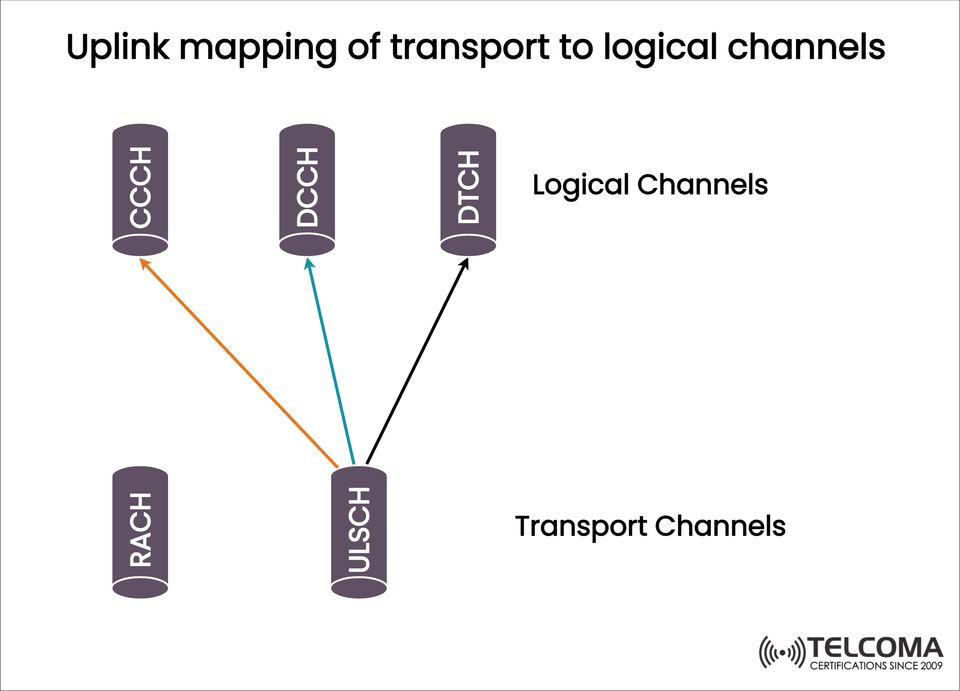
The diagram provided shows this mapping, focusing on the uplink direction. It illustrates how various logical channels like CCCH, DCCH, and DTCH connect to transport channels such as RACH and ULSCH.
For those in telecom, getting a handle on this mapping is crucial for understanding resource allocation, signaling design, and QoS (Quality of Service). If you’re a tech fan, it sheds light on how your smartphone interacts with the 5G network.
Logical vs Transport Channels in 5G
Before we dive into the uplink mapping, let’s clarify the two types of channels:
Logical Channels (What data is being transmitted?)
Logical channels define the type of data being carried. They answer the question: “What kind of information is this?”
CCCH (Common Control Channel): Used for sending control information before a dedicated connection is set up.
DCCH (Dedicated Control Channel): Carries control messages for a connection that's already established (like RRC messages).
DTCH (Dedicated Traffic Channel): Handles user data, such as browsing the internet, streaming videos, or making voice calls.
Transport Channels (How is data transmitted over the air?)
Transport channels dictate how the data is transmitted across the airwaves. They answer: “How is this data delivered to/from the physical layer?”
RACH (Random Access Channel): Used for initial access and connection requests.
UL-SCH (Uplink Shared Channel): The main transport channel for most uplink data, covering both user and signaling.
The Uplink Mapping Explained
The uploaded diagram highlights the uplink mapping process:
CCCH → RACH & UL-SCH
DCCH → UL-SCH
DTCH → UL-SCH
Let’s break this down a bit more.
CCCH (Common Control Channel) Mapping
Purpose: Used during the initial access procedure when the UE hasn’t established a dedicated connection yet.
Transport Channels:
RACH: Carries initial random access requests.
UL-SCH: After establishing a connection, CCCH messages can also be sent via UL-SCH.
📌 Example: When your phone first connects to a 5G cell, the RRC Connection Request message goes out on CCCH → RACH.
- DCCH (Dedicated Control Channel) Mapping
Purpose: Manages dedicated control signaling once a connection is up and running between UE and gNB.
Transport Channel:
UL-SCH: DCCH messages always map to UL-SCH because they need scheduled and reliable transmission.
📌 Example: An RRC Connection Reconfiguration or signaling for handover uses DCCH → UL-SCH mapping.
DTCH (Dedicated Traffic Channel) Mapping
Purpose: Carries user-plane data (like internet traffic, video calls, or VoIP).
Transport Channel:
UL-SCH: All DTCH traffic is mapped to UL-SCH.
📌 Example: Uploading a file to cloud storage or sending a WhatsApp voice message is done via DTCH → UL-SCH.
Key Insights from Uplink Mapping
RACH is Only Used Initially
RACH is set aside for initial access when there’s no scheduling in place.
After the UE connects, all channels shift to UL-SCH.
UL-SCH is the Workhorse
Handles both control and data traffic once resources are assigned.
It’s flexible and supports various logical channels at the same time while taking care of QoS.
Logical Separation but Transport Unification
Even though logical channels split traffic into control versus user data, transport channels streamline everything into efficient uplink scheduling.
Why Uplink Mapping Matters in 5G
Efficient Spectrum Use
The mapping makes sure that only crucial messages use RACH, which helps to avoid congestion.
The majority of traffic flows through UL-SCH, which is efficiently scheduled by the gNB.
QoS Differentiation
Control messages (from DCCH) need reliability and low latency.
User traffic (DTCH) can be scheduled based on different QoS profiles (like eMBB, URLLC, mMTC).
Security and Reliability
The mapping makes sure that control signaling is secure through UL-SCH, with encryption and integrity checks in place.
It prevents the random access channel from being used for heavy data loads.
Detailed Comparison: Logical vs Transport Channels in Uplink
Layer Channel Function Mapped To Logical CCCH Initial control signaling (e.g., connection setup)RACH, UL-SCH Logical DCCH Dedicated control signaling (e.g., handover)UL-SCH Logical DTCH User traffic (voice, data, video)UL-SCH Transport RACH Random access requests Physical Layer (PRACH)Transport UL-SCH Scheduled uplink data & signaling Physical Layer (PUSCH)
Example Scenario: UE Uplink Communication
Let’s look at a practical example of how this mapping works in a real 5G situation:
Initial Connection:
The UE sends an RRC Connection Request on CCCH → RACH.
Connection Setup:
After scheduling, the UE exchanges control messages over DCCH → UL-SCH.
User Data Transmission:
The UE uploads a video or file using DTCH → UL-SCH.
This step-by-step process shows how mapping transitions from RACH to UL-SCH taking the lead.
Challenges in Uplink Mapping
RACH Collisions: When multiple UEs try accessing at once, it can lead to retries and increased latency.
UL-SCH Scheduling Complexity: The gNB has to manage QoS for numerous users, balancing low-latency URLLC needs with high-throughput eMBB demands.
Dynamic Resource Allocation: The choices for mapping depend on network load, UE category, and what services are being used.
Future Outlook
In 5G-Advanced and 6G, we might see changes in uplink mapping strategies:
AI/ML-based Scheduling: Smarter allocation methods for UL-SCH resources.
Improved RACH Procedures: Aiming to reduce collisions and speed up access.
QoS-aware Transport Enhancements: Refining mapping to better prioritize URLLC, IoT, and immersive XR traffic.
Conclusion
The uplink mapping of transport to logical channels in 5G NR is vital for creating an organized, efficient, and secure flow of data from UE to gNB.
The CCCH takes care of initial signaling via RACH and later through UL-SCH.
The DCCH assures dedicated and reliable signaling on UL-SCH.
The DTCH is responsible for all user data through UL-SCH.
By linking logical channels (what type of data is being sent) to transport channels (how the data is delivered), 5G uplink communication achieves a balance of efficiency, reliability, and QoS.
For telecom professionals, this mapping is key in shaping robust uplink strategies. And for tech enthusiasts, it provides a glimpse into the behind-the-scenes processes that ensure seamless mobile connectivity.
The diagram lays out these inner workings, but in practice, this mapping forms the backbone that enables 5G to deliver incredible speeds and reliable performance.