
5G Vision and Targets: eMBB, URLLC, and mMTC Explained

Introduction: The Promise of 5G
5G isn’t just another upgrade in mobile technology—it’s a game changer. Unlike earlier generations that mainly focused on speed, 5G aims to do much more: it’s set to support not only smartphones but also industries, smart cities, self-driving cars, and billions of IoT devices.
The 3GPP’s vision for 5G centers on three main goals:
eMBB (Enhanced Mobile Broadband): Super-fast data speeds for immersive experiences.
URLLC (Ultra-Reliable Low Latency Communications): Critical services with almost no delay.
mMTC (Massive Machine-Type Communications): Efficiently connecting billions of IoT devices.
The attached image illustrates these three pillars along with their technical targets.
eMBB: Enhanced Mobile Broadband
eMBB is likely the most relatable aspect of 5G since it directly affects daily users. Its aim is to greatly increase mobile data capacity and speeds.
eMBB Targets (from the image):
1,000+ Capacity per km²
10 Gbps Peak Throughput
100 Mbps for Every User
Spectrum Efficiency
What It Means:
1,000+ Capacity per km² * Networks need to manage busy urban areas where numerous devices operate at once. * This is achieved through massive MIMO, small cells, and smart spectrum use.
10 Gbps Peak Throughput * Not every user will reach 10 Gbps, but this represents the theoretical maximum speed. * It supports smooth 4K/8K video streaming, AR/VR, and cloud gaming.
100 Mbps for Every User * Ensures a minimum experience even when the network is crowded. * No one should suffer from slow speeds due to congestion.
Spectrum Efficiency * More effective use of spectrum compared to LTE. * Techniques like beamforming and dynamic spectrum sharing (DSS) help maximize capacity.
eMBB guarantees high-speed connectivity for both consumers and businesses, turning mobile internet into a fiber-like experience.
URLLC: Ultra-Reliable Low Latency Communications
URLLC focuses on mission-critical applications where delays or failures aren’t options. It brings in extremely low latency with near-perfect reliability.
URLLC Targets (from the image):
Low Latency (1 ms)
High Reliability (99.9999%)
High Availability
Reduced Cost per Bit
What It Means:
1 ms Latency * Allows for real-time responses. * Vital for self-driving cars, remote surgeries, and industrial automation.
5G Vision and Targets (Recap)
The image you uploaded gives a quick overview of the three main pillars of 5G and how they perform.
eMBB (Enhanced Mobile Broadband):
10 Gbps peak speed
100 Mbps guaranteed per user
High spectral efficiency
Support for ultra-dense usage
URLLC (Ultra-Reliable Low Latency Communications):
1 ms latency
99.9999% reliability
High availability
Optimized cost per bit
mMTC (Massive Machine-Type Communications):
1,000,000+ devices per km²
Energy-efficient (10+ years device lifetime)
Reduced signaling for sporadic IoT traffic
These pillars really show that 5G is a flexible platform designed to meet the needs of consumers, businesses, and industrial IoT all at once.
Data Rate Fundamentals in 5G
The performance of any wireless network ultimately relies on three main factors:
Modulation
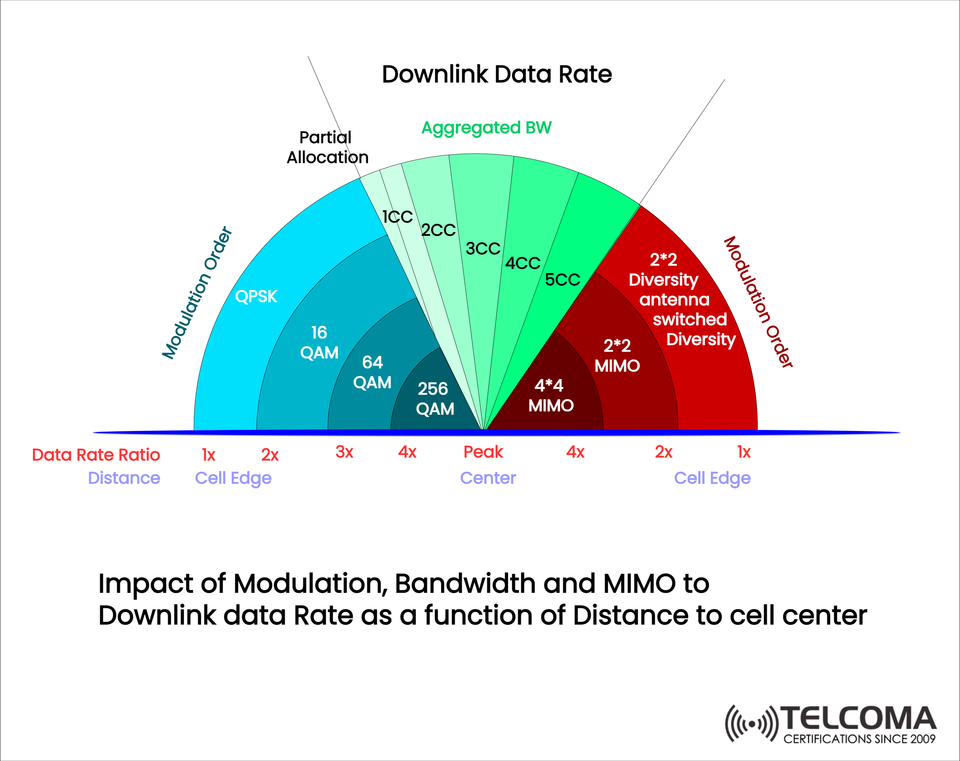
Higher modulation techniques (QPSK → 16QAM → 64QAM → 256QAM) send more bits for each symbol.
For instance, 256QAM carries 8 bits per symbol, while QPSK only manages 2.
Bandwidth
More bandwidth means more resource blocks available.
5G widens spectrum use from the usual sub-6 GHz to mmWave bands (>24 GHz), allowing for up to 400 MHz per channel.
MIMO (Multiple Input, Multiple Output)
This involves sending parallel data streams using spatial multiplexing.
Massive MIMO (64T64R or more) significantly boosts throughput, especially on the downlink.
These three factors set the Shannon capacity limit and shape the uplink/downlink experience in real-world applications.
Impact on Downlink Data Rate
The downlink performance chart from your upload shows how distance from the cell center affects data throughput.
Key Observations:
Close to Cell Center:
Users get to use higher-order modulation (256QAM), receive maximum bandwidth, and benefit from multiple MIMO layers.
Achievable speeds: Multi-Gbps in mmWave settings.
Farther from Cell Center:
Signal-to-noise ratio (SNR) drops.
Modulation may fall to 64QAM or QPSK, leading to fewer bits per symbol.
Throughput takes a noticeable hit, especially at the cell edge.
Role of MIMO:
Massive MIMO increases capacity near the center but sees diminishing returns at the edge due to poorer channel conditions.
Conclusion:
Downlink data rates are very much impacted by channel quality, making beamforming and small cell deployment essential for a consistent user experience.
Impact on Uplink Data Rate
The uplink chart reveals that uplink performance has its own quirks because of power limits at the user equipment (UE).
Key Observations:
Near Cell Center:
Users can send data with higher-order modulation (64QAM or even 256QAM in some cases).
Uplink speeds can hit several hundred Mbps.
Farther from Cell Center:
Power-limited UEs can’t maintain those higher modulations.
Uplink reverts to QPSK or 16QAM.
Data rates drop considerably more than in the downlink.
MIMO in Uplink:
It's restricted by the device's form factor and battery capacity.
Usually, there are fewer transmit antennas (like 2T2R), which means less gain compared to the downlink's massive MIMO.
5G Data Rate Examples
Here’s a simplified look at how these factors translate into actual performance:
Parameter Example Case 1Example Case 2Example Case 3ModulationQPSK64QAM256QAMBandwidth20 MHz100 MHz400 MHz MIMO Layers2x24x464x64Throughput (Downlink)~50 Mbps~1 Gbps10+ Gbps
This highlights how much spectrum availability and advanced antenna systems are vital to 5G's potential.
Linking Vision with Performance
eMBB: Needs broad bandwidth + high-order modulation + massive MIMO to hit those multi-Gbps speeds.
URLLC: It's less about the speed and more about low latency & reliability → relies on edge computing + smart scheduling.
mMTC: Prioritizes coverage and device density, not necessarily top speeds → depends on narrowband technologies like NB-IoT integrated into 5G.
Challenges in Meeting 5G Data Rate Targets
Despite all these advancements, we're still facing some hurdles:
mmWave Limitations: Offers ultra-high speeds but struggles with coverage & penetration.
Uplink Bottleneck: Limited transmit power at the user end.
Spectrum Licensing: Comes with high costs and fragmented availability.
Energy Efficiency: Massive MIMO uses a lot of power.
Mobility: Keeping up throughput in high-speed scenarios (like trains) is pretty complicated.
Future Outlook
The path toward full 5G performance is still being shaped. Here are some trends to watch:
6G Research: Checking out the THz spectrum and networks that run on AI.
Integrated Sensing & Communication (ISAC): Networks that can also detect objects.
Non-Terrestrial 5G: Combining satellite and terrestrial systems for worldwide coverage.
AI-Driven RAN: Smarter scheduling and networks that optimize themselves.