
5G vs 4G/LTE: Performance Goals Across Speed, Latency, and Connectivity

Making the leap from 4G/LTE to 5G is one of the biggest technological advancements in the history of telecommunications. While 4G brought mobile internet, streaming, and IoT capabilities into the limelight, 5G is set to take us into an ultra-connected world with incredible speed, super-low latency, and the ability to connect a massive number of devices.
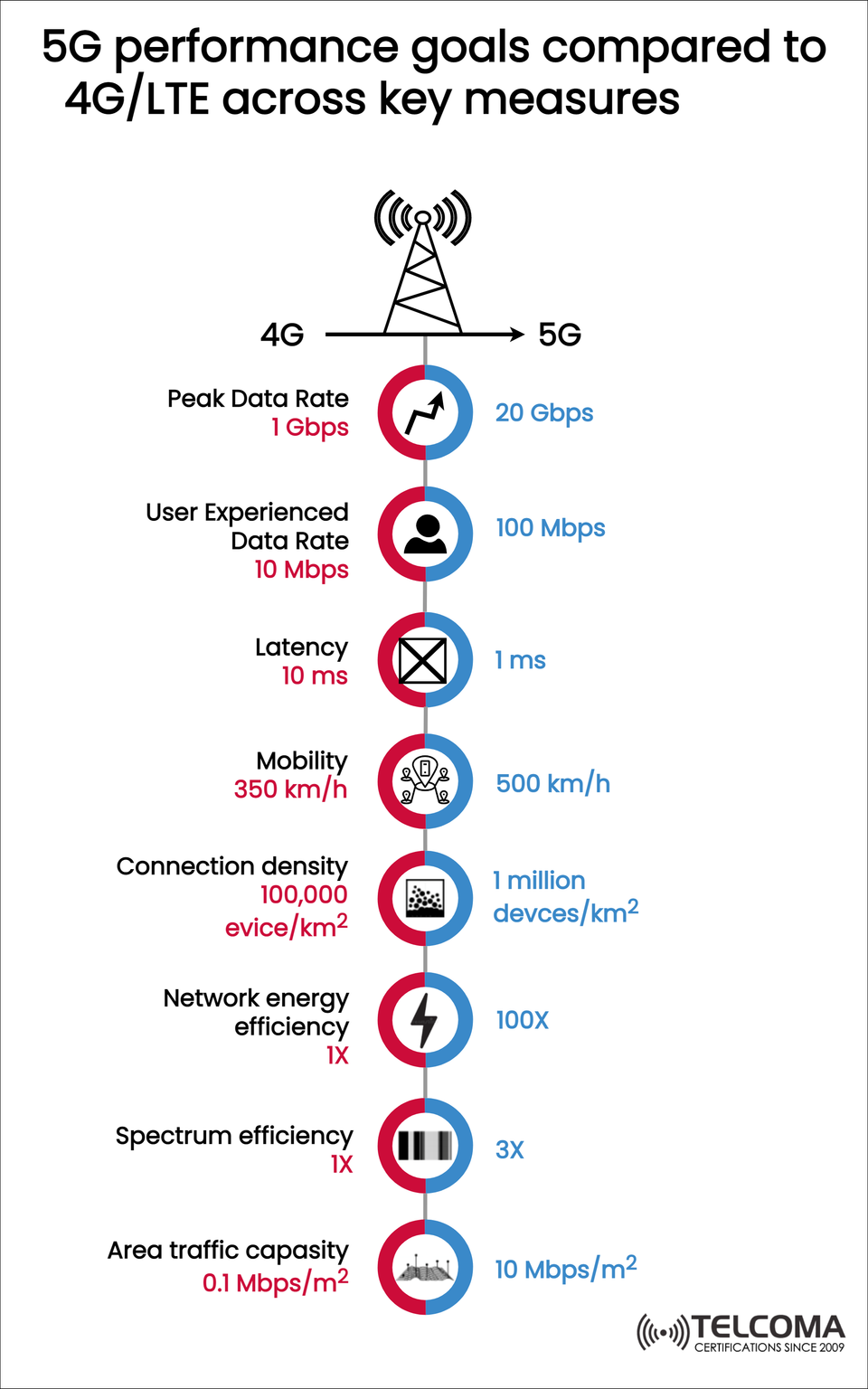
The infographic up top lays out how 5G stacks up against 4G/LTE on key measures like data rate, latency, mobility, connection density, and efficiency. In this blog, we’ll dive into each one, break down what it really means, and show how 5G is driving innovation across various industries—from healthcare to self-driving cars.
- Peak Data Rate: 20 Times Faster Speeds
4G/LTE: 1 Gbps
5G: 20 Gbps
The peak data rate is the theoretical max speed you can hit in ideal network conditions. With 5G being 20 times faster than 4G, it opens up a world for ultra-HD streaming, immersive VR/AR experiences, and lightning-fast access to cloud computing.
This change means businesses can shift huge amounts of data in real time, fueling things like smart factories, remote surgeries, and high-speed trading.
- User-Experienced Data Rate: Reliable Everyday Speeds
4G/LTE: 10 Mbps
5G: 100 Mbps
The user-experienced data rate is what actual users can expect in everyday situations. With 5G, users should see stable speeds around 100 Mbps, which is ten times what they get with 4G.
This guarantees smooth video calls, cloud gaming, and better communication between IoT devices, even in busy areas. Plus, telecommunication providers can enhance customer satisfaction by reducing slowdowns during peak times.
- Latency: Ultra-Low Delay
4G/LTE: 10 ms
5G: 1 ms
Latency measures how long it takes for data to get from point A to B. With 5G, latency drops to a mere 1 millisecond, compared to 10 ms on 4G.
This is a game changer for applications like:
Self-driving cars that need split-second decisions.
Remote surgeries where even a tiny delay can be dangerous.
AR and VR, where low latency helps avoid motion sickness and lag.
- Mobility: Faster and More Reliable When Moving
4G/LTE: 350 km/h
5G: 500 km/h
5G keeps its connections strong even at speeds up to 500 km/h, making it perfect for high-speed trains and future hyperloop systems. Travelers can count on steady connectivity, and IoT devices mounted on vehicles can keep communicating seamlessly.
- Connection Density: Facilitating the Internet of Everything
4G/LTE: 100,000 devices/km²
5G: 1 million devices/km²
The boost in connection density is a key feature of 5G. With the capacity to link ten times more devices per square kilometer, 5G paves the way for the explosive growth of IoT ecosystems.
This means smart cities, connected homes, and industrial networks can function smoothly with millions of sensors and devices working harmoniously together.
- Network Energy Efficiency: Greener Connections
4G/LTE: Baseline (1X)
5G: 100X
5G networks are built to be 100 times more energy-efficient than 4G. This is crucial as telecom companies expand their networks to accommodate more traffic without overconsuming energy.
Energy efficiency brings:
Lower costs for service providers.
A smaller carbon footprint for a greener telecom industry.
Longer battery life for IoT and mobile devices.
- Spectrum Efficiency: Using Frequencies Better
4G/LTE: Baseline (1X)
5G: 3X
Spectrum efficiency looks at how well a network uses available frequency bands to send data. With three times better efficiency, 5G can handle more capacity and speeds with the same spectrum resources.
This helps operators meet rising data demands without running out of frequency options.
- Area Traffic Capacity: Managing Heavy Data Loads
4G/LTE: 0.1 Mbps/m²
5G: 10 Mbps/m²
The area traffic capacity of 5G is 100 times higher than that of 4G, making it easier for busy urban areas, stadiums, and concerts to maintain great connectivity even when a lot of users are online.
For users, this means fewer dropped calls and smoother experiences at larger events.
Comparative Table: 5G vs 4G in Key Areas
Performance Metric | 4G/LTE | 5G | Improvement
Peak Data Rate | 1 Gbps | 20 Gbps | 20x faster
User-Experienced Data Rate | 10 Mbps | 100 Mbps | 10x faster
Latency | 10 ms | 1 ms | 10x lower delay
Mobility | 350 km/h | 500 km/h | More reliable
Connection Density | 100,000 devices/km² | 1 million devices/km² | 10x capacity
Network Energy Efficiency | 1X | 100X | 100x efficient
Spectrum Efficiency | 1X | 3X | 3x efficient
Area Traffic Capacity | 0.1 Mbps/m² | 10 Mbps/m² | 100x capacity
Why These Improvements Matter
The shift from 4G to 5G isn't just about speeding up downloads. It's about building a hyperconnected ecosystem that can support:
Smart cities with millions of connected devices.
Self-driving transportation systems that depend on ultra-low latency.
Healthcare breakthroughs like remote surgeries and AI diagnostics.
Industrial automation where robots and sensors work together in real-time.
Enhanced consumer experiences in gaming, entertainment, and education.
5G is setting the stage for Industry 4.0, the Internet of Things (IoT), and other future advances that require plenty of bandwidth and reliable, low-latency communication.
Conclusion
The shift from 4G/LTE to 5G represents more than just an upgrade—it's a major change in our digital landscape. With 20x faster speeds, 10x lower latency, 10x more connection density, and 100x improved energy efficiency, 5G paves the way for a truly connected digital future.
For telecom experts, this opens up new avenues in network deployment, optimization, and service innovation. For tech lovers, it heralds the beginning of next-gen experiences—from immersive AR to driverless cars.
As 5G adoption speeds up around the globe, its impact on industries, society, and daily life will be transformative, laying the groundwork for technologies we’ve only just begun to imagine.