
5G vs Legacy Authentication: Understanding Security Architectures in Mobile Networks
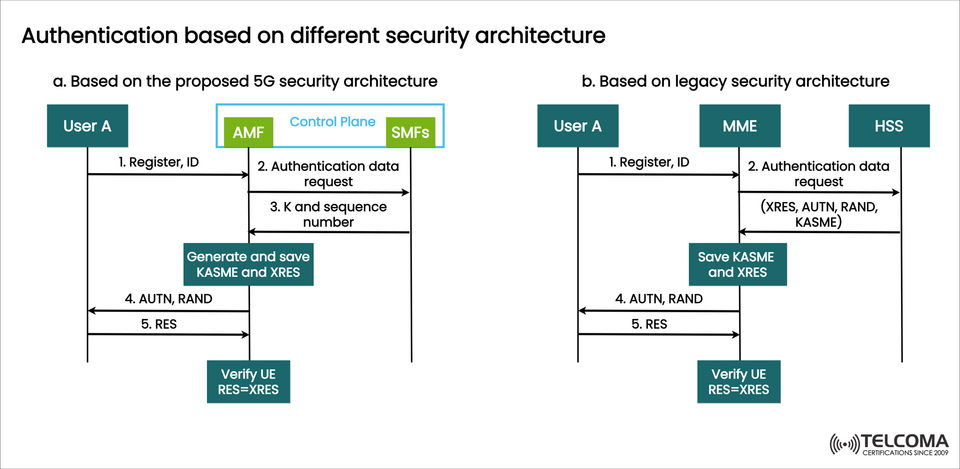

5G vs Legacy Authentication: A Look into Security Architectures
Security is super important in mobile communication. As networks shift from old LTE/EPC systems to 5G core architectures, the ways we authenticate have changed to provide better protection against threats, quicker verification, and improved reliability.
The diagram I've uploaded shows a comparison of authentication flows in 5G versus legacy security architectures. On the left, you can see the proposed 5G authentication method, while the right side depicts the traditional LTE-based approach.
In this article, we'll dive into both processes, highlight their key differences, and discuss why 5G leads to a more secure and efficient authentication framework.
Why Authentication is Important in Mobile Networks
Authentication plays a crucial role in ensuring that:
Only legitimate users can access network services.
Keys for encryption and integrity protection are properly secured.
Risks like replay attacks, impersonation, and eavesdropping are kept in check.
Without solid authentication, networks can face issues like fraud, data theft, and service misuse. That’s why 5G introduces a revamped authentication framework compared to earlier systems.
Legacy Authentication Architecture
In legacy LTE systems, authentication relies on three main components:
User A (UE): The subscriber device that kicks off registration.
MME (Mobility Management Entity): This is the control plane function in LTE that handles user signaling and authentication requests.
HSS (Home Subscriber Server): The central database that holds user credentials and keys.
Legacy Authentication Flow (As shown in the diagram)
Registration Request: * User A sends its identity (ID) to the MME.
Authentication Data Request: * MME sends the request to the HSS.
Response from HSS: * HSS generates and sends back: * XRES (Expected Response) * AUTN (Authentication Token) * RAND (Random Challenge) * KASME (Key for Access Security Management Entity)
Authentication Challenge: * MME sends AUTN + RAND to the user device.
User Response (RES): * The UE calculates its response and sends it back to the MME.
Verification: * If RES = XRES, the authentication is successful.
✅ Key Limitation: In legacy systems, the MME stores authentication vectors (XRES, KASME). If these are compromised, attackers can exploit this central weak point.
5G Authentication Architecture
In 5G, authentication is improved with new network functions and better cryptographic methods:
User A (UE): The subscriber that starts the process.
AMF (Access and Mobility Management Function): The 5G equivalent of MME, but with more responsibilities.
SMFs (Session Management Functions): These play a part in session-related security.
Control Plane: Takes on a more integrated role in authentication.
5G Authentication Flow (As shown in the diagram)
Registration Request: * User A sends ID to the AMF.
Authentication Data Request: * AMF requests authentication data from the security functions.
Key Derivation: * The control plane responds with the master key (K) and sequence number.
Vector Generation: * Rather than just relying on HSS, the AMF itself creates and saves KASME and XRES.
Authentication Challenge: * AMF sends AUTN + RAND to the user.
User Response (RES): * The UE computes the response using its stored keys.
Verification: * The AMF checks if RES = XRES.
✅ Key Enhancement: In 5G, the AMF takes on key derivation and verification, which makes the process less dependent on external databases like HSS. This helps reduce latency and boost security.
Key Differences Between Legacy and 5G Authentication
Aspect Legacy Architecture (LTE/EPC)5G Security Architecture Main Control Entity MMEAMF (Access & Mobility Management)Authentication Storage Stored in MME Generated & saved in AMF Dependency on HSS High Reduced (AMF generates vectors)Security Level Moderate, prone to attacks Stronger cryptography & resilience Latency in Authentication Higher (round trips to HSS)Lower (AMF handles internally)
Why 5G Authentication is Stronger
Reduced Attack Surface: * With LTE, storing vectors in the MME creates vulnerabilities, but 5G’s AMF minimizes risks from external storage.
Improved Key Handling: * Keys are generated dynamically, which lowers exposure to threats.
Resilience Against Replay Attacks: * Sequence numbers and better key derivation methods defend against replays.
Faster Verification: * The AMF can verify responses locally, cutting down on delays.
Future-Ready Security: * The design is adaptable enough to fit in with 5G-Advanced and 6G security mechanisms.
Real-World Implications
For Operators: * Simpler authentication means less signaling overhead. * Better protection against core network breaches.
For Enterprises (Private 5G): * Secure local authentication without heavy reliance on external databases.
For End Users: * Lower risk of SIM cloning, identity theft, or session hijacking.
Authentication in 6G: Looking Ahead
While the authentication in 5G is pretty strong, research for 6G is already considering:
Quantum-safe cryptography to tackle threats from quantum computers.
Blockchain-based authentication for a decentralized trust model.
AI-driven anomaly detection to catch malicious authentication attempts.
The shift from LTE to 5G and beyond clearly shows that authentication is shifting from just access control to ensuring trust, privacy, and resilience across every layer of the network.
Conclusion
The uploaded diagram clearly shows the differences between legacy LTE/EPC authentication and 5G authentication architecture.
In legacy systems, the process heavily relies on the MME and HSS, storing key vectors centrally, which can lead to potential security shortcomings.
With 5G, the AMF takes over key management and verification, which boosts both security and efficiency.
As we move towards 6G, the principles behind 5G authentication—strong cryptography, reduced reliance on centralized databases, and integrated verification—will set the groundwork for even more secure communications.