
5G Waveform Evolution Explained: From Release 15 OFDMA to Future Waveforms Beyond 71 GHz
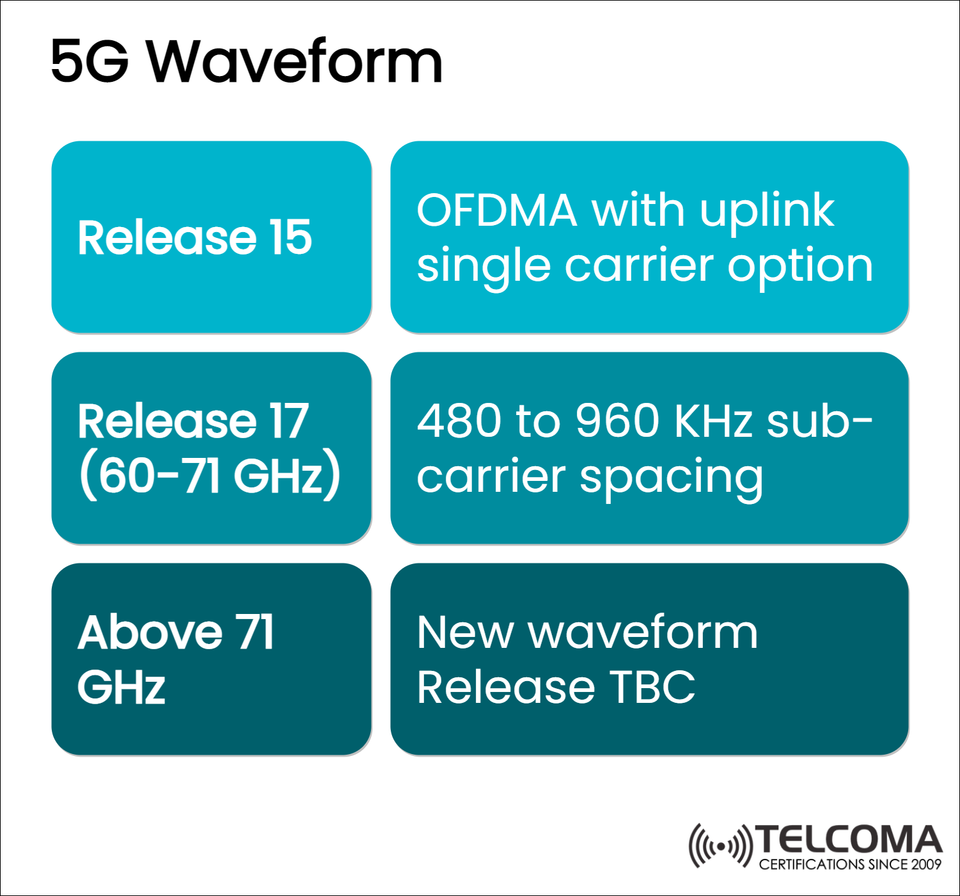

The Evolution of 5G Waveform: From Release 15 to Beyond 71 GHz
The 5G waveform is really the main tech behind how radio signals are sent, modulated, and received through the air. It's the backbone of 5G New Radio (NR), and it really determines how well the system can deliver super-fast data speeds, low latency, and smart spectrum usage.
As shown in the image above, the 5G waveform has changed over the years with 3GPP Releases — it kicked off with Release 15, saw some tweaking in Release 17, and we’re expecting some big innovations for frequencies above 71 GHz in future releases.
What Is a Waveform in Wireless Communication?
A waveform refers to the detailed mathematical and physical structure that defines how data is embedded in radio waves. It plays a key role in determining the time, frequency, and phase characteristics of the signal, directly affecting performance factors like:
Spectral efficiency – how well bandwidth is utilized
Latency – the delay between sending and receiving
Interference resilience – how well it holds up in crowded network setups
Device power efficiency – especially crucial for sending data from devices back to the network
In 5G NR, waveform design works to balance three key use cases:
Enhanced Mobile Broadband (eMBB) – for high data throughput
Ultra-Reliable Low-Latency Communication (URLLC) – to keep delays to a minimum
Massive Machine-Type Communication (mMTC) – energy-efficient support for IoT devices
5G NR Waveform in Release 15: The Foundation
3GPP Release 15, finalized in 2018, laid down the first commercial 5G spec, bringing in a flexible, scalable OFDMA-based waveform for both downlink and uplink communication.
Downlink Waveform: OFDMA (Orthogonal Frequency Division Multiple Access)
Allows multiple users to send data at the same time through orthogonal subcarriers.
Perfect for high data throughput and multi-user scheduling.
Works well with massive MIMO and beamforming to enhance spectral efficiency.
Uplink Waveform Options
OFDMA – for flexible, high-capacity uplink scheduling.
DFT-s-OFDM (Single-Carrier FDMA) – chosen for power-efficient uplink transmission, particularly on mobile devices to lower Peak-to-Average Power Ratio (PAPR).
Key Release 15 Waveform Features
Parameter Description Numerology Scalable subcarrier spacing: 15, 30, 60, 120, 240 kHz Waveform Type CP-OFDM (with cyclic prefix)Frequency Range Up to 52.6 GHz (FR1 + FR2)Multiple Access OFDMA (DL), DFT-s-OFDM (UL)Use Cases eMBB, URLLC, mMTC
Why OFDMA Was Chosen
A proven technology from LTE, made more flexible.
Efficient resource allocation with minimal inter-symbol interference.
Works with both FDD and TDD duplexing.
Easy to integrate with massive MIMO systems.
In summary:
Release 15's OFDMA-based waveform created a solid starting point for early 5G rollouts, offering both scalability and efficiency for varying frequency bands.
Release 17: Optimizing Waveforms for 60–71 GHz
With 5G expanding into higher frequency ranges (particularly above 60 GHz), Release 17 brought in some essential waveform upgrades to address new propagation challenges.
Frequency Range 2 (FR2) Expansion
Release 17 pushed 5G operations up to 71 GHz, aiming at high-capacity, ultra-dense networks — perfect for hotspots, business settings, and fixed wireless access.
Enhanced Subcarrier Spacing
Subcarrier spacing was boosted from 480 kHz to 960 kHz.
This shortens the symbol duration, helping to deal with phase noise and Doppler effects that come with high frequencies.
Why Larger Subcarrier Spacing Is Needed
High frequencies mean shorter wavelengths and quicker signal changes.
Bigger subcarrier spacing allows for better synchronization and toughness in places with fast time variations.
It lessens inter-symbol interference (ISI) and phase noise distortion.
Waveform Type
While OFDMA stays core, it’s optimized for mmWave characteristics to provide better synchronization and quicker signal processing.
Benefits of Release 17 Enhancements
Boosted throughput and reliability at mmWave frequencies.
Supports low-latency applications like real-time AR/VR and vehicle communications.
Better compatibility with WiGig (the unlicensed 60 GHz band).
Feature Release 15Release 17Frequency Range Up to 52.6 GHz60–71 GHz Subcarrier Spacing15–240 kHz480–960 kHz Waveform Type CP-OFDM / DFT-s-OFDM Enhanced OFDM Symbol Duration Longer Shorter Primary Use Case eMBB / URLLC High-frequency eMBB, dense deployment
Release 17 marks a major milestone, setting 5G NR up for super-high-capacity applications in tight urban and corporate settings.
Beyond 71 GHz: Future Waveform Directions (Release TBC)
The next step in wireless communication reaches beyond 71 GHz — possibly up to 140 GHz and even terahertz (THz) frequencies. But working at these high ranges brings specific challenges that traditional OFDM waveforms might not handle as effectively.
Challenges Above 71 GHz
High path loss and limited signal reach.
Significant phase noise from oscillator imperfections.
Beam alignment issues with highly directional antennas.
Hardware non-linearity in transceiver components.
Why a New Waveform Is Needed
To tackle these challenges, researchers are looking into developing new waveform designs tailored for extreme frequency bands.
Engineering Insights: Subcarrier Spacing and Performance Trade-offs
The choice of subcarrier spacing (Δf) is key in how waveforms perform:
Narrower spacing (15–60 kHz):
Great for low-frequency, wide-area coverage.
Better at resisting multipath effects.
Wider spacing (120–960 kHz):
Fits mmWave and THz bands.
Shortens symbol duration to handle phase noise and Doppler shifts.
Allows for ultra-low latency communication.
This flexibility is part of 5G NR’s scalable numerology, meant to support everything from rural coverage to tightly packed small cells in cities.
Why OFDMA Still Dominates 5G
Even with new waveforms being considered, OFDMA remains a key player in 5G for several reasons:
Impressive spectral efficiency and low inter-carrier interference.
Simplified equalization thanks to FFT techniques.
Strong compatibility with massive MIMO and beamforming.
Easy to implement using existing 4G infrastructure.
Its versatility keeps it relevant, even at mmWave and maybe sub-THz frequencies — though eventually modified or hybrid waveforms might take the lead.
Conclusion
The evolution of 5G waveforms highlights a journey of innovation fueled by the demand for flexibility, efficiency, and scalability.
Release 15 set the stage with a robust OFDMA-based foundation for a range of 5G applications.
Release 17 further honed it for high-frequency mmWave operations with improved subcarrier spacing (480–960 kHz).
Looking beyond 71 GHz, we can expect a new waveform approach that will meet the extreme demands of frequency, latency, and capacity — laying the groundwork for 5G-Advanced and 6G.
As telecom networks move toward terabit-per-second speeds and AI-driven adaptability, waveform design will stay central to future connectivity, shaping how efficiently the world communicates in the 6G era.