
5G Wireless-Wireline Convergence Architecture: Bridging Fixed and Mobile Broadband

Introduction: Why We Need Convergence in 5G
The demand for smooth broadband access globally is driving changes in telecom networks. Historically, fixed broadband (wired) and mobile broadband (wireless) operated as distinct systems, each with its own setup. This division led to inefficiencies, increased costs, and varied experiences for users.
The answer lies in 5G Wireless-Wireline Convergence (WWC) Architecture. It merges both access types into a single 5G core network. This integration helps operators streamline control, simplify management, and provide consistent services whether users connect through fiber, DSL, or 5G.
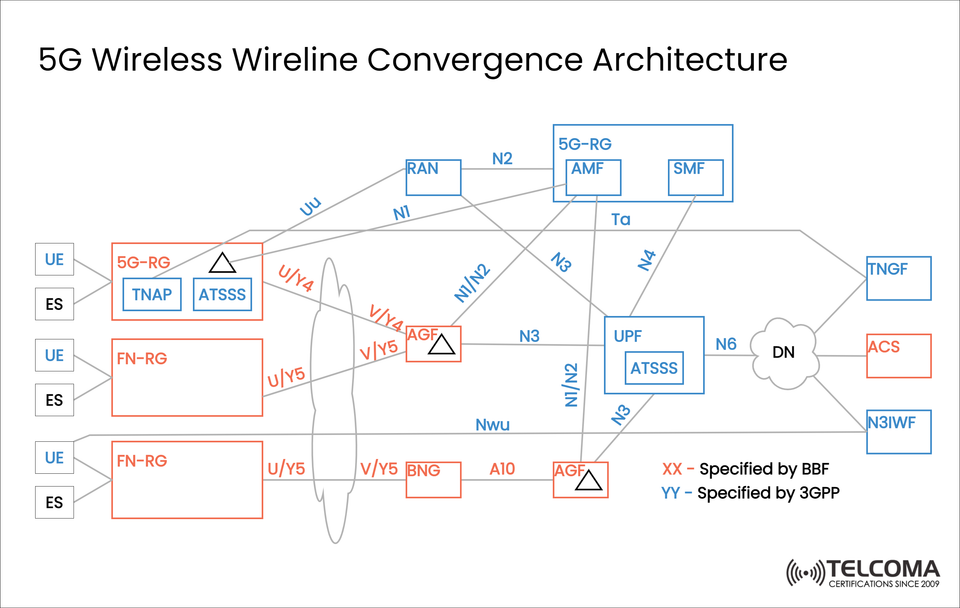
The diagram included gives a clear overview of the WWC architecture, pointing out integration areas, functional components, and standardized interfaces from 3GPP (3rd Generation Partnership Project) and BBF (Broadband Forum).
What is 5G Wireless-Wireline Convergence (WWC)?
5G WWC is a standardized framework that combines wireline broadband access (like fiber, DSL, PON) with the 5G mobile core network.
Instead of having separate cores for fixed and mobile, convergence provides:
Unified service delivery – One subscription and policy management.
Seamless mobility – Smooth transitions between wired and wireless networks without interruptions.
Operational efficiency – A single architecture that cuts down on redundant functions.
Scalability and flexibility – Catering to both consumer and enterprise needs.
In short, WWC connects traditional fixed broadband with advanced 5G networks.
Key Components of the 5G WWC Architecture
The diagram shows both wireless (blue) and wireline (red) elements, along with standardized interfaces. Let’s take a closer look.
User Equipment (UE) and End Systems (ES)
UE: Devices like smartphones, laptops, or IoT gateways.
ES: End systems such as PCs, smart TVs, or industrial machinery. These can link through 5G radio (wireless) or fixed network gateways (wireline).
Residential Gateways (RG)
5G-RG (Residential Gateway): A customer device with built-in 5G functionality, including features like TNAP (Trusted Non-3GPP Access Point) and ATSSS (Access Traffic Steering, Switching, and Splitting).
FN-RG (Fixed Network RG): An older or fixed broadband gateway that connects to the 5G core via an Access Gateway Function (AGF).
It’s worth noting: 5G-RG is “5G-native,” whereas FN-RG requires interworking through AGF.
Access Gateway Function (AGF)
Serves as a translation and control point between fixed access networks and the 5G core.
Ensures FN-RG devices can use 5G services without needing native 5G capabilities.
Connects with both wireline broadband networks (like BNG – Broadband Network Gateway) and the 5G core (via N2/N3 interfaces).
Broadband Network Gateway (BNG)
It’s the traditional point for aggregating and enforcing policies in fixed broadband.
Links FN-RG to AGF through U/Y5 and V/Y5 interfaces.
5G Core Components
AMF (Access and Mobility Management Function): Manages registration, mobility, and access authentication.
SMF (Session Management Function): Oversees session setup, IP distribution, and QoS policies.
UPF (User Plane Function): Directs user data between access and external networks (DN – Data Network).
ATSSS (Access Traffic Steering, Switching, and Splitting): Allows smooth use of both fixed and mobile access simultaneously (like using Wi-Fi and 5G together).
Interworking Functions
N3IWF (Non-3GPP Interworking Function): Links non-3GPP access (like Wi-Fi) to the 5G core.
TNGF (Trusted Non-3GPP Gateway Function): For trusted fixed access networks.
ACS (Access Control System): Manages subscriber authentication and service rollout.
Interfaces and Standards
Defined by BBF (red) – for example, U/Y5, V/Y5.
Defined by 3GPP (blue) – such as N1, N2, N3, N6. This joint standardization guarantees compatibility across different vendors and network operators.
How 5G WWC Works: A Step-by-Step Guide
UE/ES connects via either a 5G-RG (wireless) or FN-RG (fixed).
For 5G-RG: The device directly communicates with the 5G core through RAN → AMF/SMF/UPF.
For FN-RG: The device connects via BNG → AGF, which translates fixed broadband signals into 5G-compatible messages.
Authentication and Policy are centrally applied in the 5G core (AMF/SMF).
ATSSS manages traffic, enabling data flows to utilize both fixed and wireless connections as needed.
UPF directs traffic to the external Data Network (DN), like the internet or enterprise cloud.
This setup ensures that all users, regardless of their access point, enjoy the same 5G core services.
Benefits of 5G Wireless-Wireline Convergence
This convergence architecture brings multiple benefits for both operators and users:
✅ Seamless User Experience – A single cohesive subscription and policy across both fixed and mobile.
✅ Less Complexity – A unified 5G core takes the place of dual infrastructures.
✅ Traffic Optimization – ATSSS helps balance traffic for better reliability.
✅ Cost Efficiency – Streamlined operations and shared infrastructure reduce CAPEX/OPEX.
✅ Future-Ready – Supports innovations like smart homes, industrial IoT, and private enterprise networks.
Challenges in Deploying 5G WWC
Despite the advantages, operators encounter several challenges:
Legacy Integration – Many FN-RGs require AGF-based translations.
QoS Consistency – Keeping service levels steady across wireline and wireless.
Standard Alignment – Continuous updates from 3GPP and BBF need to be coordinated.
Operational Change – Adapting OSS/BSS models to manage unified subscriber systems.
Real-World Use Cases
The 5G WWC architecture isn’t just theoretical — it's being put to practical use:
Converged Home Broadband – A single plan covering both 5G mobile and fiber services.
Enterprise Networks – Integrated fixed-wireless solutions for smart offices and factories.
Mobile Offloading – Smooth transitions between Wi-Fi/fixed and 5G mobile for data-heavy applications.
Network Resilience – Dual connectivity ensures services remain uninterrupted even if one connection fails.
🌐 5G Wireless-Wireline Convergence: The Future of Unified Connectivity
The lines between fixed broadband and mobile networks are fading away. Thanks to 5G Wireless-Wireline Convergence (WWC), both access methods now connect to a single 5G Core, allowing for uninterrupted service delivery, optimized traffic management, and scalability for the future.
🚀 Benefits include:
✅ Seamless user experience
✅ Lower operational costs
✅ Resilient, dual-connectivity networks
🔑 Key components:
5G-RG & FN-RG (residential gateways)
AGF (Access Gateway Function)
AMF, SMF, UPF in 5G Core
ATSSS for traffic steering
⚡ Advantages of 5G WWC:
✅ Seamless service across fixed & mobile
✅ Reduced complexity
✅ Optimized traffic steering
✅ Cost efficiency
Conclusion: The Future of Unified Access
The 5G Wireless-Wireline Convergence Architecture marks a significant step in the evolution of telecom. By merging fixed and mobile broadband into the 5G core network, operators can provide seamless, reliable, and scalable services for both consumers and businesses.