
5GC Architecture Explained: CUPS and Hierarchical UPF Deployment for Efficient 5G Core
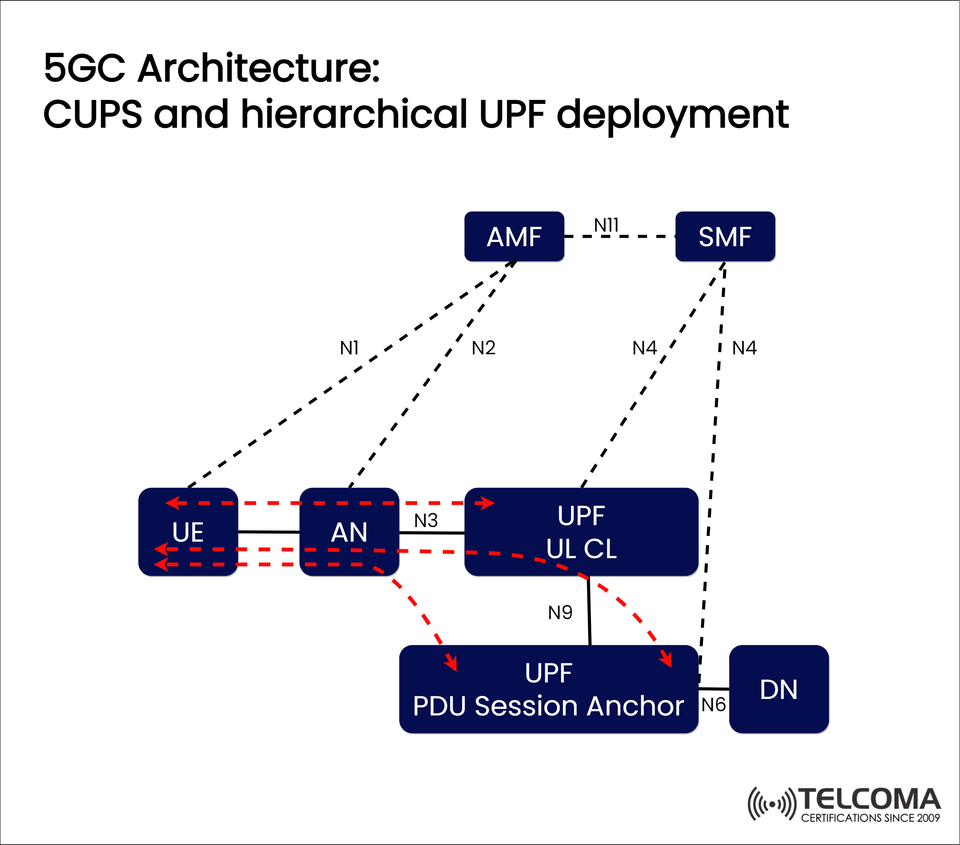

5GC Architecture: CUPS and Hierarchical UPF Deployment
5G Core (5GC) is designed to allow for many advanced use cases, such as ultra-reliable low latency communication (URLLC), enhanced mobile broadband (eMBB), or massive Internet of Things (IoT). One of the enablers of this flexibility is Control and User Plane Separation (CUPS) and a hierarchical UPF deployment. In this blog, we will go into detail about how this architecture works based on the image above.
🔧 What is CUPS in 5G Core?
Control and User Plane Separation (CUPS) is an important concept in 5G as it allows control plane (signaling, session management) and user plane (actual data traffic) to operate separately.
✅ Benefits of CUPS:
Scale control and user planes independently
Reduce latency with local data breakout
Make network upgrades and maintenance easier
Flexibility in where to place the UPF (closer to edge or centralized)
📊 Components of the 5GC Architecture (Image above)
The diagram gives an overview of how CUPS is used in a hierarchical UPF deployment:
Component Description
UE User Equipment (e.g., smartphone, IoT device)
AN (Access Node) RADIO INTERFACE: gNB or other access node can be seen as the gNB handling the radio interface
AMF Access and Mobility Management Function
SMF Session Management Function
UPF (UL CL) User Plane Function - Uplink Classifier
UPF (PDU Session Anchor) Anchor
🔁 Interface Overview
Interface Connects Function
N1 UE ↔ AMF NAS signalling
N2 AN ↔ AMF RAN to core signalling
N3 AN ↔ UPF (UL CL) User data tunnel
N4 SMF ↔ UPF (UL CL and PDU Anchor) Control data flow, policies
N6 UPF (PDU Session Anchor) ↔ DN Connections to external data networks
N9 UPF (UL CL) ↔ UPF (PDU Anchor) User data forwarding to/from UPFs
N11 AMF ↔ SMF Coordination for control plane
🏗 Tiered UPF Deployments
5GC architecture enables tiered chaining of UPFs allowing flexibility for deployment:
- UL CL (Uplink Classifier) UPF
- Classifies traffic from a proximity to the edge
- Routes data to the appropriate PDU Session Anchor
- Shows optimised routing for latency-sensitive services
- PDU Session Anchor UPF
- Acts as a central data anchor
- Manages session continuity and interconnects with the DN
- Has roaming and handover support
🌍 Real-world use-cases enabled by this architecture
Use Case Enabled by
Edge Computing (MEC) Deploy UL CL UPF close to users
Latency-sensitive applications Fast routing through local UPFs
IoT traffic tilting Display various possibilities in grouping UPF classification
Network Slicing Allow custom session anchoring for each slice
Roaming support PDU Anchor ensures continuity
🧠 Summary of CUPS Benefits
Modular Scaling: Provides independent control and deployment of user plane
Improved Performance: Provides lower latency and optimized routing options
Network Flexibility: Local breakout for edge apps
Vendor Agnostic: Standard interfaces will provide multi-vendor implementations
⚙️ Implementation Models for Hierarchical UPFs
With CUPS and hierarchical UPFs operators can build their network to suit their services and regional requirements. Below are some common implementation models.
🌐 Centralize Upf Deployment
Where: Core data centers
Use Case: Traditional broadband, roaming, non-latency dependant service
Advantage: Easy to manage and consolidated resources
Disadvantage: Latency potential for edge use cases
🏙 Distributed UL CL UPF Deployment
Where: Near the edge of a network (i.e., at regional hubs or gNB site)
Use case: Low-latency services, edge computing, and real-time apps
Advantage: Utilizes a distributed 5G core (low latency)
📌 Recommended Practices for CUPS and UPF Implementation
To gain full advantages from CUPS and hierarchical UPFs, telecom architects need to adhere to these recommended practices:
Policy-based routing: Use the SMF to define intelligent rules for traffic breakout.
Telemetry and observability: Observe traffic flow and UPF load over time.
Dynamic scaling: Utilize UPFs deployed as cloud-native VNFs/CNFs with auto-scaling capabilities.
Security segmentation: Implement session-based isolation and firewalling with each PDU session.
Resiliency: Deploy redundant UPFs that are configured for fast failover paths via N9.
📈 Why CUPS Complements Future-ready 5G Core
🔮 Sets Up The Network For:
6G networks and AI-native networks with intent-based routing
Cloud-native 5GC with microservices
Massive IoT where traffic is uplink-heavy and where traffic routing needs to be localized
Private 5G and enterprise slicing with isolated control and user planes
🔗 Facilitates Integration With:
Service-Based Architecture (SBA)
Network exposure (NEF) for third-party services to consume
Policy control (PCF) and charging interfaces
🧭 SMF in the UPF Selection Process
The Session Management Function (SMF) is the control point for CUPS. It:
Selects which UPFs to use (providing location, policy, and service type)
Instantiates uplink classifiers as needed
Manages N4 signaling to configure forwarding rules in the UPFs
Supports session migration and handovers
📊 CUPS + Hierarchical UPF at a Glance
Feature Traditional EPC 5GC (with CUPS & Hierarchical UPF)
Control/User Plane Coupled Yes No
Latency Optimization Limited High (via UL CL UPFs)
Edge Breakout Support Minimal Robust
Session Continuity across UPFs No Yes
Cloud Native Flexibility Low High
🏁 Conclusion
CUPS properly implemented with hierarchical UPF deployment allow an operator to deploy 5GC as a true cloud-native and service-aware architecture. This architecture allows the operator to choose intelligently how to distribute its functions across the network to respond to the divergent demands of 5G services for ultra-low latency gaming to mission-critical industrial automation.
Understanding this architecture is important for telecom engineers, architects, or strategists that want to take full advantage of 5G. This architecture will help the development of important use cases in 6G such as network slicing, edge compute, and will provide a great base for future services.
🏁 Final Thoughts
The 5G Core Architecture utilizing CUPS and hierarchical UPF deployment approach is radically different from the way we design and implement mobile core networks today. By separating control and user plane responsibilities and allowing for flexible, intelligent UPF placement, this architecture allows operators to deliver ultra-reliable, high-speed, and customized connectivity to every user and device.
Understanding CUPS and UPF chaining is essential for success, whether building an industrial private 5G network or deploying nationwide coverage with edge computing; this is a critical concept as 5G rolls out and evolves.