
6 GHz Frequency Bands Explained: U-NII-5 to U-NII-8 Usage and Incumbent Services

📶 An Introduction to the 6 GHz Spectrum
The 6 GHz frequency range (5.925 GHz to 7.125 GHz) represents an opportunity for new wireless communication experiences, with enough bandwidth to support high-speed and low-latency connectivity. Currently, the 6 GHz spectrum is being utilized by new technologies such as Wi-Fi 6E and Wi-Fi 7, as well as 5G NR-U, and private networks. However, there are already incumbent services utilizing a lot of the spectrum.
To manage coexistence, regulators and engineers have segmented the band into four sections known as U-NII (Unlicensed National Information Infrastructure) bands:
U-NII-5
U-NII-6
U-NII-7
U-NII-8
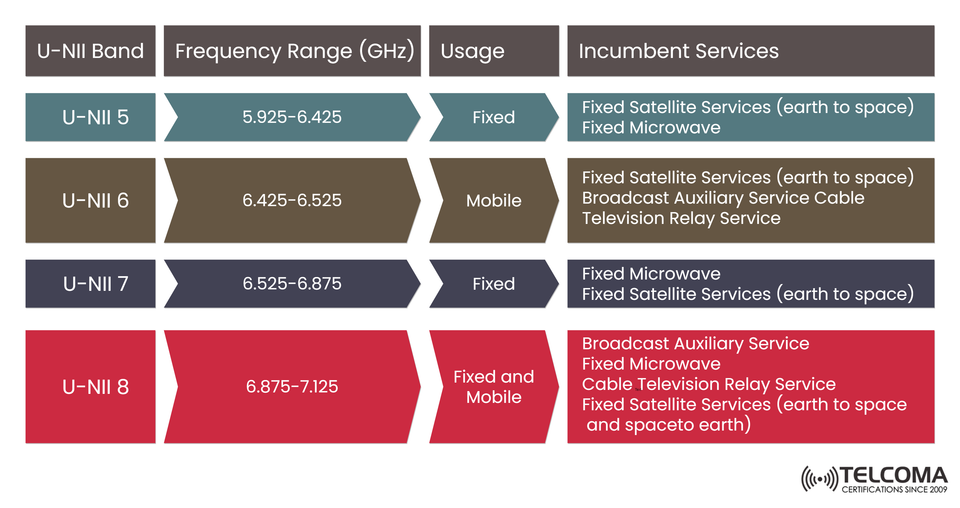
In the image you've provided, the U-NII bands are summarized by frequency range, usage, and incumbent services - here we will summarize this breakdown in more detail for the purpose of planning and deployment.
🧭 U-NII Band Breakdown
U-NII Band Frequency range (GHz) Usage Incumbent Services
U-NII-5 5.925 - 6.425 Fixed Fixed Satellite Services (Earth to space), Fixed Microwave
U-NII-6 6.425 - 6.525 Mobile Fixed Satellite Services, Broadcast Auxiliary, Cable TV Relay
U-NII-7 6.525 - 6.875 Fixed Fixed Microwave, Fixed Satellite Services
U-NII-8 6.875 - 7.125 Fixed & Mobile Broadcast Auxiliary, Fixed Microwave, Cable TV Relay, Fixed Satellite Services (bi-directional)
🔍 Understanding All U-NII Bands
🟦 U-NII-5 (5.925 - 6.425 GHz)
This Band is mostly responsible for fixed microwave links and earth-to-space satellite uplinks.
Wi-Fi 6E, operating under standard power with AFC, are allowed under grand-fathering.k
Restrictions abound here particularly outdoor usage.
🟫 U-NII-6 (6.425 - 6.525 GHz)
This shorter sub-band contains a sizeable portion of mobile services including and not limited to television broadcast relay and auxiliary services.
Indoor use is only permitted for Wi-Fi in most parts of the world.
You have also to share this band with Satellite Link uplinks and Broadcast auxiliary services that must not cause interference.
🟪 U-NII-7 (6.525 - 6.875 GHz)
This band is dedicated primarily to support backhaul using microwave and satellite to enable high capacity.
This band is where most of the standard power Wi-Fi 6E deployments are occurring globally, particularly for later sectors.
Most countries are requiring AFC for coexistence in this band.
🟥 U-NII-8 (6.875 - 7.125 GHz)
Full of both Fixed and Mobile pioneers that include two directional satellite links (Earth to space and space to earth).
This maybe the least congested space (tto do low power indoor Wi-Fi 6E or even 7).
This band is normally used by Relays and Broadcasters - particularly around media transmission hubs.
🛠️ Considerations for Deployment By Telecoms
When determining about 6 GHz deployments engineers must consider:
Regulatory (Indoor vs Outdoor; AFC)
Incumbents (U-NII-5 and U-NII-7 especially)
Power Level (choosing LPI or VLP or Standard Power)
🧠 Summary Table:
A Quick Comparison of U-NII Bands
Band Range (GHz) Usage Type Incumbents (Key Examples) Wi-Fi Usage Notes
U-NII-5 5.925–6.425 Fixed Fixed Microwave, Satellite(e.g. Earth to space) Standard power with AFC required
U-NII-6 6.425–6.525 Mobile Broadcast Auxiliary, Cable TV Relay Indoor-only Wi-Fi allowed
U-NII-7 6.525–6.875 Fixed Satellite (e.g. Earth to space), Fixed Microwave High-density backhaul; AFC required
U-NII-8 6.875–7.125 Fixed & Mobile Bidirectional Satellite, Broadcast, Relay Services Indoor use prioritized
🔚 Conclusion
Despite introducing and creating never-before-seen opportunities throughout the 6 GHz band, various legacy services already use 6 GHz spectrum, and that creates potential complications. It is therefore important for network engineers and telecom providers to understand U-NII segmentation in order to:
Make more informed spectrum planning decisions
Deploy Wi-Fi 6E / Wi-Fi 7 safely
Capture the spirit of the regulations and begin with the regulatory protections of existing incumbents
As demand for higher-capacity wireless systems continues to grow and develop in different directions, the need to successfully co-exist in the 6 GHz band will be imperative learned behavior for network professionals of the future.
🌍 Global Regulatory Landscape for 6 GHz
The regulatory process for introducing the 6 GHz band (individually, the adoption and regulation of the unlicensed 6 GHz band) varies by region, with countries partially or fully opening the band for unlicensed use both depending on incumbent services that operate (as well as national spectrum priorities).
🌐 Regional Adoption Insights
Region / Country U-NII Access Wi-Fi Use Notes
USA (FCC) Full (U-NII-5 to U-NII-8) Indoor & Outdoor (with AFC) AFC required for standard-power operations
Europe (CEPT) U-NII-5 and U-NII-6 only Indoor only Wi-Fi. No AFC yet; U-NII-7 and U-NII-8 are under discussion.
India (TRAI) U-NII-5 proposed Awaiting final decision. TRAI recommended all of 6 GHz with unlicensed access
UK (Ofcom) U-NII-5 only. Indoor - Wi-Fi 6E allowed. No access to U-NII-6, 7, 8 yet.
Brazil, South Korea, Saudi Arabia Full 6 GHz opened. Full access to Wi-Fi 6E/7. Progressive spectrum policies for tech innovation.
📝 Note, always check the the local regulatory authority (FCC, CEPT, TRAI, Ofcom, etc) current licensing, AFC status, and coexistence mandates.
🚀 Examples of New Use Cases in the 6 GHz Band
With the availability of the 6 GHz band we can expect many new wireless applications, including:
📲 Next-Gen Wi-Fi (Wi-Fi 6E & Wi-Fi 7)
Ultra-wide (160 MHz) and ultra-wide (320 MHz) channels
Lower latency and lower interference environments in the 6 GHz band.
Systemically important for mixed reality (AR/VR), cloud gaming, and enterprise networks configurations.
🏙️ 5G NR-U (New Radio - Unlicensed)
5G NR over unlicensed spectrum
Most effective in private 5G deployments. Notes U-NII-5 and U-NII-7 are the transmisison frequency channels for the Ultra Wideband aspect on a systemically significant private hybrid 5G application.