
6 GHz Wi-Fi Rules: U-NII 5 to U-NII 8 Band Operation for APs and Clients

📡 Comprehending 6 GHz Wi-Fi Device Operation Rules for U-NII 5 to U-NII 8
The rapid evolution of wireless in the 6 GHz band is changing connectivity through Wi-Fi 6E and Wi-Fi 7 and introduces low-latency, potentially high throughout links. However, there are operational rules, and power discrepancies between each of the sub-bands (U-NII 5 to U-NII 8), based on either the type of device, or the deployment model.
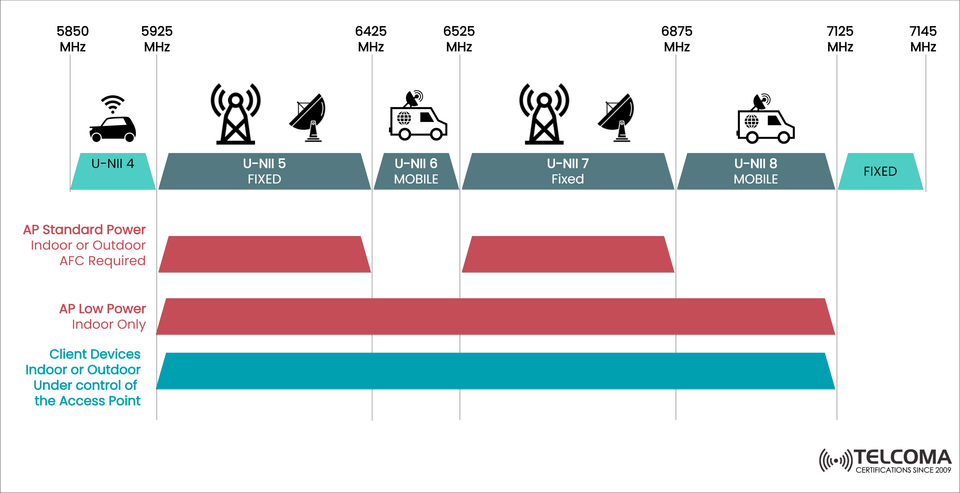
This graphic, from TELCOMA, illustrates the rules clearly so telecom professionals, system integrators and big tech can, in relation to regulatory guidelines, deployment of Access Points (APs) and client devices.
📊 Rule Breakdown by 6 GHz Band
🧭 Frequency Ranges and U-NII Bands
U-NII Band Frequency Range (MHz) Primary Use
U-NII 4 5850–5925 V2X/ITS (non-Wi-Fi)
U-NII 5 5925–6425 Wi-Fi (Standard & Low-Power APs)
U-NII 6 6425–6525 Mobile Services / Indoor Wi-Fi
U-NII 7 6525–6875 Wi-Fi, AFC Required
U-NII 8 6875–7125 Mobile + Fixed Satellite
Post-U-NII 8 7125–7145 Fixed Links Only
🔧 Device Operation Rules in 6 GHz Spectrum
This operational framework for 6 GHz distinguishes Access Points (APs) based on power classes, further distinguishes how the rules dictate how client devices can operate in the band.
🔴General Power Access Points (APs)
Usage: Indoor & outdoor
Regulatory Requirement: Must use Automated Frequency Coordination (AFC)
Permitted Bands: U-NII 5, U-NII 7, U-NII 8
Benefit: High power provides zone range
Note: AFC limits potential interference with existing fixed satellite and microwave services
🔴Low-power Indoor APs (LPI)
Usage: Indoor only
Regulatory Requirement: No AFC is required
Permitted Bands: U-NII 5 - U-NII 8
Benefit: Rapid deployment in homes, enterprises and public spaces
Limitation: Cannot use outdoors due to chance of causing interference
🔵 Client Devices
Usage: Indoor or outdoor under control of an AP
Regulatory Requirement: Must operate under either AFC enabled APs or LPI APs
Permitted Bands: U-NII 5 - U-NII 8
Types of Devices: Smartphones, laptops, VR headsets, IoT nodes
⚖️ AFC: A Critical Control Layer
Automated Frequency Coordination (AFC) is required when using the 6 GHz below with standard power APs outdoors. AFC acts as dynamic spectrum manager:
Queries geolocation database
Calculates permitted operational frequencies
Actively protects incumbent services especially fixed microwave linkages and satellite uplinks
Without AFC, devices are restricted to indoor usage also at low power levels only.
💡 Critical Deployment Considerations
Professionals should fit their adaptation to 6 GHz into the following best practices:
✅ Access Point Planning
Utilize low power APs in building deployments
Utilize AFC standard-power APs in outdoor and enterprise-grade Wi-Fi landscapes
✅ Client Device Strategy
Make sure that client firmware is dynamically controlled for power
Hold AP-to-client pairing considering power/channel constrints
✅ Compliance & Interference Deterrent
Always check local regulations (FCC, ETSI, etc.)
Avoid overlapping fixed service bands without AFC
📌 Conclusion:
Operational Awareness Satisfies Spectrum Efficiency
The 6 GHz band can offer diverse possibilities, but there is no leeway for regulatory discipline and device classifications for these deployments to be successful. Understanding how the standard power, low power, and client devices act across U-NII 5 to U-NII 8 is crucial for the network engineer to get the spectrum aligned, reduce interference, and maximize coverage.
With the uptake of Wi-Fi 6E and the adoption of Wi-Fi 7, it is critical that future networks continue to conform to these specific operational parameters.
🔮 Looking Ahead: 6 GHz and More
The 6 GHz band isn't just a pass through to a new unlicensed wireless experience – it is much more! As we move into Wi-Fi 7 and will soon be including Wi-Fi 8, spectrum efficiency and smart AP behavior will be important.
📈 New Trends to Monitor:
Mesh and Cloud-Controlled Wi-Fi Networks will ultimately see the advantages of low-power indoor deployments.
Hybrid AFC and AI-based Coordination may provide the advantages of low-power spectrum by dynamically reducing real-time interference.
Cross-border Harmonization of the U-NII bands (especially U-NII 6 and 8) is expected; however, usage will continue to vary by country.
Indoor Positioning and AR and VR Applications will increasingly lean on high-capacity low-latency performance from the 6 GHz spectrum to be realized.
🏁 In Closing: "Design for 6Ghet Success"
Deploying purpose throughput networks in the 6 GHz spectrum is not just about faster Wi-Fi; it is about compliant choice, efficiencies in sharing the spectrum and preparing for the future. With more devices being deployed, greater density is intended, meaning bandwidths will increase—the rules of play within the U-NII bands are important to your success.
🚀 Summary of Guidelines for Practitioners:
✔ Use Low Power APs indoors (no AFC needed)
✔ Use Standard Power APs outdoors or high-density indoor and always leverage an AFC if available
✔ Always keep your client devices under the AP's control
✔ Always consider local regulatory changes and share thoughts with your local IT specialist
✔ Consider planning to accommodate future spec sharing technologies
🌍 6 GHz Global Regulatory Summary (U-NII Bands)
Region|U-NII Bands Available|Maximum Power Limits|AFC Requirement|Notes
USA (FCC)|U-NII 5 to U-NII 8|36 dBm EIRP|Yes (Standard Power)|Full 1200Mhz of access. Indoor LPI and Outdoor SP done.
Europe (ETSI)|U-NII 5 & U-NII 6|LPI only (≤ 23 dBm)|No (AFC not allowed yet)|Energy only 480 MHz, no Standard Power AP's.
Canada (ISED)|U-NII 5 to U-NII 8|36 dBm EIRP|Yes (SP with AFC)|Same as FCC rules.
Brazil (ANATEL)|U-NII 5 to U-NII 8|Indoor & Outdoor permitted|AFC under evaluation|Fully supports 6 GHz.
India (TRAI)|U-NII 5 only (as of now)|Limited to indoor|No|5925–6425 Mhz only.
South Korea|U-NII 5 & 6|LPI only|No|Very similar to ETSI.
China|Not yet released|–|–|Spectrum is still reserved.
📶 Wi-Fi Generations and 6 GHz
Feature|Wi-Fi 5 (802.11ac)|Wi-Fi 6 (802.11ax)|Wi-Fi 6E|Wi-Fi 7 (802.11be)
Frequency Bands|5 GHz only| 2.4 & 5 GHz| Adds 6 GHz | 2.4, 5, 6GHz
Channel Widths|Up to 160 MHz|Up to 160 MHz | 160 MHz| 320 MHz
Max QAM|256-QAM|1024-QAM|1024-QAM|4096-QAM