
6G Architecture Explained: Designing the Next Generation of Intelligent Wireless Networks
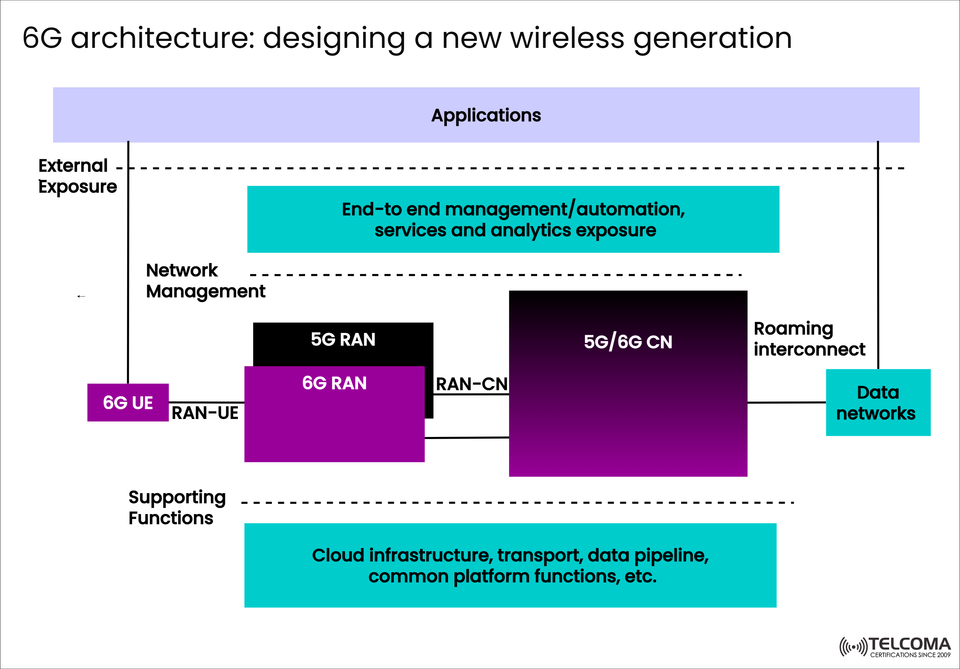

6G Architecture: Crafting the Next Wireless Generation
As we fully tap into what 5G has to offer, researchers and telecom pioneers are already working on the upcoming stage — 6G. This isn’t just about faster speeds; 6G networks are set to bring intelligence, autonomy, and deep connectivity to every layer of our communication infrastructure.
The image attached — “6G Architecture: Crafting the Next Wireless Generation” — illustrates how 6G builds on the existing 5G setup while weaving in more advanced cloud-native, AI-driven, and data-centric frameworks.
Let’s dive into how the 6G architecture is organized, what sets it apart from 5G, and why it’s vital for the future of telecommunications, IoT, and digital ecosystems.
Transitioning from 5G to 6G
While 5G changed the game in connectivity with enhanced mobile broadband (eMBB) and ultra-reliable low-latency communications (URLLC), 6G is gearing up to take things to a whole new level.
Main Objectives of 6G:
Extreme data rates — reaching up to 1 Tbps.
Sub-millisecond latency — paving the way for real-time digital twins and the tactile internet.
Native AI integration — networks that can self-learn, self-optimize, and self-heal.
Global coverage — smooth integration of terrestrial and non-terrestrial (like satellites and drones) services.
Sustainability — focusing on energy efficiency and green networking solutions.
6G won’t instantly replace 5G; instead, the two will coexist and complement each other, as shown in the diagram — featuring 5G RAN, 6G RAN, and a shared 5G/6G Core Network.
Breaking Down the 6G Network Architecture
The 6G architecture consists of five core layers, each with a unique role in delivering intelligent, high-speed, and secure communication services.
A. User Equipment (6G UE)
At the base of this architecture is the 6G User Equipment (UE) — the devices that connect users or machines to the network.
These devices will expand beyond just smartphones to include:
Autonomous drones and robots
Extended reality (XR) headsets
AI-powered IoT sensors
Connected vehicles and smart city gadgets
The 6G UE will support high device density and AI-driven local processing, keeping data transfers to a minimum for lower latency and reduced energy use.
B. 6G RAN (Radio Access Network)
The Radio Access Network (RAN) for 6G builds on the 5G RAN, ensuring backward compatibility along with upgraded features.
Key Features of 6G RAN:
Integrated 5G/6G coexistence: The diagram shows how the 5G RAN will run parallel to the 6G RAN for a smooth transition.
AI-native RAN: Machine learning models within RAN nodes dynamically optimize radio resources.
Sub-THz spectrum use: Allowing for ultra-high throughput and precise localization.
Cell-free architecture: Instead of fixed cells, devices connect to a network “fabric,” enhancing mobility and reliability.
Open and disaggregated RAN: Following Open RAN principles for flexibility and vendor neutrality.
C. 5G/6G Core Network (CN)
The Core Network — referred to as 5G/6G CN in the diagram — is where 6G really shows its intelligence.
Key Traits:
Convergence of 5G and 6G Core: Both generations will share core functions for interworking and uninterrupted service.
Cloud-native design: Fully containerized microservices architecture that operates on distributed cloud infrastructure.
AI-driven orchestration: Facilitates real-time policy control, traffic direction, and predictive optimization.
Network slicing 2.0: Highly dynamic slices managed by AI with SLA-based quality assurance for various services.
Quantum-safe security: Equipped with cryptographic algorithms and distributed ledgers to fend off quantum threats.
The 6G CN weaves in automation, analytics exposure, and cross-domain orchestration, as illustrated by the “End-to-end management and automation” layer in the diagram.
D. Supporting Functions Layer
Underneath the core and RAN lies a foundational layer that ensures good performance, scalability, and efficiency — the Supporting Functions.
Components Include:
Cloud infrastructure: Multi-access edge computing (MEC), distributed cloud systems, and hybrid cloud platforms.
Transport and backhaul: High-capacity optical and wireless backhaul with AI-optimized routing.
Data pipeline: Real-time collection, aggregation, and analytics for network intelligence.
Common platform services: APIs, data storage, and observability tools for developers and operators.
This layer serves as the digital backbone for the entire 6G ecosystem, enabling low-latency processing and data-driven automation.
E. Applications and External Exposure
At the pinnacle of the architecture is the Applications Layer, representing the services, platforms, and experiences built on the back of 6G connectivity.
Use Cases Driven by 6G Applications:
Immersive XR and holographic communication
Autonomous industry operations (Industry 5.0)
Tactile Internet for things like remote surgery or robotics
Metaverse and digital twin environments
AI-driven urban mobility and smart grid systems
The External Exposure layer, as shown in the diagram, provides open interfaces (APIs), allowing developers to make secure use of network data, automation, and analytics — sparking innovation across various sectors.
Comprehensive Management and Automation
One of the standout features in the 6G architecture diagram is the “End-to-end management/automation, services, and analytics exposure” block. This part highlights a key characteristic of 6G — autonomous, AI-powered network management.
Core Functions:
AI-Driven Orchestration: Real-time control and optimization across RAN, Core, and Cloud.
Closed-Loop Automation: Continuous feedback and self-healing features reduce the need for human intervention.
Service Exposure Framework: Unified APIs reveal analytics, policies, and service data for enterprise innovation.
Cross-Domain Analytics: Combines data from UE, RAN, and CN for predictive and prescriptive insights.
This level of intelligence and openness transforms the network from just a connectivity provider into a service and intelligence platform.
Cloud-Native and Data-Driven Infrastructure
The Cloud Infrastructure and Data Pipeline depicted in the supporting layer illustrate how 6G embraces cloud-native and data-focused design.
Key Traits:
Distributed Cloud Deployment: Blending central and edge computing for best performance.
Data-as-a-Service (DaaS): Network data becomes a valuable asset for developers and businesses.
AI-Model Training at the Edge: Allows for near-instant decision-making in applications sensitive to latency.
Zero-Touch Provisioning: Automates deployment, scaling, and healing using intent-based networking.
6G essentially merges the fields of telecommunications and IT, creating an intelligent cloud continuum from edge to core to cloud.
Roaming and Interconnectivity
As the image shows, roaming interconnect between 5G/6G Core Networks and data networks guarantees that devices transition smoothly across operators and regions.
Cross-domain orchestration will ensure seamless service continuity.
Unified data networks will manage high traffic, ensuring interoperability between terrestrial and satellite systems.
AI-assisted routing will dynamically choose the best data path for both latency and energy efficiency.
Management and Intelligence of 6G
The management framework for 6G introduces Network Intelligence Functions (NIFs) that weave AI/ML pipelines into the network fabric.
Main Capabilities:
Predictive maintenance and performance enhancements.
Context-sensitive resource management.
Energy efficiency through adjustable power scaling.
Self-configuring and self-healing features.
This shift means networks will think, learn, and adapt independently, paving the way for AI-native wireless communication.
Challenges and Research Focus for 6G
Even with all the promise, 6G faces a range of technical challenges:
Spectrum scarcity in sub-THz and visible light frequencies.
Quantum-level security risks.
AI model interoperability and standardization.
Integration with satellite and aerial networks.
Regulatory and sustainability challenges.
Research is ongoing worldwide, with organizations like 3GPP, ITU-R, and Next G Alliance at the forefront of standardization efforts.
Conclusion
The 6G architecture signifies a major leap toward intelligent, autonomous, and hyper-connected networks. As depicted in the diagram, it enhances 5G capabilities with AI-native RAN, a cloud-based core, and data-driven orchestration, all underpinned by an intelligent management framework.
For those in telecommunications, 6G isn’t just another “G” — it represents the merging of AI, cloud computing, and advanced connectivity that will reshape industries, societies, and how we engage with the digital world.