
6G Challenges for Radio Testing: From Research to Commercial Deployment

6G Challenges for Radio Testing: From Research to Commercial Launch
As everyone looks forward to the next wave of wireless tech, 6G is set to redefine connectivity, speed, and intelligence. Expected to roll out around 2030, it aims to enhance what's already possible with 5G, introducing things like ultra-low latency, terahertz communication, AI-driven networks, and pervasive connectivity.
Of course, moving forward comes with substantial hurdles—especially in the area of radio testing. Each step in development requires thorough evaluation, validation, and standardization.
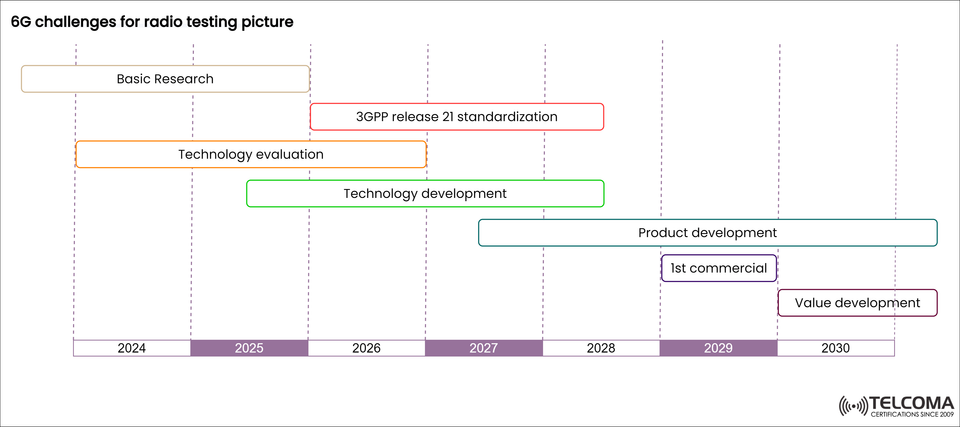
The timeline image above shows a pathway for 6G radio testing, charting the course from initial research to practical implementation. This roadmap illustrates the overlapping stages and interdependencies that will guide 6G from idea to reality.
Understanding the 6G Development Timeline
The journey of 6G radio testing, as depicted in the diagram, unfolds in six main phases from 2024 to 2030:
Basic Research (2024–2026)
Technology Evaluation (2024–2027)
3GPP Release 21 Standardization (2026–2028)
Technology Development (2025–2028)
Product Development (2027–2030)
Value Development (2029–2030)
Each phase plays a unique role in advancing 6G, ensuring that innovations are practical, scalable, and market-ready.
Basic Research (2024–2026): Establishing the Scientific Base
The basic research phase kicks off the exploration of 6G. During this time, global research institutions, universities, and telecom groups like 6G-IA, Next G Alliance, and Hexa-X dive into new ideas and technologies.
Key Research Focus Areas:
Terahertz Spectrum (100 GHz to 3 THz): Exploring ultra-high-frequency bands for lightning-fast data rates.
AI-Integrated Networks: Crafting self-optimizing networks empowered by machine learning.
Semantic Communication: Aiming for intent-driven data transfer to minimize redundancy.
Quantum Communication and Security: Investigating quantum-safe encryption and photonic transmission methods.
Sustainable and Green 6G: Striving for energy-efficient hardware and software that lower carbon footprints.
In this phase, researchers set the groundwork with theoretical frameworks and feasibility studies that will influence the future of 6G radio tech.
Technology Evaluation (2024–2027): Validating Concepts and Early Prototypes
With core concepts in hand, the next phase zeroes in on assessing their practicality through simulation, modeling, and early hardware testing.
Challenges in Evaluating 6G Radio:
Signal Propagation in Terahertz Bands: High-frequency signals are susceptible to loss, which demands innovative antenna designs.
Channel Modeling: Crafting new models for different settings (urban, rural, aerial, and maritime).
Interference Management: Testing beamforming and massive MIMO solutions to preserve signal quality.
Hardware Limitations: Assessing the performance boundaries of RF components like power amplifiers and converters.
Assessment Tools and Techniques:
Software-defined radios (SDRs) for flexible testing options.
AI-driven simulation platforms for predicting and optimizing networks.
Hardware-in-the-loop (HIL) setups for real-world signal mimicking.
By the end of this phase, researchers should have a clear sense of which technologies are ready for standardization.
3GPP Release 21 Standardization (2026–2028): Creating the Global Framework
The 3rd Generation Partnership Project (3GPP) is pivotal in establishing 6G standards with Release 21, anticipated around 2027–2028.
Key Areas of Focus for Standardization:
Waveform and Modulation Techniques: Determining optimal schemes for terahertz and sub-terahertz frequencies.
Network Architecture: Merging cloud-native, AI-driven, and decentralized systems.
Radio Interface Design: Setting parameters for latency, throughput, and reliability.
Testing Methodologies: Establishing global standards for compliance, performance, and interoperability.
Why Standardization Matters:
Without cohesive standards, global interoperability and device compatibility could fall apart. 3GPP ensures that all 6G-enabled devices and networks can work together seamlessly across different regions and manufacturers.
Technology Development (2025–2028): Prototyping and Pre-Commercial Trials
During this phase, research evolves into practical systems. Telecom companies, chipmakers, and equipment providers ramp up development of hardware and software prototypes in line with 3GPP guidelines.
Key Activities:
RF System Prototyping: Building base stations and mobile devices that support terahertz frequencies.
AI-Driven Network Control: Applying algorithms to enhance spectrum allocation and energy efficiency.
Edge-Cloud Integration: Creating architectures for real-time computing at the network edge.
Real-World Testing: Conducting field trials to confirm lab results.
Testing Challenges in Radio:
Exact synchronization of terahertz signals.
Calibration of new antenna setups.
Ensuring stability with dynamic mobility scenarios (like vehicles, drones, and satellites).
This phase overlaps with standardization, making sure prototypes are in sync with developing specifications.
Product Development (2027–2030): Launching 6G
As the tech matures, the product development phase commences. This stage is about polishing prototypes into commercial-grade solutions that check all regulatory and performance boxes.
Anticipated Advances:
6G Modems and Chips: Designed to manage multi-band communications and AI tasks.
Terahertz Base Stations: Enabling ultra-dense networks for cities.
Expanding the Device Ecosystem: Including smartphones, AR/VR headsets, drones, and self-driving cars hooked into 6G networks.
Testing in Production Settings:
Conformance Testing: Making sure products align with 3GPP and regulatory standards.
Interoperability Testing: Checking seamless communication between devices from different manufacturers.
Performance Benchmarking: Evaluating latency, throughput, and reliability under various conditions.
First Commercial Launch (2029):
The initial batch of 6G services is projected to roll out around 2029, marking the shift from trial systems to active deployment.
Value Development (2029–2030): Encouraging Adoption and Monetization
As 6G becomes commercially available, the spotlight shifts to creating value and growing the ecosystem.
Key Value Development Areas:
Industrial Automation: 6G enabling instant control of robotics and digital twins.
Immersive Experiences: XR (Extended Reality), tactile internet, and holographic communication.
AI-Driven Infrastructure: Crafting networks that self-repair and self-optimize.
Focus on Sustainability and Cost Efficiency: Lower energy consumption per transmitted bit.
This stage zooms in on discovering revenue models, cross-industry applications, and long-term scalability of 6G technology.
Conclusion: Charting the Course for the 6G Era
The 6G radio testing roadmap outlines a detailed and layered journey that brings together innovation, evaluation, and collaboration. Each step—from basic research to value development—ensures that 6G will be more than just an update; it's set to create a fundamental shift in global connectivity.
By 2030, we can expect 6G to transform communication—facilitating real-time digital twins, AI-driven automation, and smooth human-machine interaction across sectors. But to bring this vision to life, we need to tackle significant challenges in radio testing, standardization, and validation.
Ultimately, 6G will not only link people and devices but also bridge realities—be they physical, digital, or cognitive—ushering us into a new era of smart networks.