
Understanding Distributed Detection Systems in Wireless Sensor Networks: Architecture, Function, and Applications

Introduction
In today's fast-evolving world of telecommunications and wireless sensor networks (WSNs), distributed detection systems are crucial for making reliable decisions in uncertain situations. These systems allow for the efficient gathering, transmission, and combination of data from various sensors, helping to accurately detect or classify different phenomena.
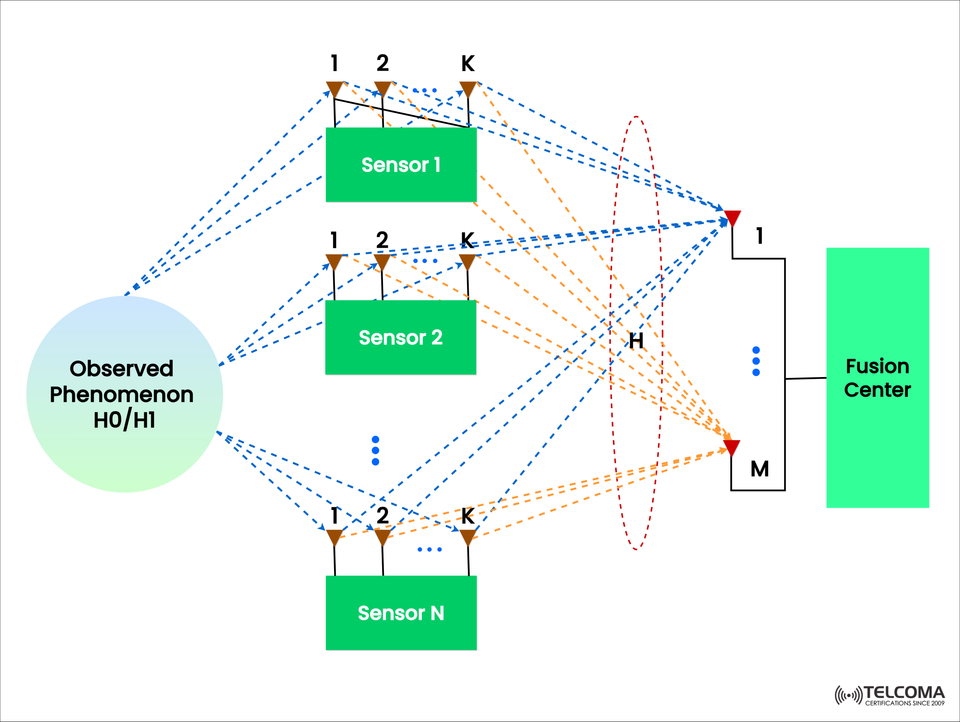
The diagram above illustrates the setup of a Distributed Detection System, where several sensors monitor an event (H₀/H₁) and relay their observations to a Fusion Center (FC), which then makes a final decision. This setup underpins a lot of modern applications like smart surveillance, environmental monitoring, industrial automation, and IoT networks.
Let’s take a closer look at how this system operates, its components, the flow of data, and the advantages it brings to telecom and sensor networks.
What Is Distributed Detection?
Distributed detection is about multiple sensors working together to identify a certain phenomenon or event. Rather than depending on a single central sensor (which could fail or give inaccurate readings), a distributed detection system combines the data or decisions from numerous sensors spread out over an area to enhance overall reliability and precision.
Key Concept
Each sensor monitors the same phenomenon — usually designated as H₀ (null hypothesis) or H₁ (alternative hypothesis) — and sends either raw data or a local decision to a Fusion Center, which makes the ultimate decision based on all received inputs.
This approach is essential where individual sensor readings might be noisy, incomplete, or not entirely dependable due to channel interference, distance, or environmental factors.
System Architecture Explained
The diagram presents the architecture for distributed detection, which includes the following main elements:
Observed Phenomenon (H₀/H₁)
This represents the event or state in the real world that the sensors are trying to detect.
H₀: Indicates the absence of the event (like “No intrusion detected”).
H₁: Indicates the presence of the event (like “Intrusion detected”).
Each sensor gathers data relevant to this phenomenon, such as temperature, motion, vibration, or signal energy.
Sensors (Sensor 1 to Sensor N)
There are N sensors spread across the area of interest. Each sensor observes the same phenomenon but has its own local view. Each sensor does a few things:
Data Acquisition: Gathers signals or measurements from the environment.
Local Processing: Carries out local computations like threshold detection, signal conditioning, or data compression.
Decision Making (Optional): Some sensors may even make local binary or multi-level decisions (like 0 or 1) before sending them to the fusion center.
In the diagram:
The dashed blue lines show data links between the observed phenomenon and the sensors.
Each sensor processes multiple channels (1, 2, …, K), indicating multi-dimensional observations or different signal sources.
Communication Links
Every sensor sends its data or decisions through wireless or wired communication channels to the fusion center.
These links are depicted by orange dashed lines in the image and can be:
Error-prone (subject to noise or interference)
Energy-limited (common in IoT systems)
Bandwidth-constrained, which means communication protocols need to be efficient.
So, it’s vital to optimize what data gets sent and how much, ensuring the network runs smoothly.
- Fusion Center (FC)
The Fusion Center acts as the decision-making core of the system. It compiles information from all sensors and applies statistical methods or machine learning models to reach a final decision.
Common Fusion Strategies
Data Fusion (Centralized): Sends raw sensor data to the FC, which then handles detection or classification.
Decision Fusion (Distributed): Each sensor shares a local decision, and the FC combines them (like through majority voting, Bayesian inference, or likelihood ratio tests).
Fusion Rules Examples
Fusion Rule Description Example AND Rule FC decides H₁ only if all sensors report H₁ High reliability, low false alarms OR Rule FC decides H₁ if any sensor reports H₁ High sensitivity Majority Rule FC decides H₁ if more than half report H₁ Balanced accuracy Weighted Fusion FC prioritizes more reliable sensors Adaptive accuracy enhancement
Workflow of Distributed Detection
The diagram provides a clear step-by-step overview of how data flows through the system:
Phenomenon Observation: The real-world event (H₀ or H₁) generates signals that are captured by the distributed sensors.
Local Measurement and Processing: Each sensor (Sensor 1…N) processes K measurement channels and pulls out key features.
Local Decision (Optional): Sensors might make local decisions (e.g., H₀ = 0, H₁ = 1).
Data Transmission: Each sensor sends its findings through communication channels (marked as dashed lines) to the FC.
Global Decision at Fusion Center: The FC gathers all inputs (1…M) and applies fusion algorithms to decide — confirming whether H₁ (event detected) or H₀ (no event) is the case.
Applications in Telecom and IoT
Distributed detection systems have become fundamental in next-gen telecom networks and IoT environments. Here are some key applications:
- Cognitive Radio Networks (CRN)
Sensors monitor spectrum usage (H₀/H₁: “spectrum free” or “occupied”) and relay their findings to a fusion center, which manages dynamic spectrum access.
- Environmental and Industrial Monitoring
Various sensors detect temperature, pollution levels, or machinery vibrations and collaborate to identify anomalies or dangerous situations.
- Surveillance and Security Systems
Sensors (like cameras, radars, and motion detectors) keep an eye on a region and collectively determine if an intruder is present.
- Smart Cities and Infrastructure
Distributed detection helps manage traffic flow, energy use, and public safety more effectively.
Healthcare Monitoring
Wearable sensors gather physiological data, and the fusion center (like a mobile device) integrates this information to track patient health.
Advantages of Distributed Detection Systems
✅ High Reliability: Resilient to failures or errors of individual sensors.
✅ Scalability: Easy to expand by adding more sensors.
✅ Energy Efficiency: Local processing lessens communication workload.
✅ Improved Accuracy: Merges data for better statistical reliability.
✅ Fault Tolerance: Redundancy ensures steady performance.
Challenges and Design Considerations
Despite the perks, distributed detection comes with its own set of design challenges:
Communication Constraints: Limited bandwidth and energy in wireless sensor networks.
Channel Errors: Noisy transmissions can hurt decision accuracy.
Synchronization: Sensors need to work together well for accurate fusion.
Security and Privacy: It's important to protect sensor data from tampering or interception.
Algorithm Complexity: Balancing computation needs between sensors and fusion centers can be tricky.
Emerging Trends and Future Directions
Machine Learning–Based Fusion: AI models are taking over traditional fusion rules for adaptive decision-making.
Edge Computing Integration: Moving fusion closer to sensors to cut down on delays.
Energy Harvesting Sensors: Aiming to prolong sensor network lifetimes.
5G and Beyond: Distributed detection will be key in ultra-reliable low-latency communications (URLLC).
Blockchain Integration: Ensures trust and data integrity among distributed sensors.
Conclusion
The distributed detection system is essential to modern wireless sensor and telecom networks. By effectively merging data from various sensors, it significantly boosts reliability, robustness, and accuracy when it comes to detecting real-world events.
The diagram shows how each part — from sensors to communication links to the fusion center — contributes to an integrated decision-making process. As 5G, IoT, and AI technologies continue to advance, distributed detection will remain pivotal in crafting intelligent, self-organizing, and resilient communication systems.