
6G Smart Cities: Enabling Technologies Transforming the Future of Urban Connectivity

Introduction
The race towards 6G technology is picking up speed, and it’s set to change the way our cities function, connect, and grow. While 5G introduced us to fast connectivity and kicked off the Internet of Things (IoT) revolution, 6G is looking to establish a fully interconnected and intelligent ecosystem — which will be the backbone of the smart cities of tomorrow.
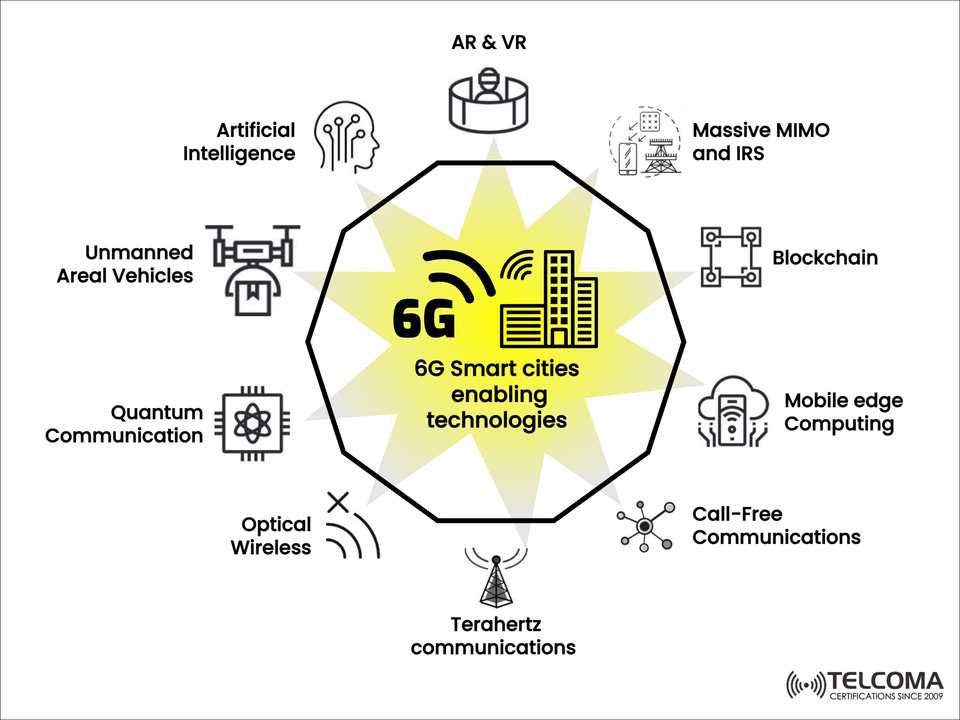
In the image uploaded, you'll find the key enabling technologies for 6G smart cities — like Artificial Intelligence (AI), Quantum Communication, Terahertz Networks, Mobile Edge Computing, and more. These advancements are going to enable ultra-low latency, high reliability, and a level of machine-type communication that truly outpaces what 5G offers.
In this blog, we'll dive into how these technologies come together to power 6G smart cities, what they're used for, and how they’ll drive the digital transformation of urban areas.
What Are 6G Smart Cities?
6G smart cities mark the next step in urban development — fusing advanced communication networks with AI-driven automation, immersive experiences, and smart infrastructure.
They utilize 6G networks to connect everything — from vehicles and buildings to healthcare systems, energy grids, and public services — leading to cities that are truly data-driven, sustainable, and autonomous.
Operating at frequencies above 100 GHz, 6G will support data rates beyond 1 Tbps, have sub-millisecond latency, and feature AI-powered self-optimization, basically acting as the digital nervous system for future cities.
Key Enabling Technologies for 6G Smart Cities
The image highlights ten essential technologies that will drive the 6G ecosystem. Let’s explore each one and see how they contribute.
Artificial Intelligence (AI)
AI is central to the design and operation of 6G. It enables intelligent network management, predictive maintenance, and self-optimizing systems.
In smart cities, AI will:
Control autonomous vehicles and traffic management.
Streamline energy distribution in smart grids.
Facilitate personalized healthcare and emergency responses.
Anticipate urban trends to enhance city planning.
With AI, 6G networks will become self-learning and adaptive, reducing the need for human input and boosting efficiency.
Augmented and Virtual Reality (AR & VR)
The arrival of 6G will lead to immersive AR/VR experiences integrated into daily urban living.
Thanks to terabits-per-second data rates and ultra-low latency, users will enjoy real-time holographic communication and virtual settings that feel just like reality.
Possible applications include:
Virtual education and remote training sessions.
AR-enhanced healthcare for remote surgeries.
Virtual tourism and real estate previews.
Smart workplace collaboration via holographic meetings.
These technologies will revolutionize social interaction and business practices in interconnected cities.
Massive MIMO and Intelligent Reflecting Surfaces (IRS)
Massive MIMO (Multiple Input, Multiple Output) and IRS (Intelligent Reflecting Surfaces) are crucial for attaining the high data capacities of 6G networks.
Massive MIMO employs hundreds of antennas to transmit data concurrently, boosting network throughput.
IRS are programmable surfaces that smartly reflect and direct signals to enhance coverage and cut down interference.
Together, they boost signal reliability, spectral efficiency, and energy savings, ensuring smooth connectivity in crowded urban areas.
Blockchain Technology
Blockchain paves the way for decentralized security and transparency in smart city operations.
It guarantees data integrity and trust among the millions of connected devices and stakeholders.
Examples of use include:
Secure IoT communication and device verification.
Decentralized identity management.
Smart contracts for public services and resource sharing.
Transparent supply chains in urban logistics.
Integrating blockchain means 6G smart cities can function on trust, privacy, and data protection.
Mobile Edge Computing (MEC)
Mobile Edge Computing brings processing power closer to users — right at the network's edge — lowering latency and enhancing real-time processing.
In 6G smart cities:
MEC will enable autonomous vehicles to make split-second decisions.
Smart traffic management and public safety systems will handle data locally for immediate responses.
It will facilitate AR/VR and IoT applications that require quick data processing.
Edge computing, therefore, makes the 6G ecosystem quicker, more efficient, and aware of context.
Call-Free Communications
A standout feature of 6G, call-free communication involves continuous, context-driven data exchanges between users and devices, eliminating the need for traditional calls or connections.
For example:
Smart assistants can proactively communicate based on context.
IoT systems can autonomously share data for predictive maintenance or energy savings.
This will change how humans and machines interact in the 6G landscape — moving toward seamless, invisible connectivity.
Terahertz Communications
Terahertz (THz) frequencies (0.1–10 THz) are set to be the backbone of 6G communication.
They offer:
Data rates surpassing 1 Tbps.
Extremely low latency.
Massive bandwidth for ultra-HD and real-time applications.
In smart cities, terahertz communication will enable:
Autonomous transport systems.
Real-time 3D mapping.
Holographic communication and remote surgery.
THz technology connects radio and optical communication, allowing for incredible speed and precision.
Optical Wireless Communication
Also known as Li-Fi (Light Fidelity) or free-space optical communication, this technology uses visible or infrared light for super-fast data transmission.
Advantages include:
Interference-free communication in congested areas.
Secure, high-capacity indoor networks.
Support for data-heavy applications like AR, VR, and 8K streaming.
Optical wireless links will work alongside terahertz and RF systems, ensuring comprehensive 6G coverage.
Quantum Communication
Quantum communication guarantees unbreakable data security via quantum key distribution (QKD).
In 6G smart cities, it will protect sensitive information like health records, financial transactions, and government communications.
Key features include:
Protection against cyber threats and data breaches.
Secure communication for critical infrastructure.
Quantum-based random number generation for encryption.
Quantum tech will ensure 6G is the most secure communication generation yet.
Unmanned Aerial Vehicles (UAVs)
Drones or UAVs will be essential for 6G-enabled smart cities as mobile base stations, data relays, and monitoring tools.
Use cases include:
Disaster management and emergency communications.
Traffic surveillance and logistics delivery.
Real-time inspections of cities and infrastructure.
When combined with AI and edge computing, UAVs will boost city-wide situational awareness and connectivity resilience.
How These Technologies Interconnect
6G smart cities will thrive on synergy among these innovations instead of relying on any one technology alone.
For instance:
AI + MEC enables real-time coordination for autonomous vehicles.
Blockchain + IoT ensures secure communications for devices.
Terahertz + Massive MIMO delivers unmatched data capacities for immersive applications.
This convergence of communication, computing, and intelligence is what paints the 6G vision of a fully connected world.
Applications of 6G Smart Cities
Autonomous Transportation Systems – AI-driven traffic management, UAV logistics, and vehicle-to-everything (V2X) networks.
Smart Healthcare – Real-time monitoring of patients, remote surgeries, and predictive analytics.
Sustainable Infrastructure – Energy efficiency, waste management, and smart grids.
Public Safety and Surveillance – AI-based threat detection, quantum-secure communication.
Immersive Education and Entertainment – 3D holographic learning experiences, AR/VR campuses, and virtual concerts.
Conclusion
6G smart cities signify the next phase of digital civilization — where every object, person, and process is intelligently connected.
As the image shows, technologies like AI, blockchain, terahertz communication, edge computing, and quantum systems will collaborate to create urban environments that are more efficient, sustainable, and focused on people.
6G is not just about quicker speeds — it’s about transforming connectivity into intelligence, paving the way for smarter cities and a smarter planet.