
A Complete Guide to ONAP Architecture: Key Components, Functions, and Telecom Use Cases

Introduction: Why ONAP Matters for Telecom and Cloud-Native Networks
Today’s telecom landscape is changing rapidly, and automation along with orchestration has become essential rather than optional. With networks expanding to support 5G, IoT, and edge computing, managing everything manually just doesn’t cut it anymore. That’s where ONAP (Open Network Automation Platform) comes into play.
ONAP offers a unified platform for designing, orchestrating, and automating both physical and virtual network functions. It helps telecom operators transition to cloud-native deployments, streamline how services are delivered, and achieve closed-loop automation.
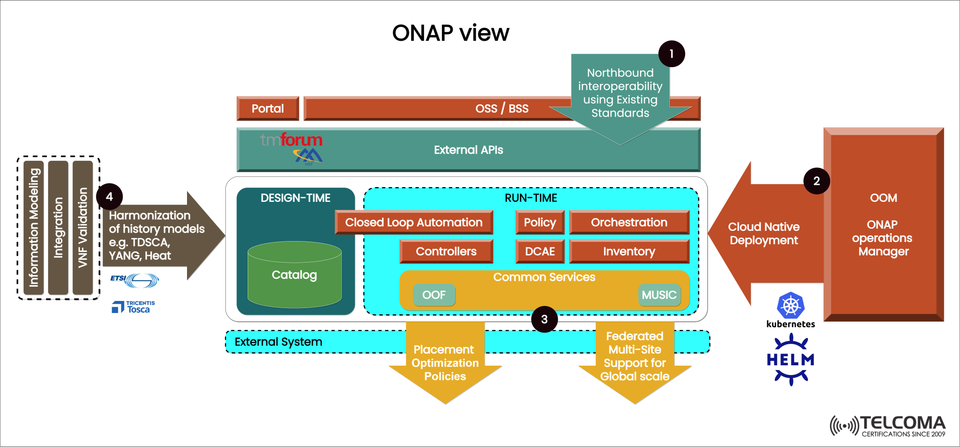
The following diagram provides an overview of ONAP’s architecture, illustrating how different components work together during both design-time and run-time, while ensuring interoperability, automation, and scalability.
ONAP Architecture Overview
ONAP’s architecture consists of four main layers:
Northbound Interoperability Layer
Cloud-Native Deployment and Operations Management
Design-Time and Run-Time Functions
Information Modeling and Standards Harmonization
Each of these layers is crucial for ONAP to deliver end-to-end service automation. Let’s break it down a bit more.
- Northbound Interoperability Using Existing Standards
At the top of the ONAP architecture, you’ll find the Portal and OSS/BSS (Operations Support Systems / Business Support Systems).
ONAP makes sure there’s northbound interoperability with existing standards like TM Forum APIs, letting operators easily integrate ONAP with their established systems.
This layer acts as a connection point between ONAP and higher-level business functions such as billing, customer management, and service assurance.
External APIs facilitate smooth communication between ONAP and other third-party systems.
Key Benefits:
Quick service integration
Less vendor lock-in
Scalability for the future
- Cloud-Native Deployment with ONAP Operations Manager (OOM)
These days, telecom networks are shifting towards cloud-native deployments, and ONAP is built to support this transition.
The ONAP Operations Manager (OOM) allows for containerized deployments using Kubernetes and Helm charts.
This means ONAP services can be modular, scalable, and updated independently without any downtime.
Being cloud-native provides high availability and supports continuous integration/continuous delivery (CI/CD) pipelines.
Benefits of OOM:
Faster launches of new services
Easier lifecycle management
Better resilience thanks to container orchestration
- Design-Time and Run-Time Capabilities
Design-Time (Service Modeling and Catalog)
The Catalog is where you design and store network functions, services, and policies. This stage is all about modeling and validation.
Service templates can be built using TOSCA, YANG, or HEAT.
The catalog ensures consistency across different deployments.
It connects with external systems for validation, making sure network functions meet the reliability required in telecom.
Run-Time (Execution and Automation)
When it comes to run-time, ONAP takes the designed services and puts them into action. This phase includes several key modules:
Closed Loop Automation – This enables real-time monitoring and corrective actions.
Policy Framework – This establishes the rules and conditions that govern when automation happens.
Orchestration – This automates the provisioning of network resources across both cloud and physical infrastructure.
Controllers – These manage specific domains, like SDN controllers or virtualized RAN elements.
DCAE (Data Collection, Analytics, and Events) – This collects telemetry data and feeds it back into automation loops.
Inventory – This keeps a real-time view of network resources and services.
Common Services: OOF and MUSIC
OOF (Optimization Framework): This manages placement optimization policies, ensuring network resources are utilized efficiently.
MUSIC (Multi-Site State Coordination): This offers federated multi-site support, ensuring scalability on a global scale.
Impact:
The distinction between design-time and run-time makes for a smooth transition from service definition to execution and optimization.
- Information Modeling and Standards Harmonization
One of ONAP’s strengths lies in its commitment to industry standards.
ONAP supports the harmonization of modeling languages like TOSCA, YANG, and HEAT.
These standards help ensure vendor-neutral integration and interoperability.
Validation frameworks, like Tricentis Tosca, are used to check VNFs (Virtual Network Functions) before deployment.
This standards-based approach makes ONAP versatile enough to fit into multi-vendor ecosystems, which is essential in today's diverse telecom landscapes.
Key Features of ONAP (Summarized)
Feature Description Benefit Closed-Loop Automation Real-time detection and correction Improves reliability Policy Framework Defines automation rules Greater control Service Orchestration Automates provisioning Faster service delivery OOM with Kubernetes/Helm Cloud-native deployment Scalability & flexibility OOF (Optimization)Efficient resource place met Cost savings MUSIC Multi-site coordination Global scalability Standards Harmonization TOSCA, YANG, HEAT support Vendor neutrality
Why ONAP is Crucial for 5G and Beyond
As operators begin rolling out 5G networks, ONAP’s capability to manage complexity becomes invaluable:
Network Slicing: ONAP can dynamically orchestrate slices tailored for various use cases (like IoT, ultra-low latency, high bandwidth).
Edge Computing: With federated multi-site support, ONAP can effectively handle edge deployments at scale.
Automation in 5G Core: Closed-loop automation guarantees resilience in highly distributed 5G cores.
ONAP isn’t just a management tool—it’s a strategic enabler for 5G, IoT, and AI-driven networks.
Harnessing the Potential of ONAP in Telecom Automation
The future of the telecom industry hinges on automation, scalability, and interoperability, and that’s precisely where ONAP (Open Network Automation Platform) shines.
ONAP offers a cohesive framework for designing, orchestrating, and automating network services, whether in physical or virtual settings. It integrates cloud-native deployment (using Kubernetes & Helm) with robust runtime components like orchestration, closed-loop automation, and policy enforcement.
Here are some key features of ONAP:
Closed-Loop Automation: It identifies problems and can self-correct in real time.
Service Orchestration: Facilitates automated provisioning across various cloud infrastructures.
Optimization (OOF): Implements smart placement policies to enhance resource efficiency.
Multi-Site Coordination (MUSIC): Manages operations on a global scale effectively.
Standards Harmonization: Ensures support for TOSCA, YANG, and HEAT, promoting vendor neutrality.
Conclusion: The Future of Telecom Automation with ONAP
The ONAP architecture provides a well-rounded framework for designing, orchestrating, and automating modern telecom networks. By combining cloud-native deployment, closed-loop automation, optimization frameworks, and standards harmonization, ONAP sets itself up as the backbone of future telecom operations.
For telecom professionals, adopting ONAP means reduced operational costs, quicker time-to-market, and the flexibility to keep up with emerging technologies like 5G and edge computing.
As networks get more complex, ONAP will continue to play a central role in helping operators deliver scalable, reliable, and automated services worldwide.