
A Complete Guide to the Service-Driven 5G Architecture for Telecom Professionals

A Telecommunications Professional's Complete Guide to Service-Driven 5G Architecture
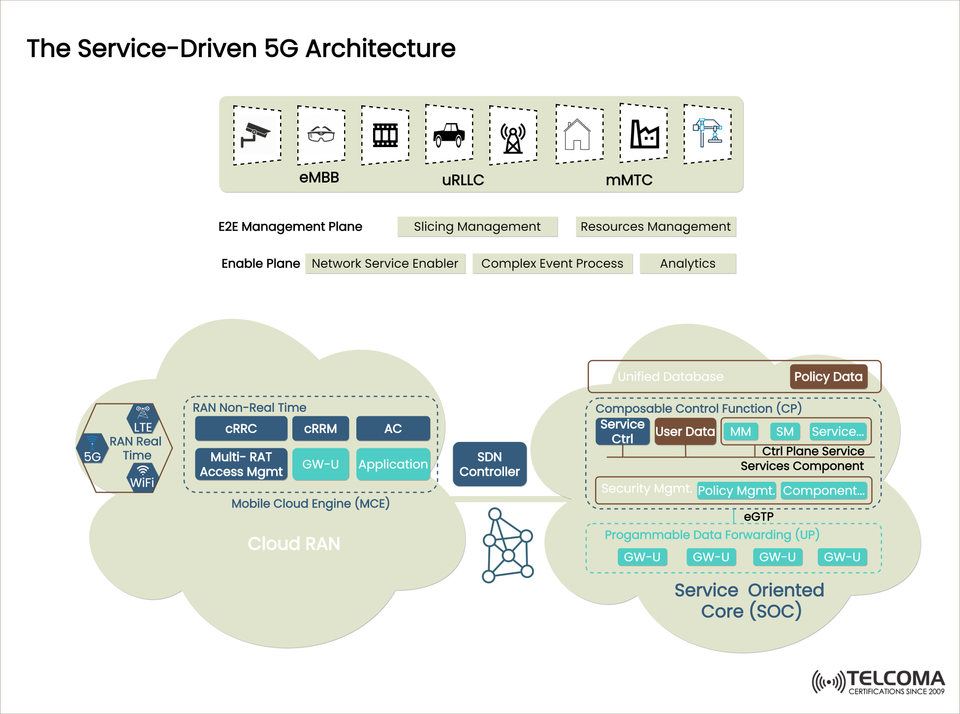
The 5G era is not only about speed; it also offers a whole new service-driven architecture to provide seamless, scalable, and intelligent connectivity. The intention of this blog post is to clarify the Service-Driven 5G Architecture as provided in the image, for both telecommunications professionals and tech-savvy individuals who are eager to learn how the next generation of networks is constructed.
Key 5G Services Supported by the Architecture
The architecture will provide support for three distinct service categories within 5G:
eMBB (Enhanced Mobile Broadband): High data throughput for applications like immersive 4K/8K video, VR, and AR.
URLLC (Ultra-Reliable Low Latency Communication): Mission critical applications that require almost zero latency, like autonomous vehicles and remote surgeries.
mMTC (Massive Machine-Type Communication): Scalably providing support for billions of low-power IoT devices in smart cities or some aspects of industrial automation.
Knowing the Layers of Architecture
🌐 E2E Management Plane
The first layer is the management plane, which will be responsible for end-to-end orchestration of services:
Slicing Management: Dynamically creates isolated virtual networks to satisfy diverse service demands.
Resource Management: Distributes bandwidth, compute, and storage resources dynamically for the benefit of each service.
🧠 Enable Plane
The intelligence layer of the architecture:
Network Service Enabler - Coordinates different network functions and allow dynamic service deployment.
Complex Event Processing (CEP) - Real-time monitoring and analysis of network traffic/data that can automate responses.
Analytics - collects and analyzes data to optimize performance, predict failures, and improve decision making
Cloud RAN: Disaggregated and Centralized Access
The Cloud RAN (Radio Access Network) dissolves traditional notions and relationships by virtualizing and sketching centralized radio functions.
The critical components include:
Components Functions
RAN Real-Time Enables time sensitive functions across the 5G, LTE, and Wi-Fi domains
RAN Non-Real-Time Provides control functions for example:
- cRRC (Centralized RRC)
- cRRM (Centralized RRM)
- AC (Admission Control)
Multi-RAT Access Mgmt Provides non-disruptive functionality for all forms of access
GW-U (User Gateway) Acts as the enabling flow from user data toward the core
Application Layer Function for network applications on the Mobile Cloud Engine (MCE)
Such modularity can allow operators to respond to fluctuating Traffic demands while maintaining high levels of efficiency in time and cost.
SDN Controller: Programmability Across the Entire Domain
At the center of the architecture sits the SDN controller that connects Cloud RAN to the Core network:
Enables dynamic, policy-driven routing.
Centralizes control that makes network function virtualization much simpler.
Enables quicker service deployment through programmability.
Service Oriented Core (SOC): Smart and Modular Core Network
The SOC is designed for flexibility and is broken into two planes:
🧩 Control Plane (CP) – Composable Control Functions
Service Ctrl, User Data, MM, SM: Composed of modular microservices for user authentication, session management, and mobility.
Unified DB & Policy Data: Centralized data for user profile management and policy enforcement.
Security Mgmt & Policy Mgmt: Enabling authentication, encryption, access.
🔄 User Plane (UP) – Programmable Data Forwarding
GW-U instances: Multiple GWs to handle this data forwarding.
eGTP tunneling and transport protocol.
By separating these planes and decomposing service, the SOC allows real time service adaptation and flexible network slices, which is essential in supporting the varying requirements of 5G new capabilities.
Benefits of Service-Oriented 5G Architecture
✅ End-to-End Network Slicing: Split and customize network resources for each service while providing service isolation.
✅ Cloud-Native Structure: Flexibility, scale, and fast delivery of network functions.
✅ Programmable Core and RAN: Provide data-driven representation for dynamic policies and intelligent routing.
✅ Centralized Analytics and Policy Management: To enable tuning and proactive network plan.
✅ Multi-Access Integration: A unified approach to handling 5G, LTE, and Wi-Fi while enabling seamless mobility capabilities.
Deployment Considerations for Telecom Operators
Moving to a service-driven 5G architecture is not simply an equipment upgrade, it is a fundamental change in how a network is designed and operated. To that end, telecom operators must consider the following.
📌 Virtualization & Cloud-Native Infrastructure
The rapid rollout, scaling, and updating of services is enabled by VNFs and CNFs.
Infrastructure components must function well with Kubernetes-based orchestration platforms, and support microservices and container life-cycle management.
📌 End-to-End Automation
AI/ML-powered analytics will enable real-time network changes based on usage trends.
Orchestration platforms should support end-to-end service chaining, policy enforcement, and elastic scaling of resources.
📌 Interoperability with Legacy Networks
Existing LTE and Wi-Fi will always be an advantage of 5G networks, and Multi-RAT Access Management allows for smooth co-existence.
Time will need to be archived to dismantle active 4G components without disrupting services in the process.
Real-World Use Cases of Service-Driven 5G Architecture
🚗 Autonomous Transportation (uRLLC)
The low latency and high reliability characteristics of a 5G architecture will provide the safe, in-sync interaction between vehicles, and vehicles and infrastructure.
Network slicing will provide dedicated, isolated path, for the control signals on the vehicles:
🏭 Smart Manufacturing (mMTC + uRLLC)
Thousands of vehicles across factory floors are connected via mMTC slices.
uRLLC slices provide high speed for real time automation along with alerts for safety-critical situations.
📶 Fixed Wireless Access (eMBB)
Using cell sites in rural areas to provide high speed broadband connectivity.
Future Outlook: Evolving Toward 6G with a 5G Foundation
5G is still spreading around the world, but it will provide a base architecture to launch 6G. Future advancements will provide:
Native AI/ML in the control plane
Terahertz frequency support, among others, supporting higher throughput
Expanded integration of edge computing in support of ultra-localized decision making
Quantum safe security protocols in the Service Oriented Core
By understanding and applying the modular, scalable principles of the Service Driven 5G Architecture today, telecommunication professionals will be well-positioned for the networks of tomorrow, which will be more intelligent and adaptive.
Wrap-Up
The shift to a Service Driven 5G Architecture will allow networks to become flexible platforms for innovation. Service providers will be able to deliver guaranteed performance across a wide range of services, including powering smart cities, providing remote surgical experiences, or industrial IoT.
This architectural model changes networks from a static infrastructure to a programmable, intelligent service delivery platform, changing how built and delivered communication services are interpreted.
Conclusion:
A pathway to future networks
Service Driven 5G architecture is not just a technical design—it is a strategic framework to enable network operators to meet the growing demands of digital transformation. By leveraging programmable component-centric approaches built around intelligent control and cloud-native design, it alludes to a future of service-based component designs that can evolve and develop value add IT services for users.