
A Generic Architecture for 5G Wireless Systems: Core Components and Applications

A Look at 5G Wireless System Architecture
5G isn’t just about faster speeds; it’s really a total overhaul of how we think about networks—how they’re built, how they’re set up, and how we use them. This new generation combines cloud computing, massive MIMO macro cells, mmWave connections, and different services like smart communities, healthcare, industry automation, and vehicle networks.
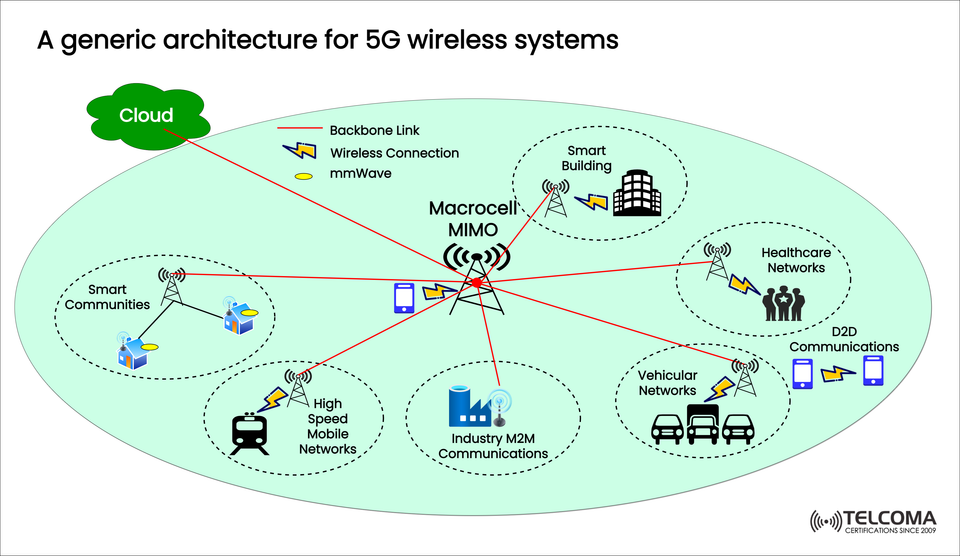
The diagram shared shows a basic layout of a 5G wireless system, illustrating how various components and services link up through a macro cell MIMO hub, supported by the cloud with both backbone and wireless connections. Let’s dive into the details.
Core Components of 5G Architecture
The architecture of 5G focuses on three main performance pillars:
Enhanced Mobile Broadband (eMBB): Fast internet for devices and multimedia.
Ultra-Reliable Low-Latency Communications (URLLC): Essential for critical applications like healthcare and self-driving cars.
Massive Machine-Type Communications (mMTC): Able to connect billions of IoT devices.
In the diagram, you can see these pillars represented across different domains, such as smart buildings, vehicle networks, industry communication, and device-to-device (D2D) services.
- Cloud Integration
The cloud is a key part of 5G. It hosts network functions, handles data centrally, and supports scalability. By shifting intelligence to the cloud, operators can:
Network slicing for various services.
Scalable resource management for bandwidth-heavy or latency-sensitive applications.
Edge computing (MEC), allowing for quick data processing near users.
- Macrocell MIMO
At the center of the diagram is the Macrocell with MIMO (Multiple-Input, Multiple-Output), which serves as the main access point connecting different networks and domains.
Massive MIMO antennas offer parallel data streams, boosting both throughput and coverage.
Macrocells collect wireless traffic and send it to the cloud through backbone links.
They’re vital for managing dense urban setups and high-capacity environments.
- Backbone Links and Wireless Connections
Backbone links (shown in red) connect the macrocell MIMO to the cloud, giving high-capacity backhaul.
Wireless links (blue signals) expand coverage to smart buildings, communities, and networks.
mmWave (indicated by yellow ovals) offers ultra-fast wireless connections but has a limited range, ideal for hotspots and indoor use.
Application Domains in 5G Architecture
This architecture supports various application domains, each with its own performance needs, all made possible through flexible spectrum usage, network slicing, and MIMO improvements.
Smart Communities
Illustrated with small homes linked through local base stations.
Applications range from smart homes to energy management and local IoT networks.
Benefits include reliable connectivity for residents and optimized energy use.
Smart Buildings
Big structures directly connect to the macrocell via mmWave or wireless links.
Use cases include office automation and secure management of IoT devices.
Integrating with indoor small cells keeps connectivity smooth in dense areas.
Healthcare Networks
Health services rely on URLLC for remote surgery and patient monitoring.
With 5G, low latency and high reliability make real-time telemedicine possible.
Wearable IoT devices enable ongoing health monitoring.
High-Speed Mobile Networks
Shown with a high-speed train connected via mmWave.
Use cases involve uninterrupted connections in moving vehicles and real-time streaming.
5G ensures seamless transitions between cells even at speeds over 300 km/h.
Industry M2M Communications
Machine-to-Machine (M2M) communication is essential for industrial automation.
Use cases include robotics and predictive maintenance.
Key advantages are reduced downtime and improved safety.
Vehicular Networks
Important for self-driving cars and connected vehicle communications (V2X).
5G facilitates: * Vehicle-to-Infrastructure (V2I) for traffic control. * Vehicle-to-Vehicle (V2V) for avoiding collisions. * Vehicle-to-Network (V2N) for infotainment access.
Device-to-Device (D2D) Communications
D2D allows devices to communicate directly without going through the base station.
Benefits include: * Decreased latency. * Lower power consumption. * Local services like emergency alerts and smart grid communication.
The Role of mmWave in 5G Architecture
The image highlights mmWave connections as crucial for high-speed wireless communication.
Pros: Extremely high data rates, perfect for video streaming and ultra-fast broadband.
Cons: Short-range, easily obstructed by buildings and trees.
Solution: Using small cells and beamforming to keep strong connections.
Why Macrocell MIMO is Essential
The macrocell MIMO is at the core of this 5G setup. Its functions involve:
Collecting data from various networks.
Offering wide coverage while supporting multiple domains.
Boosting spectral efficiency through massive MIMO and beamforming.
Without macrocell MIMO, the system wouldn’t have the capacity or dependability needed for multi-domain integration.
Comparing 5G Domains
Domain Use Case Performance Needs5G Feature Smart Communities Homes, IoT, energy management Moderate bandwidth, reliability IoT integration, eMBB Smart Buildings Offices, automation High bandwidth, indoor coverage mmWave, small cells Healthcare Networks Remote surgery, telemedicine Ultra-low latency, high reliability URLLC, edge computing High-Speed Mobile Trains, transport Seamless handovers, high mobility Fast cell switching, beamforming Industry M2MRobotics, automation Scalability, reliability mMTC, network slicing Vehicular Networks Autonomous cars, V2XUltra-low latency, high reliability URLLC, V2X protocolsD2D Communications Direct device connections Low latency, localized data exchangeD2D protocols, side link
Looking Ahead: Future of 5G Architecture
The 5G framework laid out here sets the stage for the evolution towards 6G. Future advancements may include:
AI-driven networks that adjust themselves in real-time.
Integrated sensing and communication for advanced vehicle and healthcare applications.
Terahertz (THz) frequencies for even faster speeds.
More precise network slicing to cater to niche markets.
Final Thoughts
This generic architecture for 5G wireless systems illustrates how macrocell MIMO, cloud integration, backbone connections, and service-specific domains come together to deliver advanced applications. From smart communities and healthcare networks to vehicle communications and D2D services, this architecture is geared to meet the wide-ranging demands of today’s digital life.
5G is about transforming wireless communication into a multi-dimensional ecosystem through eMBB, URLLC, and mMTC. For telecom experts, understanding this architecture is crucial for developing networks that aren't just speedy but also smart, scalable, and prepared for the future.